
Pulp Fiction, 1954 · page 80 of 100
2-Gun Western, February 1954 — page 80: what you’re looking at
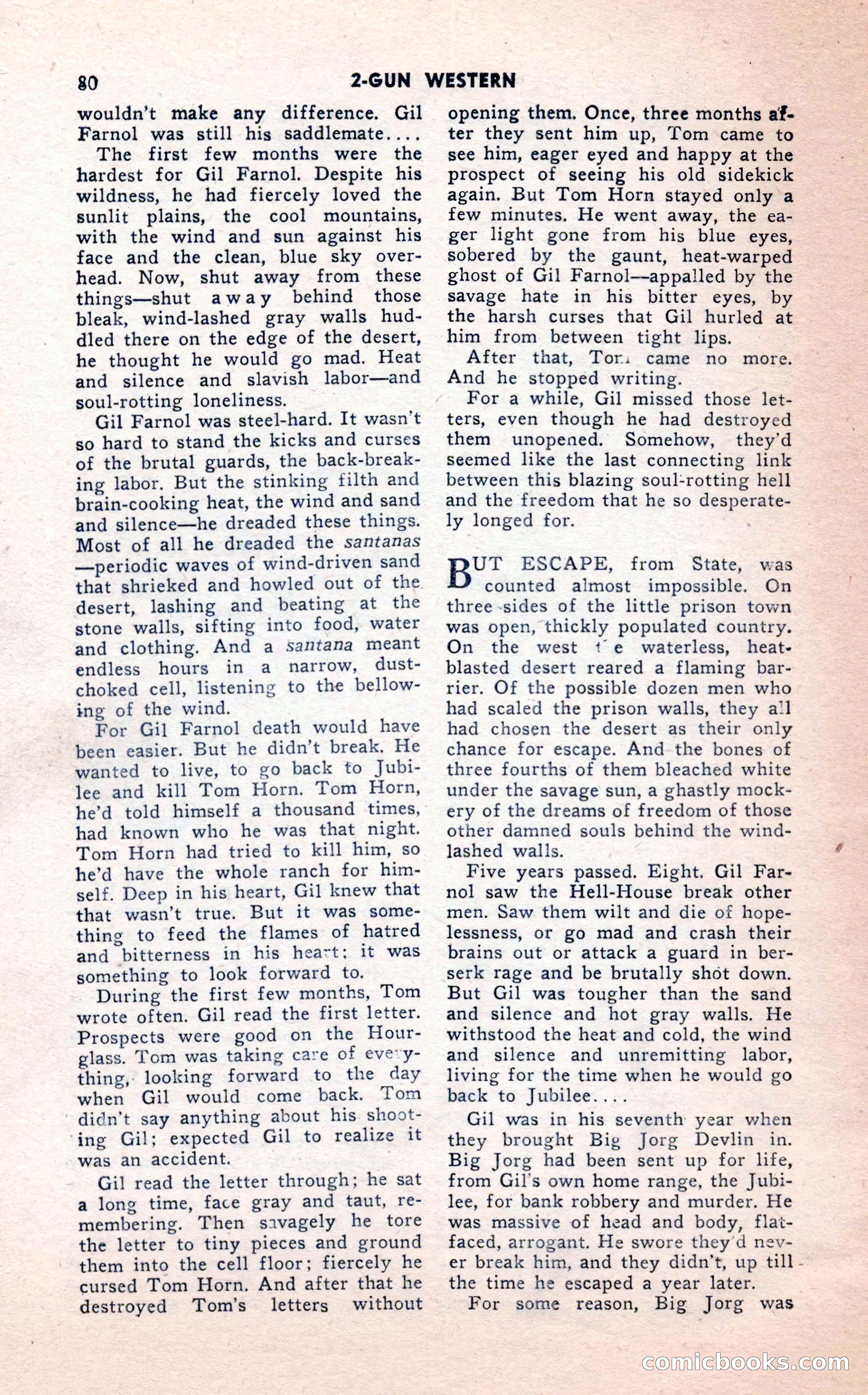
A restored page from Pulp Fiction, 1954. Page through the whole issue in the reader above.
📄 Transcribed text from this page (OCR, searchable)
Machine-transcribed from the original scan — historical spelling and the odd misread are preserved.
80 wouldn’t make any difference. Gil Farnol was still his saddlemate.... The first few months were the hardest for Gil Farnol. Despite his wildness, he had fiercely loved the sunlit plains, the cool mountains, with the wind and sun against his face and the clean, blue sky over- head. Now, shut away from these things—shut away behind those bleak, wind-lashed gray walls hud- dled there on the edge of the desert, he thought he would go mad. Heat and silence and slavish labor—and soul-rotting loneliness. Gil Farnol was steel-hard. It wasn’t so hard to stand the kicks and curses of the brutal guards, the back-break- ing labor. But the stinking filth and brain-cooking heat, the wind and sand and silence—he dreaded these things. Most of all he dreaded the santanas —periodic waves of wind-driven sand that shrieked and howled out of the desert, lashing and beating at the stone walls, sifting into food, water and clothing. And a santana meant endless hours in a narrow, dust- choked cell, listening to the bellow- ing of the wind. For Gil Farnol death would have been easier. But he didn’t break. He wanted to live, to go back to Jubi- lee and kill Tom Horn. Tom Horn, he’d told himself a thousand times, had known who he was that night. Tom Horn had tried to kill him, so he’d have the whole ranch for him- self. Deep in his heart, Gil knew that that wasn’t true. But it was some- thing to feed the flames of hatred and bitterness in his heatt; 1t was something to look forward to. During the first few months, Tom wrote often. Gil read the first letter. Prospects were good on the Hour- glass. Tom was taking care of evety- thing, looking forward to the day when Gil would come back. Tom didn’t say anything about his shoot- ing Gil; expected Gil to realize it Was an accident. Gil read the letter through; he sat a long time, face gray and taut, re- membering. Then savagely he tore the letter to tiny pieces and ground them into the cell floor; fiercely he cursed Tom Horn. And after that he destroyed Tom’s letters without 2-GUN WESTERN opening them, Once, three months af- ter they sent him up, Tom came to see him, eager eyed and happy at the prospect of seeing his old sidekick again. But Tom Horn stayed only a few minutes. He went away, the ea- ger light gone from his blue eyes, sobered by the gaunt, heat-warped ghost of Gil Farnol—appalled by the savage hate in his bitter eyes, by the harsh curses that Gil hurled at him from between tight lips. After that, Tor: came no more. And he stopped writing. For a while, Gil missed those let- ters, even though he had destroyed them unopened. Somehow, they'd seemed like the last connecting link between this blazing soul-rotting hell and the freedom that he so desperate- ly longed for. | UT ESCAPE, from State, was counted almost impossible. On three sides of the little prison town was open, thickly populated country. On the west te waterless, heat- blasted desert reared a flaming bar- rier. Of the possible dozen men who had scaled the prison walls, they a1l had chosen the desert as their only chance for escape. And the bones of three fourths of them bleached white under the savage sun, a ghastly mock- ery of the dreams of freedom of those other damned souls behind the wind- lashed walls. Five years passed. Eight. Gil Far- nol saw the Hell-House break other men. Saw them wilt and die of hope- lessness, or go mad and crash their brains out or attack a guard in ber- serk rage and be brutally shot down. But Gil was tougher than the sand and silence and hot gray walls. He withstood the heat and cold, the wind and silence and unremitting labor, living for the time when he would go back to Jubilee.... Gil was in his seventh year when they brought Big Jorg Devlin in. Big Jorg had been sent up for life, from Gil’s own home range, the Jubi- lee, for bank robbery and murder. He was massive of head and body, flai- faced, arrogant. He swore they'd nev- er break him, and they didn’t, up till the time he escaped a year later. For some reason, Big Jorg was COPMICLOOOKS (C@)