
Pulp Fiction, 1954 · page 59 of 100
2-Gun Western, February 1954 — page 59: what you’re looking at
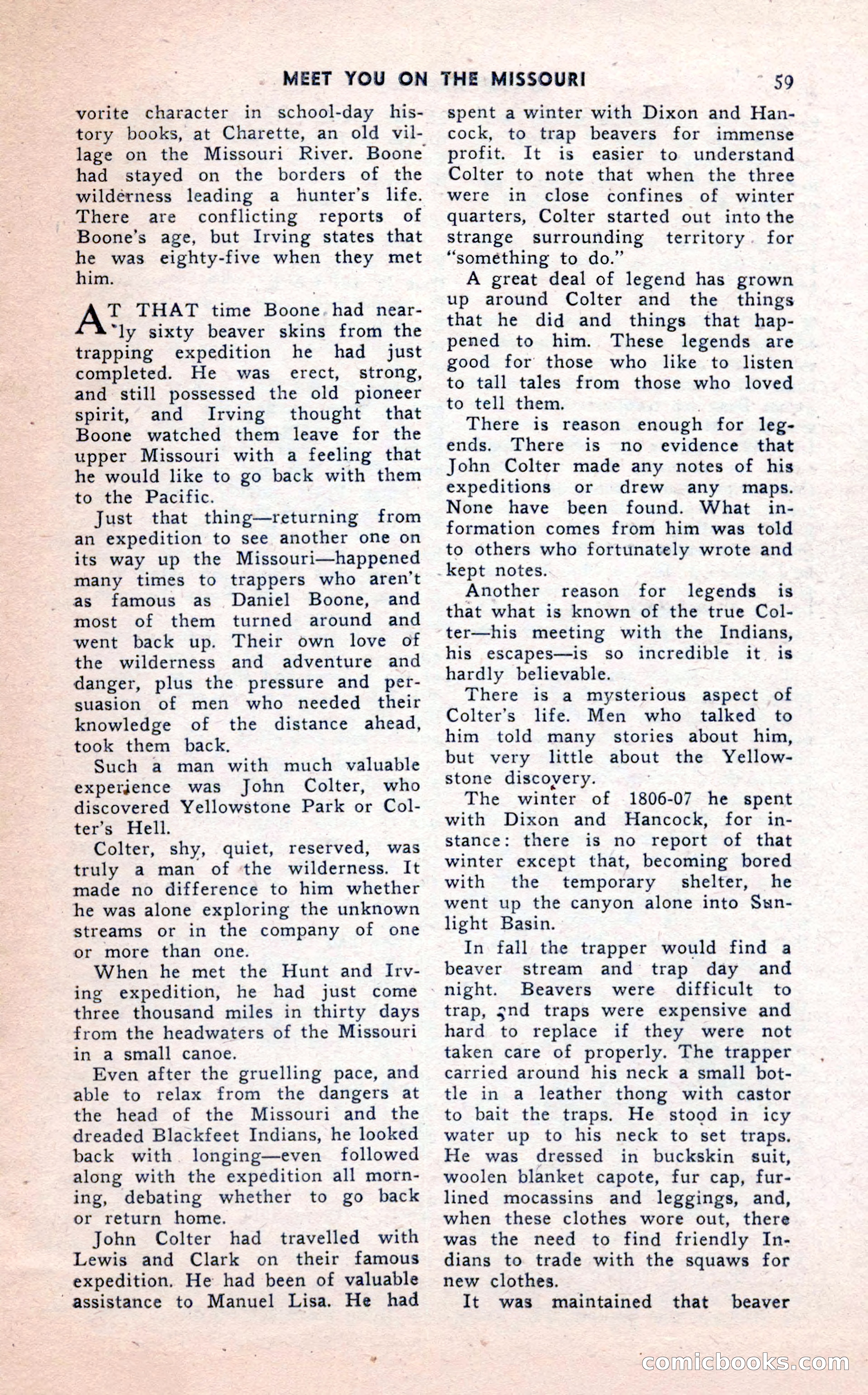
A restored page from Pulp Fiction, 1954. Page through the whole issue in the reader above.
📄 Transcribed text from this page (OCR, searchable)
Machine-transcribed from the original scan — historical spelling and the odd misread are preserved.
MEET YOU ON THE MISSOURI vorite character in school-day his- tory books, at Charette, an old vil- lage on the Missouri River. Boone had stayed on the borders of the wilderness leading a hunter’s life. There are conflicting reports of Boone’s age, but Irving states that he was eighty-five when they met him. T THAT time Boone. had near- “ly sixty beaver skins from the trapping expedition he had just completed. He was erect, strong, and still possessed the old pioneer spirit, and Irving thought that Boone watched them leave for the upper Missouri with a feeling that he would like to go back with them to the Pacific. Just that thing—returning from an expedition to see another one on its way up the Missouri—happened many times to trappers who aren't as famous as Daniel Boone, and most of them turned around and went back up. Their own love of the wilderness and adventure and danger, plus the pressure and per- suasion of men who needed their knowledge of the distance ahead, took them back. Such a man with much valuable experience was John Colter, who discovered Yellowstone Park or Col- ters Hell. Colter, shy, quiet, reserved, was truly a man of the wilderness. It made no difference to him whether he was alone exploring the unknown streams or in the company of one or more than one. When he met the Hunt and Irv- ing expedition, he had just come three thousand miles in thirty days from the headwaters of the Missouri in a small canoe. Even after the gruelling pace, and able to relax from the dangers at the head of the Missouri and the dreaded Blackfeet Indians, he looked back with. longing—even followed along with the expedition all morn- ing, debating whether to go back or return home. John Colter had travelled with Lewis and Clark on their famous expedition. He had been of valuable “assistance to Manuel Lisa. He had - night. 59 spent a winter with Dixon and Han- cock, to trap beavers for immense profit. It is easier to understand Colter to note that when the three were in close confines of winter quarters, Colter started out into the strange surrounding territory. for “something to do.” A great deal of legend has grown up around Colter and the things that he did and things that hap- pened to him. These legends are good for those who like to listen to tall tales from those who loved to tell them. 3 There is reason enough for leg- ends. There is no evidence that John Colter made any notes of his expeditions or drew any = maps. None have been found. What in- formation comes from him was told to others who fortunately wrote and -kept notes. Another reason for legends is that what is known of the true Col- ter—his meeting with the Indians, his escapes—is so incredible it is hardly believable. There is a mysterious aspect of Colter’s life. Men who talked to him told many stories about him, but very little about the Yellow- stone discovery. The winter of 1806-07 he spent with Dixon and Hancock, for in- stance: there is no report of that winter except that, becoming bored with the temporary shelter, he went up the canyon alone into Sun- light Basin. In fall the trapper would find a beaver stream and trap day and Beavers were difficult to trap, jnd traps were expensive and hard to replace if they were not taken care of properly. The trapper carried around his neck a small bot- tle in a leather thong with castor to bait the traps. He stood in icy water up to his neck to set traps. He was dressed in buckskin suit, woolen blanket capote, fur cap, fur- lined mocassins and leggings, and, when these clothes wore out, there was the need to find friendly In- dians to trade with the squaws for new clothes. It was maintained that beaver CONnNICLOOOkKS (C@)