
Pulp Fiction, 1954 · page 49 of 100
2-Gun Western, February 1954 — page 49: what you’re looking at
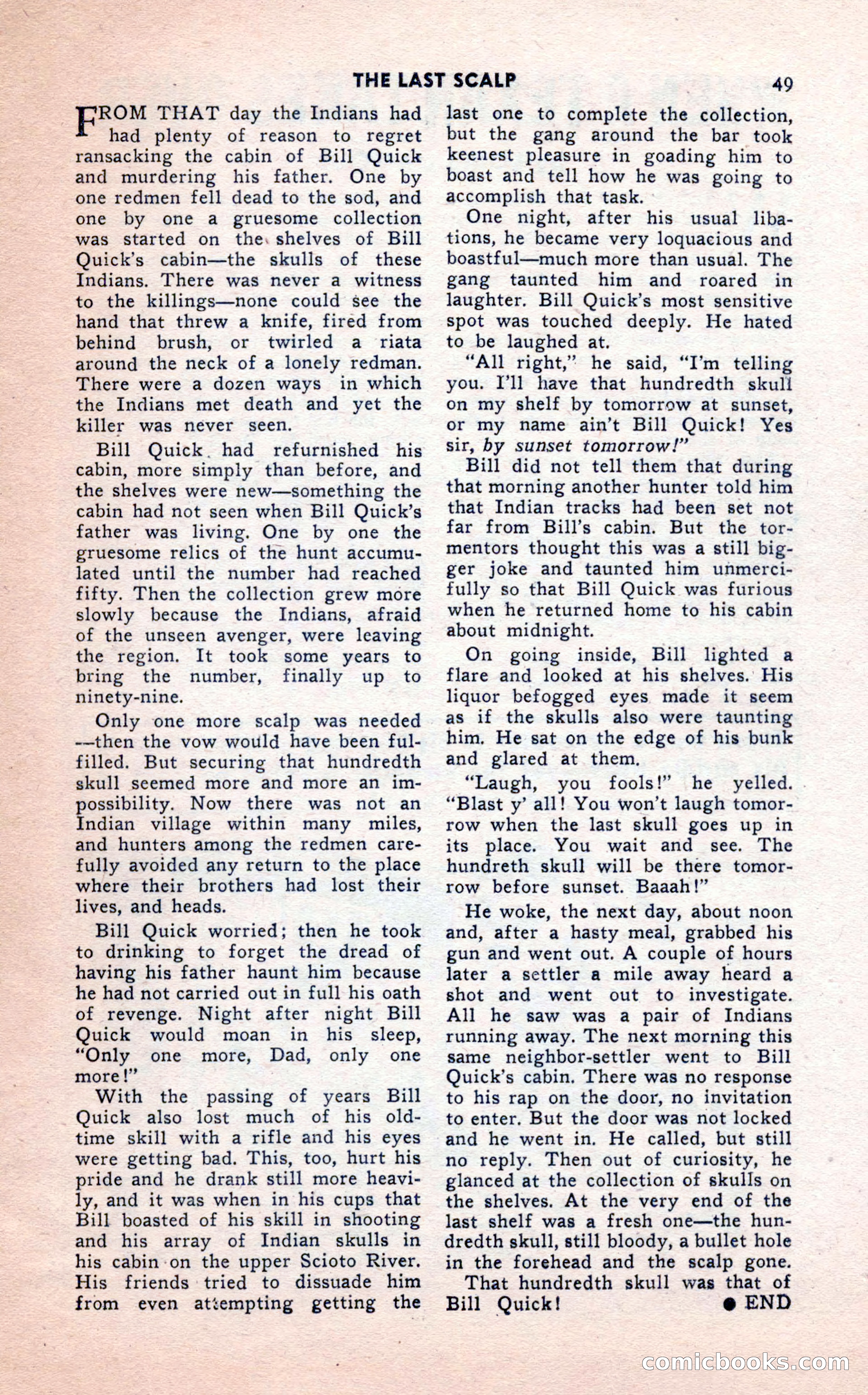
A restored page from Pulp Fiction, 1954. Page through the whole issue in the reader above.
📄 Transcribed text from this page (OCR, searchable)
Machine-transcribed from the original scan — historical spelling and the odd misread are preserved.
THE LAST SCALP | eee THAT day the Indians had had plenty of reason to regret ransacking the cabin of Bill Quick and murdering his father. One by one redmen fell dead to the sod, and one by one a gruesome collection was started on the. shelves of Bill Quick’s cabin—the skulls of these Indians. There was never a witness to the killings—none could see the hand that threw a knife, fired from behind brush, or twirled a riata around the neck of a lonely redman. There were a dozen ways in which the Indians met death and yet the killer was never seen. Bill Quick. had refurnished his cabin, more simply than before, and the shelves were new—something the cabin had not seen when Bill Quick’s father was living. One by one the gruesome relics of the hunt accumu- lated until the number had reached fifty. Then the collection grew more slowly because the Indians, afraid of the unseen avenger, were leaving the region. It took some years to bring the number, finally up _ to ninety-nine. Only one more scalp was needed -—then the vow would have been ful- filled. But securing that hundredth skull seemed more and more an im- possibility. Now there was not an Indian village within many miles, and hunters among the redmen care- fully avoided any return to the place where their brothers had lost their lives, and heads. Bill Quick worried; then he took to drinking to forget the dread of having his father haunt him because he had not carried out in full his oath of revenge. Night after night Biull Quick would moan in his sleep, “Only one more, Dad, only one more!” With the passing of years Bill Quick also lost much of his old- time skill with a rifle and his eyes were getting bad. This, too, hurt his pride and he drank still more heavi- ly, and it was when in his cups that Bill boasted of his skill in shooting and his array of Indian skulls in his cabin:on the upper Scioto River. His friends tried to dissuade him from even attempting getting the 49 last one to complete the collection, but the gang around the bar took keenest pleasure in goading him to boast and tell how he was going to accomplish that task. One night, after his usual liba- tions, he became very loquacious and boastful—much more than usual. The gang taunted him and roared in laughter. Bill Quick’s most sensitive spot was touched deeply. He hated to be laughed at. “All right,’ he said, “I’m telling you. I’ll have that hundredth skull on my shelf by tomorrow at sunset, or my name ain’t Bill Quick! Yes sir, by sunset tomorrow!” Bill did not tell them that during that morning another hunter told him that Indian tracks had been set not far from Bill’s cabin. But the tor- mentors thought this was a still big- ger joke and taunted him unmerci- fully so that Bill Quick was furious when he returned home to his cabin about midnight. On going inside, Bill lighted a flare and looked at his shelves. His liquor befogged eyes made it seem as if the skulls also were taunting him, He sat on the edge of his bunk and glared at them. “Laugh, you fools!” he _ yelled. “Blast y’ all! You won't laugh tomor- row when the last skull goes up in its place. You wait and see. The hundreth skull will be there tomor- row before sunset. Baaah!” He woke, the next day, about noon and, after a hasty meal, grabbed his gun and went out. A couple of hours later a settler a mile away heard a shot and went out to investigate. All he saw was a pair of Indians running away. The next morning this same neighbor-settler went to Bill Quick’s cabin. There was no response to his rap on the door, no invitation to enter. But the door was not locked and he went in. He called, but still no reply. Then out of curiosity, he glanced at the collection of skulls on the shelves. At the very end of the last shelf was a fresh one—the hun- dredth skull, still bloody, a bullet hole in the forehead and the scalp gone. That hundredth skull was that of Bill Quick! @ END CORNICLOOO SS (C©)