
Pulp Fiction, 1954 · page 42 of 100
2-Gun Western, February 1954 — page 42: what you’re looking at
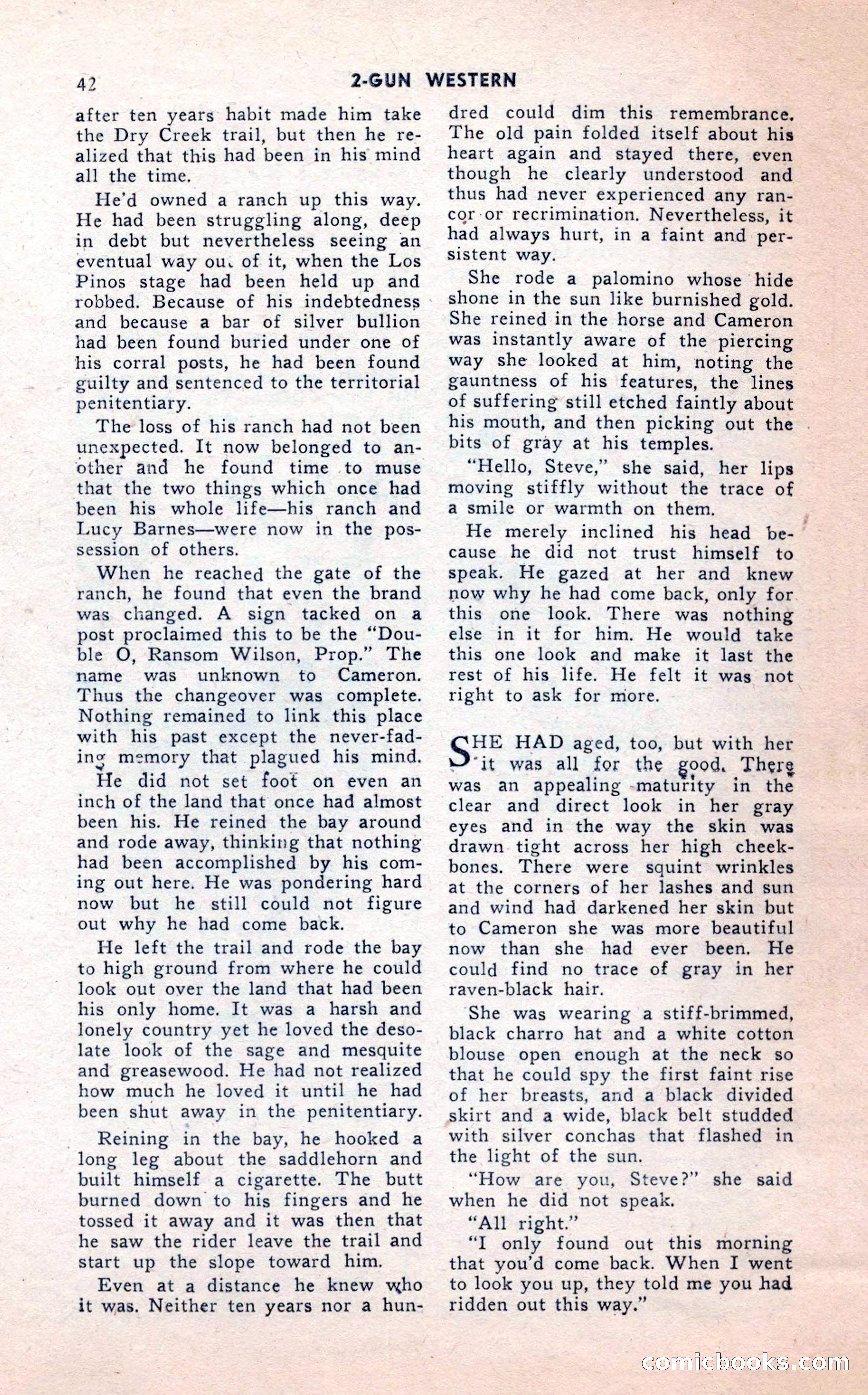
A restored page from Pulp Fiction, 1954. Page through the whole issue in the reader above.
📄 Transcribed text from this page (OCR, searchable)
Machine-transcribed from the original scan — historical spelling and the odd misread are preserved.
42 after ten years habit made him take the Dry Creek trail, but then he re- alized that this had been in his mind all the time. He'd owned a ranch up this way. He had been struggling along, deep in debt but nevertheless seeing an eventual way ou, of it, when the Los Pinos stage had been held up and robbed. Because of his indebtedness and because a bar of silver bullion had been found buried under one of his corral posts, he had been found guilty and sentenced to the territorial penitentiary. The loss of his ranch had not been unexpected. It now belonged to an- other and he found time to muse that the two things which once had been his whole life—his ranch and Lucy Barnes—were now in the pos- session of others. When he reached the gate of the ranch, he found that even the brand was changed. A sign tacked on a post proclaimed this to be the “Dou- ble O, Ransom Wilson, Prop.” The name was unknown to Cameron. Thus the changeover was complete. Nothing remained to link this place with his past except the never-fad- ing memory that plagued his mind. He did not set foot on even an inch of the land that once had almost been his. He reined the bay around and rode away, thinking that nothing had been accomplished by his com- ing out here. He was pondering hard now but he still could not figure out why he had come back. He left the trail and rode the bay to high ground from where he could look out over the land that had been his only home. It was a harsh and lonely country yet he loved the deso- late look of the sage and mesquite and greasewood. He had not realized how much he loved it until he had been shut away in the penitentiary. Reining in the bay, he hooked a long leg about the saddlehorn and built himself a cigarette. The butt burned down to his fingers and he tossed it away and it was then that he saw the rider leave the trail and start up the slope toward him. Even at a distance he knew who it was. Neither ten years nor a hun- 2-GUN WESTERN | dred could dim this remembrance. The old pain folded itself about his heart again and stayed there, even though he clearly understood and thus had never experienced any ran- cor-or recrimination. Nevertheless, it had always hurt, in a faint and per- sistent way. She rode a palomino whose hide shone in the sun like burnished gold. She reined in the horse and Cameron was instantly aware of the piercing way she looked at him, noting the gauntness of his features, the lines of suffering still etched faintly about his mouth, and then picking out the . bits of gray at his temples. “Hello, Steve,” she said, her lips moving stiffly without the trace of a smile or warmth on them. He merely inclined his head be- : cause he did not trust himself to speak. He gazed at her and knew now why he had come back, only for. this one look. There was nothing else in it for him. He would take this one look and make it last the rest of his life. He felt it was not right to ask for more. HE HAD aged, too, but with her "it was all for the good, There was an appealing -maturity in the clear and direct look in her gray eyes and in the way the skin was drawn tight across her high cheek- bones. There were squint wrinkles at the corners of her lashes and sun and wind had darkened her skin but to Cameron she was more beautiful now than she had ever been. He could find no trace of gray in her raven-black hair. She was wearing a stiff-brimmed, black charro hat and a white cotton blouse open enough at the neck so that he could spy the first faint rise of her breasts, and a black divided skirt and a wide, black belt studded with silver conchas that flashed in the light of the sun. “How are you, Steve?” she said when he did not speak. “All right.” “I only found out this morning that you’d come back. When I went to look you up, they told me you had ridden out this way.” COPNICLOOOKS (E@)