
Pulp Fiction, 1939 · page 80 of 114
Cowboy Short Stories, November 1939 — page 80: what you’re looking at
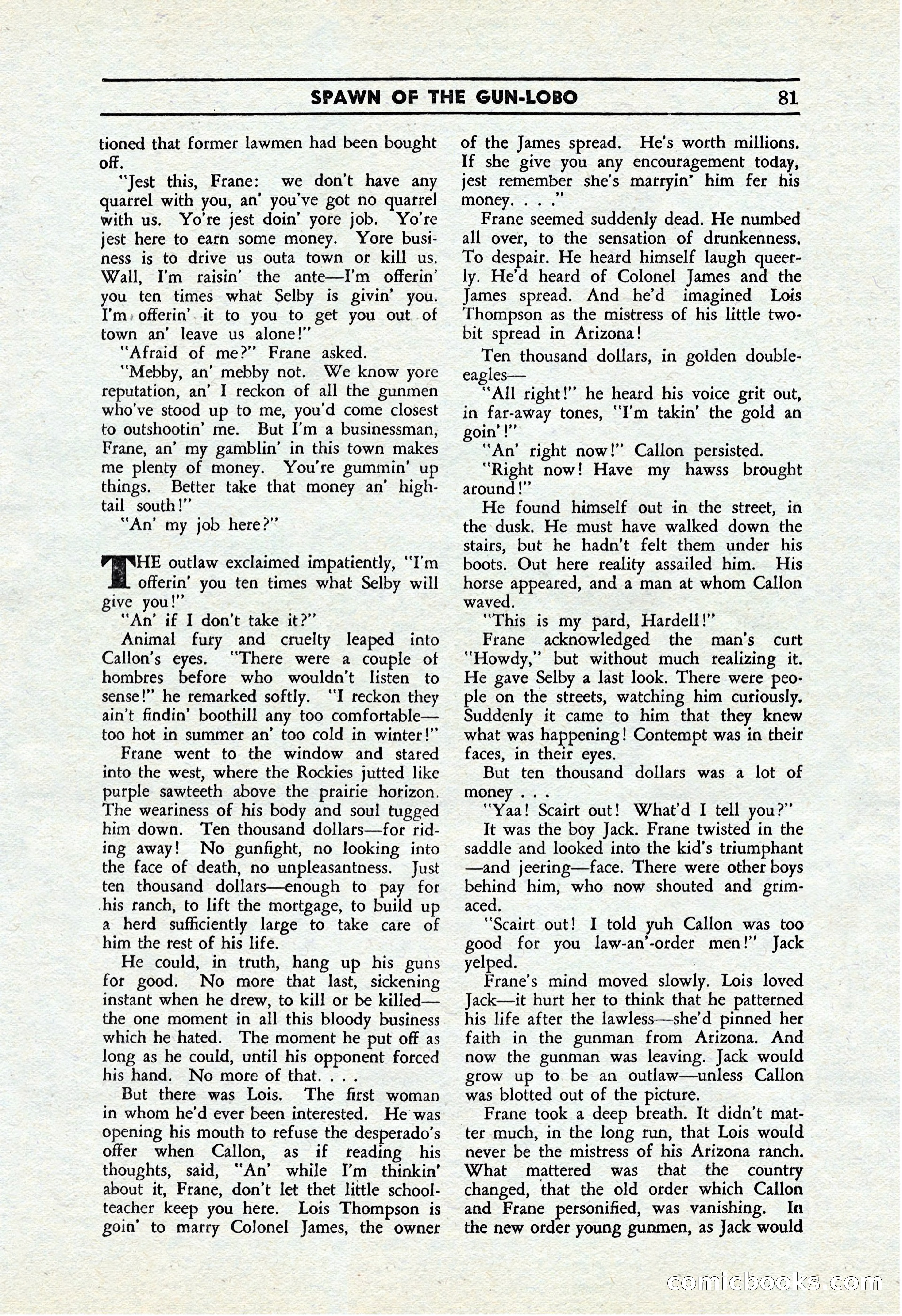
A restored page from Pulp Fiction, 1939. Page through the whole issue in the reader above.
📄 Transcribed text from this page (OCR, searchable)
Machine-transcribed from the original scan — historical spelling and the odd misread are preserved.
SPAWN OF THE GUN-LOBO 81 tioned that former lawmen had been bought off. ‘Jest this, Frane: we don’t have any quarrel with you, an’ you've got no quarrel with us. Yo're jest doin’ yore job. Yo’re jest here to earn some money. Yore bust- ness is to drive us outa town or kill us, Wall, I’m raisin’ the ante—I’m offerin’ you ten times what Selby is givin’ you. I’m: offerin’. it to you to get you out. of town an’ leave us alone!” “Afraid of me?” Frane asked. ‘““Mebby, an’ mebby not. We know yore reputation, an’ I reckon of all the gunmen who've stood up to me, you'd come closest to outshootin’ me. But I’m a businessman, Frane, an’ my gamblin’ in this town makes me plenty of money. You're gummin’ up things. Better take that money an’ high- tail south!” “An’ my job here?” HE outlaw exclaimed impatiently, “I’m offerin’ you ten times what Selby will give you!” ‘An’ if I don’t take it?” Animal fury and cruelty leaped into Callon’s eyes. “There were a couple of hombres before who wouldn't listen to sense!” he remarked softly. “I reckon they ain't findin’ boothill any too comfortable— too hot in summer an’ too cold in winter!” Frane went to the window and stared into the west, where the Rockies jutted like purple sawteeth above the prairie horizon. The weariness of his body and soul tugged him down. Ten thousand dollars—for rid- ing away! No gunfight, no looking into the face of death, no unpleasantness. Just ten thousand dollars—enough to pay for -his ranch, to lift the mortgage, to build up a herd sufficiently large to take care of him the rest of his life. He could, in truth, hang up his guns for good. No more that last, sickening instant when he drew, to kill or be killed— the one moment in all this bloody business which he hated. The moment he put off as long as he could, until his opponent forced his hand. No more of that... . But there was Lois. The first woman in whom he'd ever been interested. He was opening his mouth to refuse the desperado’s offer when Callon, as if reading his thoughts, said, “An’ while I’m_ thinkin’ about it, Frane, don’t let thet little school- teacher keep you here. Lois Thompson is goin’ to marry Colonel James, the owner of the James spread. He's worth millions. If she give you any encouragement today, jest remember she’s marryin’ him fer his money. ...” Frane seemed suddenly dead. He numbed all over, to the sensation of drunkenness. To despair. He heard himself laugh queer- ly. He'd heard of Colonel James and the James spread. And he'd imagined Lois Thompson as the mistress of his little two- bit spread in Arizona! Ten thousand dollars, in golden double- eagles— ‘All right!” he heard his voice grit out, in far-away tones, “I’m takin’ the gold an goin’ !”’ “An’ right now!” Callon persisted. “Right now! Have my hawss_ brought around !”’ He found himself out in the street, in the dusk. He must have walked down the stairs, but he hadn’t felt them under his boots. Out here reality assailed him. His horse appeared, and a man at whom Callon waved. “This is my pard, Hardell!” Frane acknowledged the man’s curt “Howdy,” but without much realizing it. He gave Selby a last look. There were peo- ple on the streets, watching him curiously. Suddenly it came to him that they knew what was happening! Contempt was in their faces, in their eyes. But ten thousand dollars was a lot of money... “Yaa! Scairt out! What'd I tell you?” It was the boy Jack. Frane twisted in the saddle and looked into the kid’s triumphant —and jeering—face. There wete other boys behind him, who now shouted and grim- aced. ‘“Scairt out! I told yuh Callon was too good for you law-an’-order men!’ Jack yelped. Frane’s mind moved slowly. Lois loved Jack—it hurt her to think that he patterned his life after the lawless—she’d pinned her faith in the gunman from Arizona, And now the gunman was leaving. Jack would grow up to be an outlaw—unless Callon was blotted out of the picture. Frane took a deep breath. It didn’t mat- ter much, in the long run, that Lois would never be the mistress of his Arizona ranch. What mattered was that the country changed, that the old order which Callon and Frane personified, was vanishing. In the new order young gunmen, as Jack would GOMIGIOO S (C@