
Pulp Fiction, 1939 · page 79 of 114
Cowboy Short Stories, November 1939 — page 79: what you’re looking at
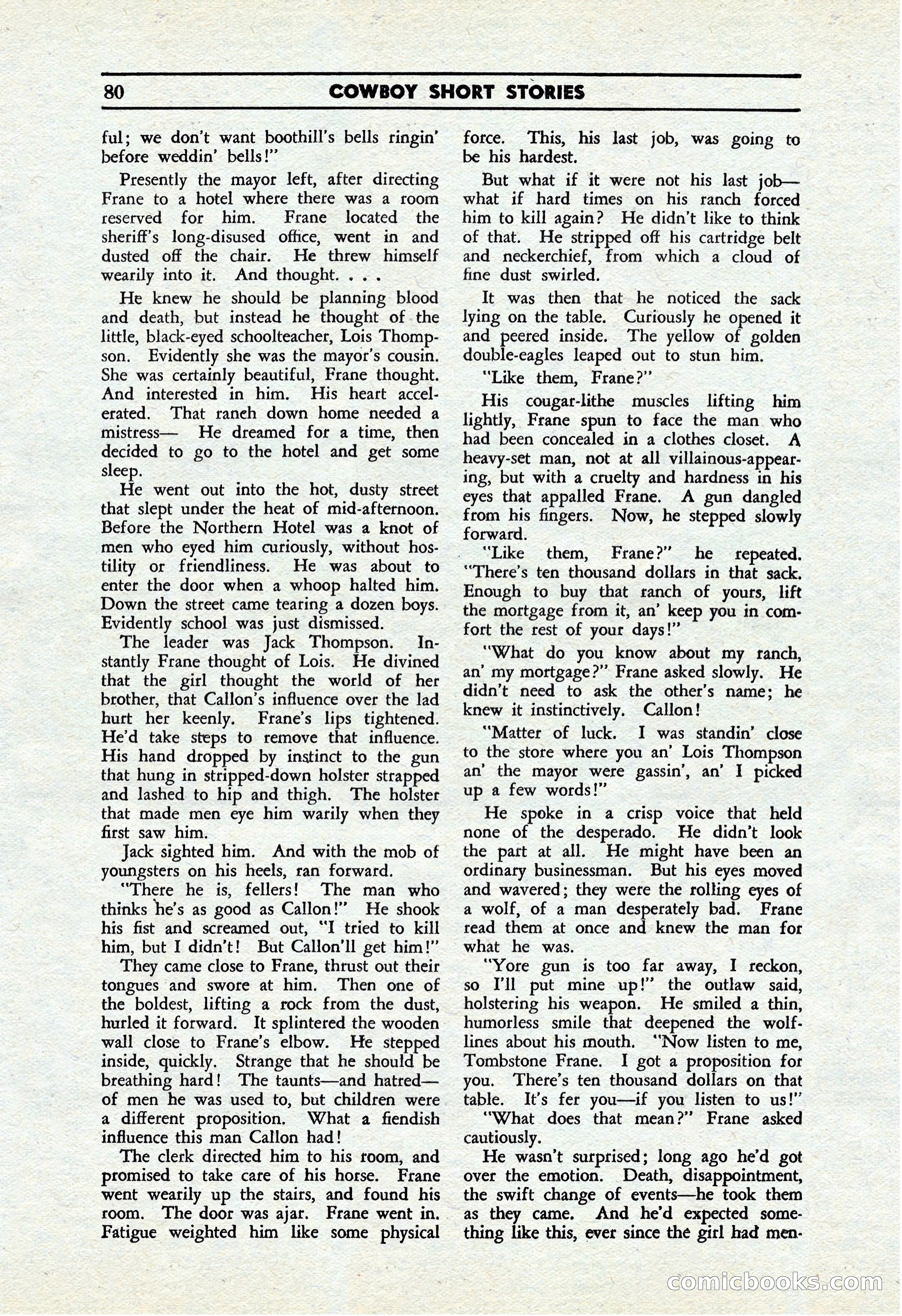
A restored page from Pulp Fiction, 1939. Page through the whole issue in the reader above.
📄 Transcribed text from this page (OCR, searchable)
Machine-transcribed from the original scan — historical spelling and the odd misread are preserved.
80 COWBOY SHORT STORIES ful; we don’t want boothill’s bells ringin’ before weddin’ bells!” Presently the mayor left, after directing Frane to a hotel where there was a room reserved for him. Frane located the sheriff's long-disused office, went in and dusted off the chair. He threw himself wearily into it. And thought.... He knew he should be planning blood and death, but instead he thought of . the little, black-eyed schoolteacher, Lois Thomp- son. Evidently she was the mayor's cousin. She was certainly beautiful, Frane thought. And interested in him. His heart accel- erated. That raneh down home needed a mistress— He dreamed for a time, then decided to go to the hotel and get some sleep. He went out into the hot, dusty street that slept under the heat of mid-afternoon. Before the Northern Hotel was a knot of men who eyed him curiously, without hos- tility or friendliness. He was about to enter the door when a whoop halted him. Down the street came tearing a dozen boys. Evidently school was just dismissed. The leader was Jack Thompson. In- stantly Frane thought of Lois. He divined that the girl thought the world of her brother, that Callon’s influence over the lad hurt her keenly. Frane’s lips tightened. He'd take steps to remove that influence. His hand dropped by instinct to the gun that hung in stripped-down holster strapped and lashed to hip and thigh. The holster that made men eye him warily when they first saw him. Jack sighted him. And with the mob of youngsters on his heels, ran forward. “There he is, fellers! The man who thinks he’s as good as Callon!” He shook his fist and screamed out, “I tried to kill him, but I didn’t! But Callon’ll get him!” They came close to Frane, thrust out their tongues and swore at him. Then one of the boldest, lifting a rock from the dust, hurled it forward. It splintered the wooden wall close to Frane’s elbow. He stepped inside, quickly. Strange that he should be breathing hard! The taunts—and hatred— of men he was used to, but children were a different proposition. What a fiendish influence this man Callon had! The clerk directed him to his room, and promised to take care of his horse. Frane went wearily up the stairs, and found his room. The door was ajar. Frane went in. Fatigue weighted him like some physical force. This, his last job, was going to be his hardest. But what if it were not his last job— what if hard times on his ranch forced him to kill again? He didn’t like to think of that. He stripped off his cartridge belt and neckerchief, from which a cloud of fine dust swirled. It was then that he noticed the sack lying on the table. Curiously he opened it and peered inside. The yellow of golden double-eagles leaped out to stun him. “Like them, Frane?” His cougar-lithe muscles lifting him lightly, Frane spun to face the man who had been concealed in a clothes closet. A heavy-set man, not at all villainous-appear- ing, but with a cruelty and hardness in his eyes that appalled Frane. A gun dangled from his fingers. Now, he stepped slowly forward. “Like them, Frane?” he repeated. “There’s ten thousand dollars in that sack. Enough to buy that ranch of yours, lift the mortgage from it, an’ keep you in com- fort the rest of your days!” “What do you know about my ranch, an’ my mortgage?” Frane asked slowly. He didn’t need to ask the other’s name; he knew it instinctively. Callon! “Matter of luck. I was standin’ close to the store where you an’ Lois Thompson an’ the mayor were gassin’, an’ I picked up a few words!” He spoke in a ctisp voice that held none of the desperado. He didn’t look the part at all. He might have been an ordinary businessman. But his eyes moved and wavered; they were the rolling eyes of a wolf, of a man desperately bad. Frane tread them at once and knew the man for what he was. “Yore gun is too far away, I reckon, so I'll put mine up!” the outlaw said, holstering his weapon. He smiled a thin, humorless smile that deepened the wolf- lines about his mouth. “Now listen to me, Tombstone Frane. I got a proposition for you. There’s ten thousand dollars on that table. It’s fer you—if you listen to us!” “What does that mean?’’ Frane asked cautiously. He wasn’t surprised; long ago he’d got over the emotion. Death, disappointment, the swift change of events—he took them as they came. And he'd expected some- thing like this, ever since the girl had men- GOmMIGIOO S EO