
Pulp Fiction, 1945 · page 9 of 68
10-Story Detective, June 1945 — page 9: what you’re looking at
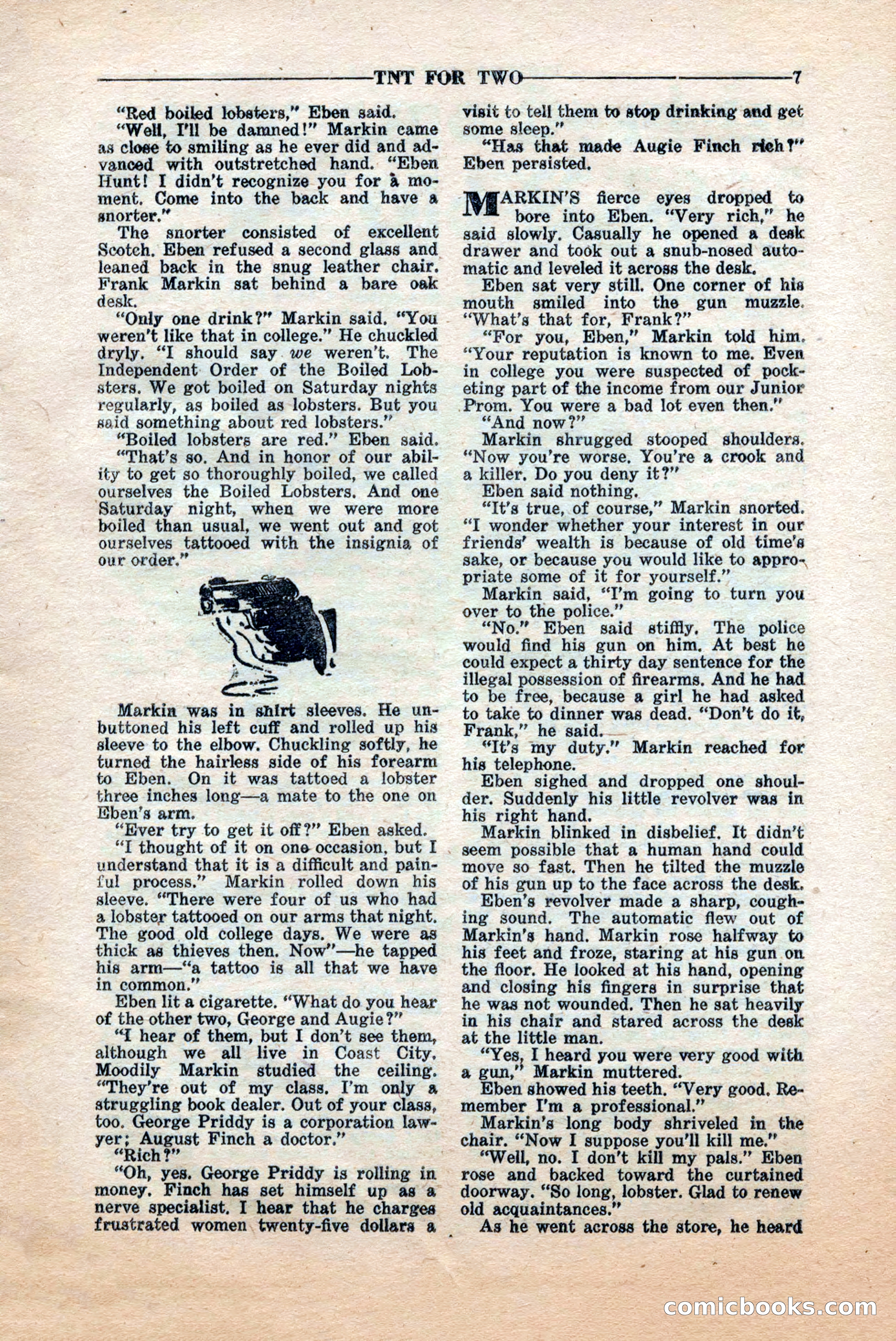
A restored page from Pulp Fiction, 1945. Page through the whole issue in the reader above.
📄 Transcribed text from this page (OCR, searchable)
Machine-transcribed from the original scan — historical spelling and the odd misread are preserved.
“Red boiled lobsters,” Eben said. “Well, I'll be damned!” Markin came as close to smiling as he ever did and ad- . vanced with outstretched hand. “Eben Hunt! I didn’t recognize you for 4 mo- ment. Come into the back and have a snorter.”” The snorter consisted of excellent Scotch. Eben refused a second glass and leaned back in the snug leather chair. — Markin sat behind a bare oak desk. “Only one drink?” Markin said, “You - weren’t like that in college.” He chuckled dryly. “I should say. we weren’t. The Independent: Order of the Boiled Lob- sters. We got boiled on Saturday nights regularly, as boiled as lobsters. But you said something about red lobsters.” “Boiled lobsters are red.” Eben said. “That’s so. And in honor of our abil- ity to get so thoroughly boiled, we called ourselves the Boiled Lobsters, And one Saturday night, when we were more boiled than usual, we went out and got ourselves tattooed with the insignia, of our order.” Markin was in shirt sleeves. He un- buttoned his left cuff and rolled up his sleeve to the elbow. Chuckling softly, he turned the hairless side of his forearm to Eben. On it was tattoed a lobster three inches long—a mate to the one on Eben’s arm. “Ever try to get it off?” Eben asked. “Tt thought of it on one occasion, but I understand that it is a difficult and pain- ful process.” Markin rolled down his sleeve. “There were four of us who had a lobster tattooed on our arms that night. The good old college days. We were as thick as thieves then. Now’’—he tapped his arm—‘“a tattoo is all that we have in common.” Eben lit a cigarette. “What do you hear of the other two, George and Augie?” “{ hear of them, but I don’t see them, although we all live in Coast City, Moodily Markin studied the ceiling. “They’re out of my class. I’m only a struggling book dealer. Out of your class, too. George Priddy is a corporation law- get? far al Finch a doctor.” c “Oh, yes. George Priddy is rolling in money, Finch has set himself up as a nerve specialist, I hear that he charges frustrated women. twenty-five dollars a | ne visit to tell them to stop drinking and get some sleep.” “Has that made Augie Finch riehf’’ Eben persisted, ARKIN’S fierce eyes dropped to bore into Eben. “Very rich,” he said slowly. Casually he opened a desk drawer and took out a snub-nosed auto- matic and leveled it across the desk. Eben sat very still. One corner of hia mouth smiled into the gun muzzle. “What's that for, Frank?” “For you, Eben,” Markin told him. “Your reputation is known to me. Even in college you were suspected of pock- eting part of the income from our Junior Prom. You were a bad lot even then.” “And now?” Markin shrugged stooped shoulders. “Now you’re worse, You’re a crook and a killer. Do you deny it?’ Eben said nothing. “It’s true, of course,” Markin snorted. “T wonder whether your interest in our friends’ wealth is because of old time's sake, or because you would like to appro- priate some of it for yourself.” Markin said, “I’m going to turn you over to the police.” “No.” Eben said stiffly. The police would find his gun on him, At best he could expect a thirty day sentence for the illegal possession of firearms. And he had to be free, because a girl he had asked to take to dinner was dead. “Don’t do i€, Frank,” he said. — “It’s my duty.” Markin reached for his telephone. Eben sighed and dropped one shoul- der. Suddenly his little revolver was in his right hand. Markin blinked in disbelief, It didn’t . seem possible that a human hand could move so fast. Then he tilted the muzzle of his gun up to the face across the desk. Eben’s revolver made a sharp, cough- ing sound. The automatic flew out of Markin’s hand, Markin rose halfway to his feet and froze, staring at his gun on the floor. He looked at his hand, opening and closing his fingers in surprise that he was not wounded. Then he sat heavily in his chair and stared across the desk at the little man. “Yes, I heard you were very good with a gun,” Markin muttered. Eben showed his teeth. “Very good. Re- member I’m a professional.” 'Markin’s long body shriveled in the chair. “Now I suppose you'll kill me.” “Weill, no. I don’t kill my pals.” Eben rose and backed toward the curtained doorway. “So long, lobster. Glad to. renew old acquaintances.” As he went across the store, he heard * Le comicbooks co