
Pulp Fiction, 1945 · page 8 of 68
10-Story Detective, June 1945 — page 8: what you’re looking at
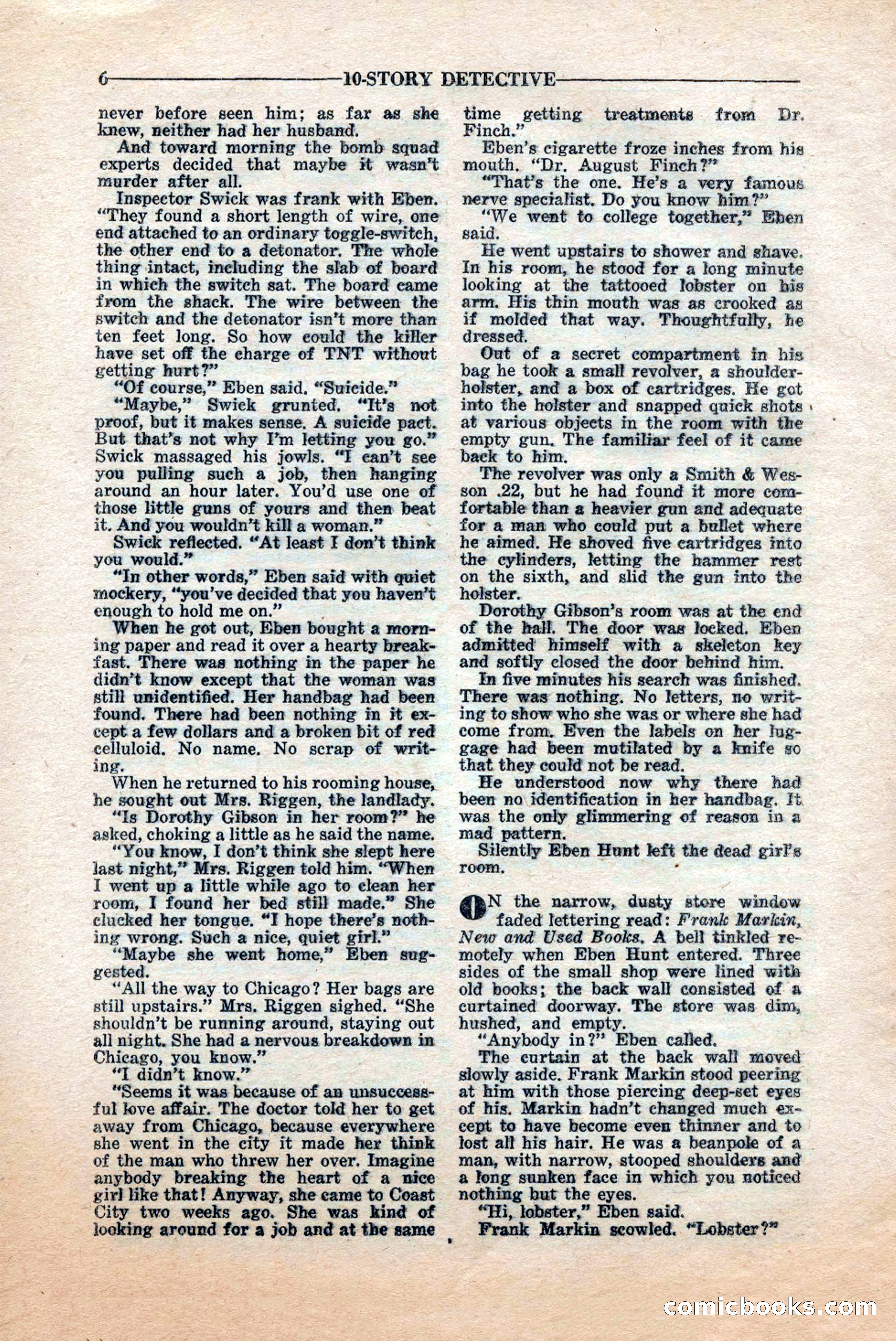
A restored page from Pulp Fiction, 1945. Page through the whole issue in the reader above.
📄 Transcribed text from this page (OCR, searchable)
Machine-transcribed from the original scan — historical spelling and the odd misread are preserved.
6————___—__—___———10-STORY DETECTIVE never before seen him; as far as she knew, neither had her husband. And toward morning the bomb squad experts decided that maybe it wasn’t raurder after all. Inspector Swick was frank with Eben. “They found a short length of wire, one end attached to an ordinary toggle-switch, the other end to a detonator. The whole thing intact, ineluding the slab of board in which the switch sat. The board eame from the shack. The wire between the switch and the detonator isn’t more than ten feet long. So how eould the killer have set off the charge of TNT without getting hurt?” “Of course,” Eben said. “Suicide.” “Maybe,” Swick grunted. “It’s not proof, but it makes sense, A suicide pact. But that’s not why I’m letting you go.” Swick massaged his jowls. “I ean’t see you pulling such a job, then hanging around an hour later. You’d use one of those ttle guns of yours and them beat it. And you wouldn’t kill a woman.” Swick reflected. “At least I don’t think you would.” “In other words,” Eben said with quiet mockery, “you’ve decided that you haven’t enough to hold me on.’ When he got out, Eben bought a morn- ing paper and read it over a hearty break- fast. There was nothing in the paper he didn’t know except that the woman was still unidentified. Her handbag had been found. There had been nothing in it ex- cept a few dollars and a broken bit of red celluloid. No name. No scrap of writ- ing When he returned to his rooming house, he sought out Mrs. Riggen, the landlady. “Ts Dorothy Gibson in her room?” he asked, choking a little as he said the name. “You know, I don’t think she slept here last night,” Mrs. Riggen told him. “When I went up a little while ago to elean her room, I found her bed stil! made.” She clucked her tongue. “7 hope there’s noth- ing wrong. Such a nice, quiet girl.” “Maybe she went home,” Eben sug- gested. “All the way to Chicago? Her bags are still upstairs.” Mrs, Riggen sighed. “She shouldn’t be running around, staying out all night. She had a nervous breakdown i im Chicago, you know,” “T didn’t know.” “Seems it was because of an unsuccess- ful love affair. The doctor told her to get away from Chicago, because everywhere she went in the city it made her think of the man who threw her over. Imagine anybody breaking the heart of a nice gir] like that! Anyway, she came to Coast City two weeks ago. She was kind of ee Z time getting treatments from Dr. Pinch.” Eben’s cigarette froze inches from his mouth, “Dr. August Finch?” “That’s the one. He’s a very famous nerve spectalist. Do you know him?” fei went to college together,” Eben said. He went upstairs to shower and shave. In his room, he stood for a long minute looking at the tattooed lobster on his arm. His thin mouth was as crooked as if molded that way. Thoughtfullty, he dressed. Out of a secret compartment in his bag he took a small revolver, a shoulder- holster, and a box of cartridges. He got into the holster and snapped quick shots at various objects in the room with the empty gun. The familiar feel of it came back to him The revolver was only a Smith & Wes- son .22, but he had found it more com- fortable than a heavier gun and adequate for a man who could put a bullet where he aimed. He shoved five cartridges mto the cylinders, letting the hammer rest on the sixth, and slid the gun into the holster. Dorothy Gibson’s room was at the end of the hall. The door was locked. Eben admitted himself with a skeleton key and softly closed the door behind him. In five minutes his search was finished. There was nothing. No Ietters, no writ- ing to show who she was or where she had come from. Even the labels on her Ing- gage had been mutilated by a kmife go that they could not be read. He understood now why there had been no identification in her handbag. fi. was the only glimmering of reason in a mad pattern Silently Eben Hunt left the dead girls room. qs the narrow, dusty stere window faded lettering read: Frank Mariin, New and Used Books, A bell tinkled re- motely when Eben Hunt entered. Three sides of the small shop were lined with old books; the back wall consisted of a curtained doorway. The store was dim, hushed, and empty. “Anybody in?” Eben called. The curtain at the back wall moved slowly aside. Frank Markin steod peering at him with those piercing deep-set eyes of his. Markin hadn’t changed much ex- cept to have become even thinner and to lost all his hair. He was a beanpole of a . man, with narrow, stooped shoulders and a long sunken face in which you noticed nothing but the eyes. “Hi, lobster,” Eben said. Prank Markin scowled. “Lobster?” (E@) Eboo - (S@)