
Pulp Fiction, 1942 · page 56 of 116
10-Story Detective, November 1942 — page 56: what you’re looking at
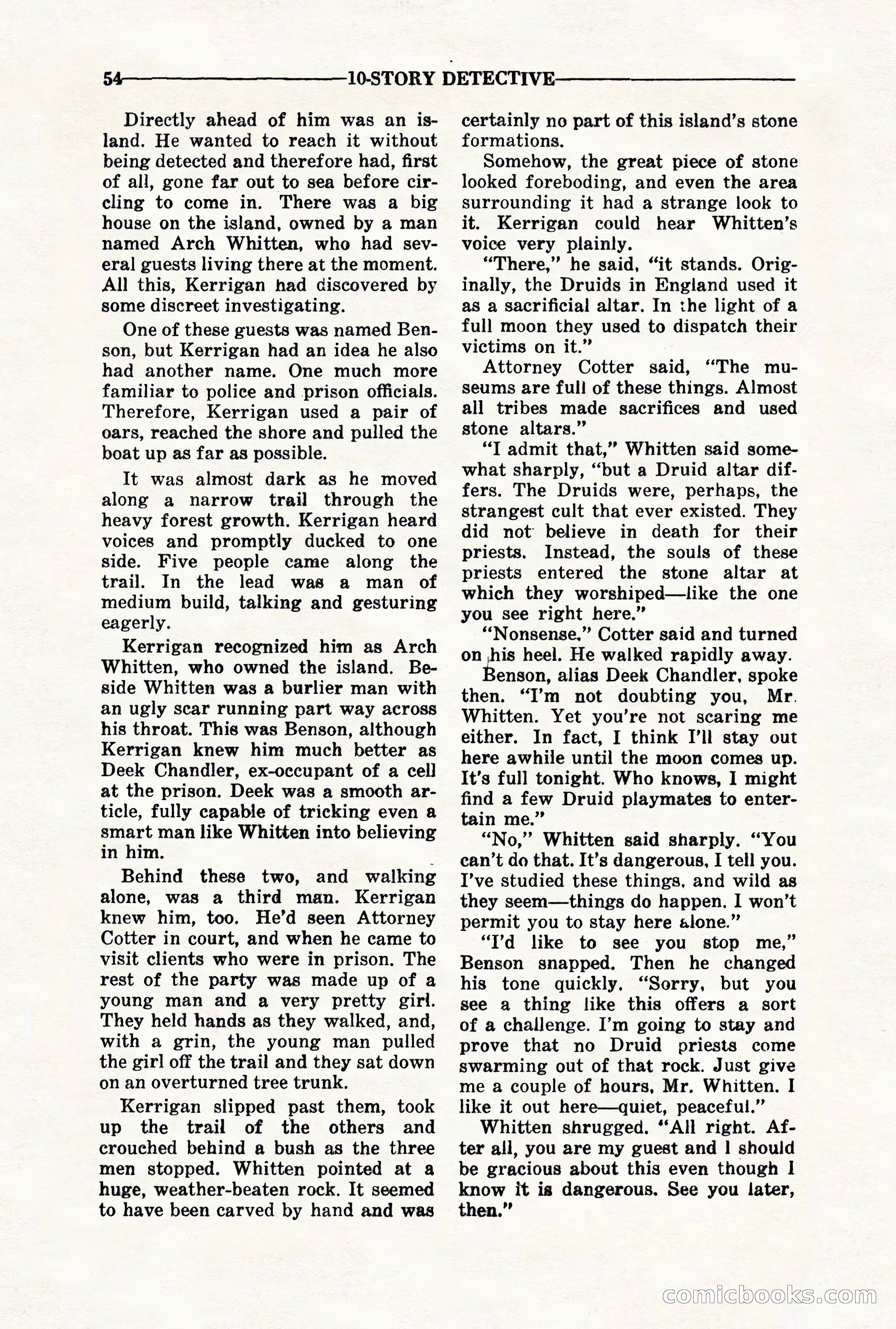
A restored page from Pulp Fiction, 1942. Page through the whole issue in the reader above.
📄 Transcribed text from this page (OCR, searchable)
Machine-transcribed from the original scan — historical spelling and the odd misread are preserved.
54 ——___________10. STORY DETECTIVE Directly ahead of him was an is- land. He wanted to reach it without being detected and therefore had, first of all, gone far out to sea before cir- cling to come in. There was a big house on the island, owned by a man named Arch Whitten, who had sev- eral guests living there at the moment. All this, Kerrigan had discovered by some discreet investigating. One of these guests was named Ben- son, but Kerrigan had an idea he also had another name. One much more familiar to police and prison officials. Therefore, Kerrigan used a pair of oars, reached the shore and pulled the boat up as far as possible. It was almost dark as he moved along a narrow trail through the heavy forest growth. Kerrigan heard voices and promptly ducked to one side. Five people came along the trail. In the lead was a man of medium build, talking and gesturing eagerly. Kerrigan recognized him as Arch Whitten, who owned the island. Be- side Whitten was a burlier man with an ugly scar running part way across his throat. This was Benson, although Kerrigan knew him much better as Deek Chandler, ex-occupant of a cell at the prison. Deek was a smooth ar- ticle, fully capable of tricking even a smart man like Whitten into believing in him. Behind these two, and walking alone, was a third man. Kerrigan knew him, too. He’d seen Attorney Cotter in court, and when he came to visit clients who were in prison. The rest of the party was made up of a young man and a very pretty girl. They held hands as they walked, and, with a grin, the young man pulled the girl off the trail and they sat down on an overturned tree trunk. Kerrigan slipped past them, took up the trail of the others and crouched behind a bush as the three men stopped. Whitten pointed at a huge, weather-beaten rock. It seemed to have been carved by hand and was certainly no part of this island’s stone formations. somehow, the great piece of stone looked foreboding, and even the area surrounding it had a strange look to it. Kerrigan could hear Whitten’s voice very plainly. “There,” he said, “it stands. Orig- inally, the Druids in England used it as a sacrificial altar. In the light of a full moon they used to dispatch their victims on it.” Attorney Cotter said, “The mu- seums are full of these things. Almost all tribes made sacrifices and used stone altars.” “T admit that,” Whitten said some- what sharply, “but a Druid altar dif- fers. The Druids were, perhaps, the strangest cult that ever existed. They did not believe in death for their priests. Instead, the souls of these priests entered the stone altar at which they worshiped—like the one you see right here.” ‘‘Nonsense,”’ Cotter said and turned on jis heel. He walked rapidly away. Benson, alias Deek Chandler, spoke then. “I’m not doubting you, Mr. Whitten. Yet you’re not scaring me either. In fact, I think I’ll stay out here awhile until the moon comes up. It’s full tonight. Who knows, I might find a few Druid playmates to enter- tain me.” “No,” Whitten said sharply. “You can’t do that. It’s dangerous, I tell you. I’ve studied these things, and wild as they seem—things do happen. I won’t permit you to stay here alone.” “I’d like to see you stop me,” Benson snapped. Then he changed his tone quickly. “Sorry, but you see a thing like this offers a sort of a challenge. I’m going to stay and prove that no Druid priests come swarming out of that rock. Just give me a couple of hours, Mr. Whitten. I like it out here—quiet, peaceful.” Whitten shrugged. “All right. Af- ter all, you are my guest and | should be gracious about this even though I know it is dangerous. See you later, then.” cComiclbool (C©