
Pulp Fiction, 1942 · page 55 of 116
10-Story Detective, November 1942 — page 55: what you’re looking at
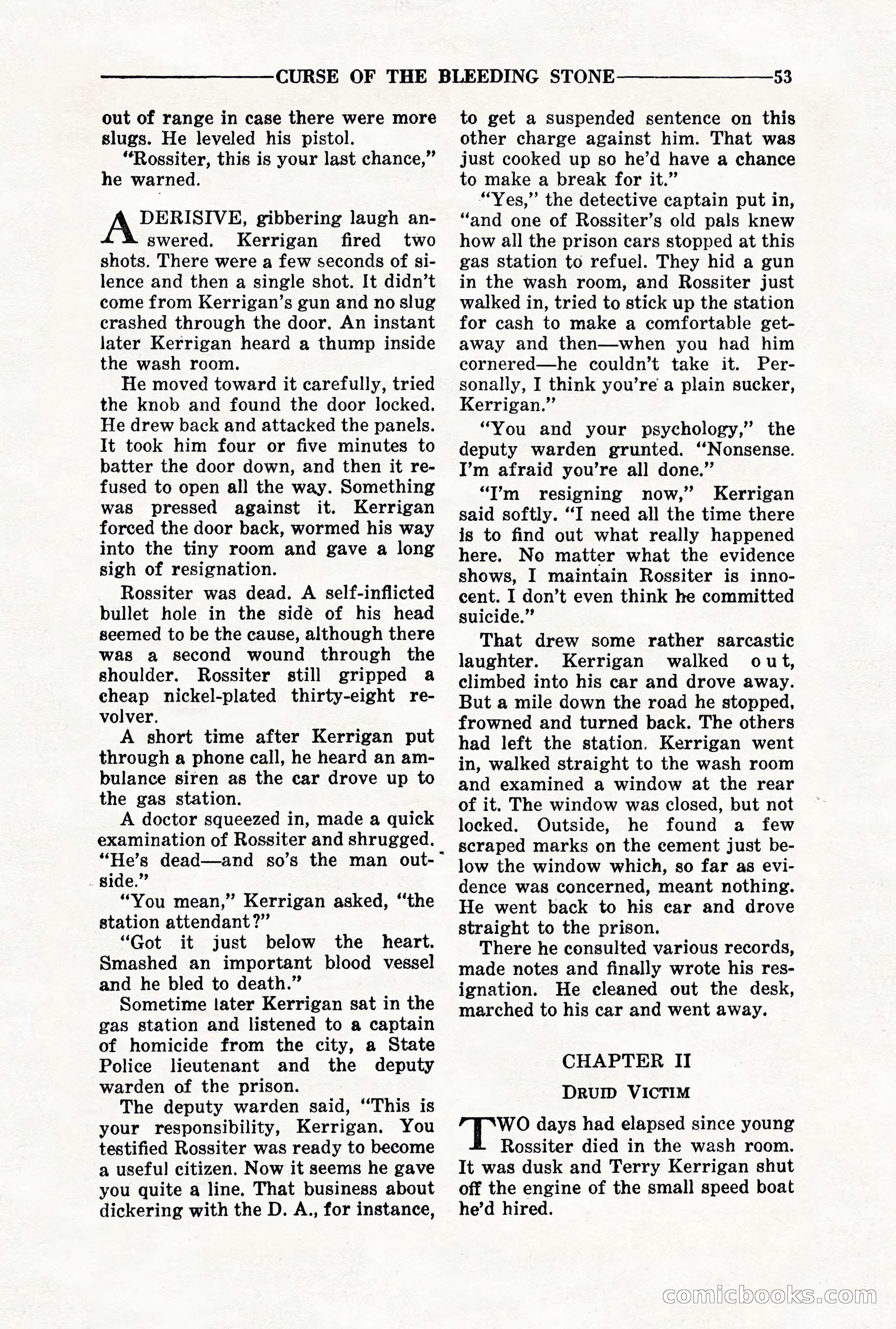
A restored page from Pulp Fiction, 1942. Page through the whole issue in the reader above.
📄 Transcribed text from this page (OCR, searchable)
Machine-transcribed from the original scan — historical spelling and the odd misread are preserved.
CURSE OF THE BLEEDING STONE out of range in case there were more slugs. He leveled his pistol. “Rossiter, this is your last chance,” he warned. DERISIVE, gibbering laugh an- swered. Kerrigan fired two shots. There were a few seconds of si- lence and then a single shot. It didn’t come from Kerrigan’s gun and no slug crashed through the door, An instant later Kerrigan heard a thump inside the wash room. He moved toward it carefully, tried the knob and found the door locked. He drew back and attacked the panels. It took him four or five minutes to batter the door down, and then it re- fused to open all the way. Something was pressed against it. Kerrigan forced the door back, wormed his way into the tiny room and gave a long sigh of resignation. _ Rossiter was dead. A self-inflicted bullet hole in the sidé of his head seemed to be the cause, although there was a second wound through the shoulder. Rossiter still gripped a eheap nickel-plated thirty-eight re- volver. A short time after Kerrigan put through a phone call, he heard an am- bulance siren as the car drove up to the gas station. A doctor squeezed in, made a quick examination of Rossiter and shrugged. ‘“He’s dead—and so’s the man out-— . side.” “You mean,” Kerrigan asked, “the station attendant?” “Got it just below the heart. Smashed an important blood vessel and he bled to death.” Sometime later Kerrigan sat in the gas station and listened to a captain of homicide from the city, a State Police lieutenant and the deputy warden of the prison. The deputy warden said, “This is your responsibility, Kerrigan. You testified Rossiter was ready to become a useful citizen. Now it seems he gave you quite a line. That business about dickering with the D. A., for instance, 53 to get a suspended sentence on this other charge against him. That was just cooked up so he’d have a chance to make a break for it.” “Yes,” the detective captain put in, “and one of Rossiter’s old pals knew how all the prison cars stopped at this gas station to refuel. They hid a gun in the wash room, and Rossiter just walked in, tried to stick up the station for cash to make a comfortable get- away and then—when you had him cornered—he couldn’t take it. Per- sonally, I think you’re a plain sucker, Kerrigan.” “You and your psychology,” the deputy warden grunted. ‘‘Nonsense. I’m afraid you’re all done.” “I’m resigning now,” Kerrigan said softly. “I need all the time there is to find out what really happened here. No matter what the evidence shows, I maintain Rossiter is inno- cent. I don’t even think he committed suicide.” That drew some rather sarcastic laughter. Kerrigan walked out, climbed into his car and drove away. But a mile down the road he stopped, frowned and turned back. The others had left the station. Kerrigan went in, walked straight to the wash room and examined a window at the rear of it. The window was closed, but not locked. Outside, he found a few scraped marks on the cement just be- low the window which, so far as evi- dence was concerned, meant nothing. He went back to his ear and drove straight to the prison. There he consulted various records, made notes and finally wrote his res- ignation. He cleaned out the desk, marched to his car and went away. CHAPTER II DRUID VICTIM WO days had elapsed since young Rossiter died in the wash room. It was dusk and Terry Kerrigan shut off the engine of the small speed boat he’d hired. DOOLK C©