
Pulp Fiction, 1942 · page 48 of 116
10-Story Detective, November 1942 — page 48: what you’re looking at
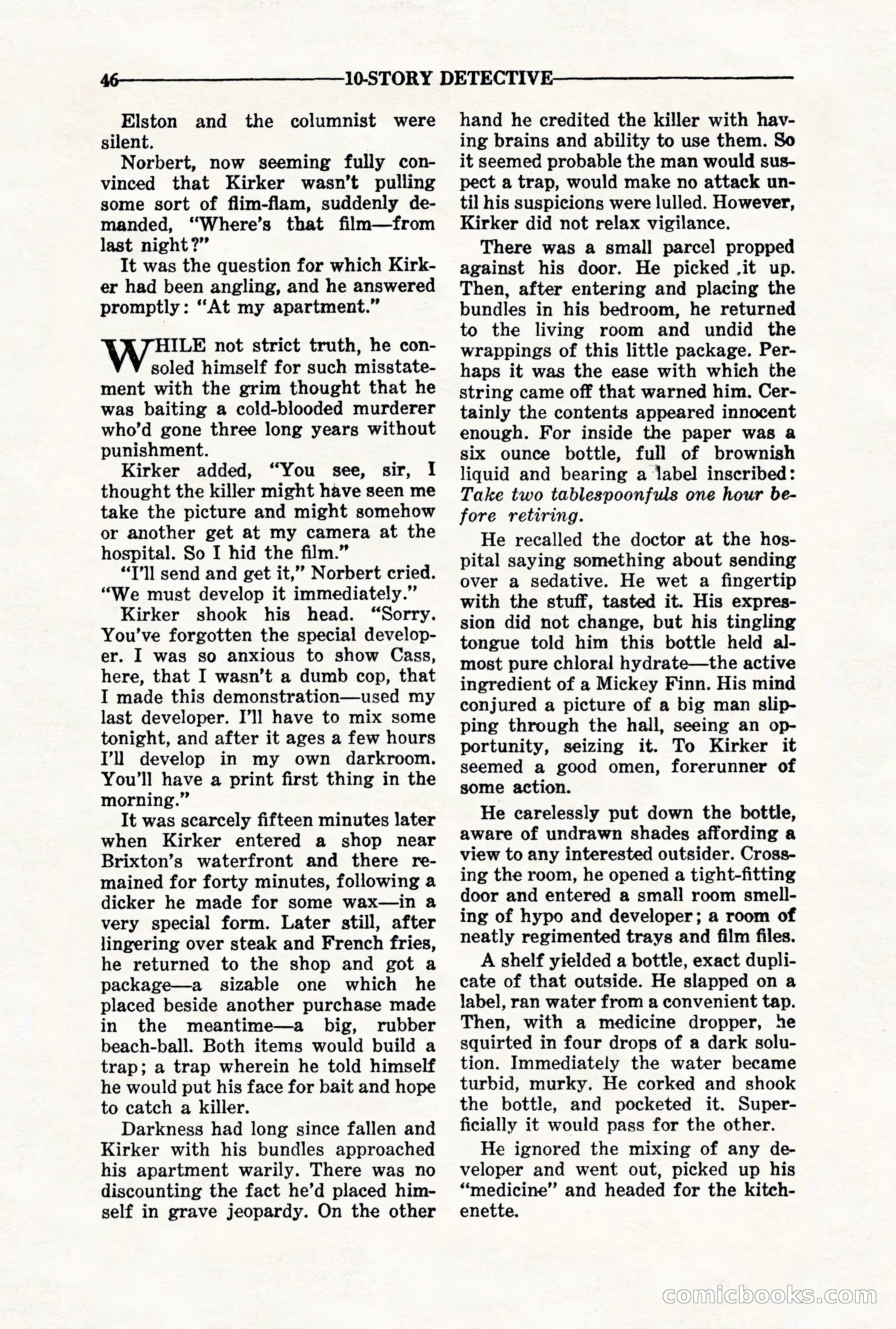
A restored page from Pulp Fiction, 1942. Page through the whole issue in the reader above.
📄 Transcribed text from this page (OCR, searchable)
Machine-transcribed from the original scan — historical spelling and the odd misread are preserved.
46-—__—_————_—_—_—————_10-STORY DETECTIVE————_———_—_— Elston and the columnist were silent. : Norbert, now seeming fully con- vinced that Kirker wasn’t pulling some sort of flim-flam, suddenly de- manded, “Where’s that film—from last night?’ It was the question for which Kirk- er had been angling, and he answered promptly: “At my apartment.” HILE not strict truth, he con- soled himself for such misstate- ment with the grim thought that he was baiting a cold-blooded murderer who’d gone three long years without punishment. Kirker added, “You see, sir, I thought the killer might have seen me take the picture and might somehow or another get at my camera at the hospital. So I hid the film.” “T’ll send and get it,” Norbert cried. “We must develop it immediately.” Kirker shook his head. “Sorry. You’ve forgotten the special develop- er. I was so anxious to show Cass, here, that I wasn’t a dumb cop, that I made this demonstration—used my last developer. I’]] have to mix some tonight, and after it ages a few hours l’ll develop in my own darkroom. You’ll have a print first thing in the morning.” It was scarcely fifteen minutes later when Kirker entered a shop near Brixton’s waterfront and there re- mained for forty minutes, following a dicker he made for some wax—in a very special form. Later still, after lingering over steak and French fries, he returned to the shop and got a package—a _ sizable one which he placed beside another purchase made in the meantime—a big, rubber beach-ball. Both items would build a trap; a trap wherein he told himself he would put his face for bait and hope to catch a killer. Darkness had long since fallen and Kirker with his bundles approached his apartment warily. There was no discounting the fact he’d placed him- self in grave jeopardy. On the other hand he credited the killer with hav- ing brains and ability to use them. So it seemed probable the man would sus- pect a trap, would make no attack un- til his suspicions were lulled. However, Kirker did not relax vigilance. There was a small parcel propped against his door. He picked ,it up. Then, after entering and placing the bundles in his bedroom, he returned to the living room and undid the wrappings of this little package. Per- haps it was the ease with which the string came off that warned him. Cer- tainly the contents appeared innocent enough. For inside the paper was a six ounce bottle, full of brownish liquid and bearing a label inscribed: Take two tablespoonfuls one hour be- fore retiring. He recalled the doctor at the hos- pital saying something about sending over a sedative. He wet a fingertip with the stuff, tasted it. His expres- sion did not change, but his tingling tongue told him this bottle held al- most pure chloral hydrate—the active ingredient of a Mickey Finn. His mind conjured a picture of a big man slip- ping through the hall, seeing an op- portunity, seizing it. To Kirker it seemed a good omen, forerunner of some action. He carelessly put down the bottle, aware of undrawn shades affording a view to any interested outsider. Cross- ing the room, he opened a tight-fitting door and entered a small room smell- ing of hypo and developer; a room of neatly regimented trays and film files. A shelf yielded a bottle, exact dupli- cate of that outside. He slapped on a label, ran water from a convenient tap. Then, with a medicine dropper, he squirted in four drops of a dark solu- tion. Immediately the water became turbid, murky. He corked and shook the bottle, and pocketed it. Super- ficially it would pass for the other. He ignored the mixing of any de- veloper and went out, picked up his “medicine” and headed for the kitch- enette. cConmiclbool (C© S|