
Pulp Fiction, 1942 · page 47 of 116
10-Story Detective, November 1942 — page 47: what you’re looking at
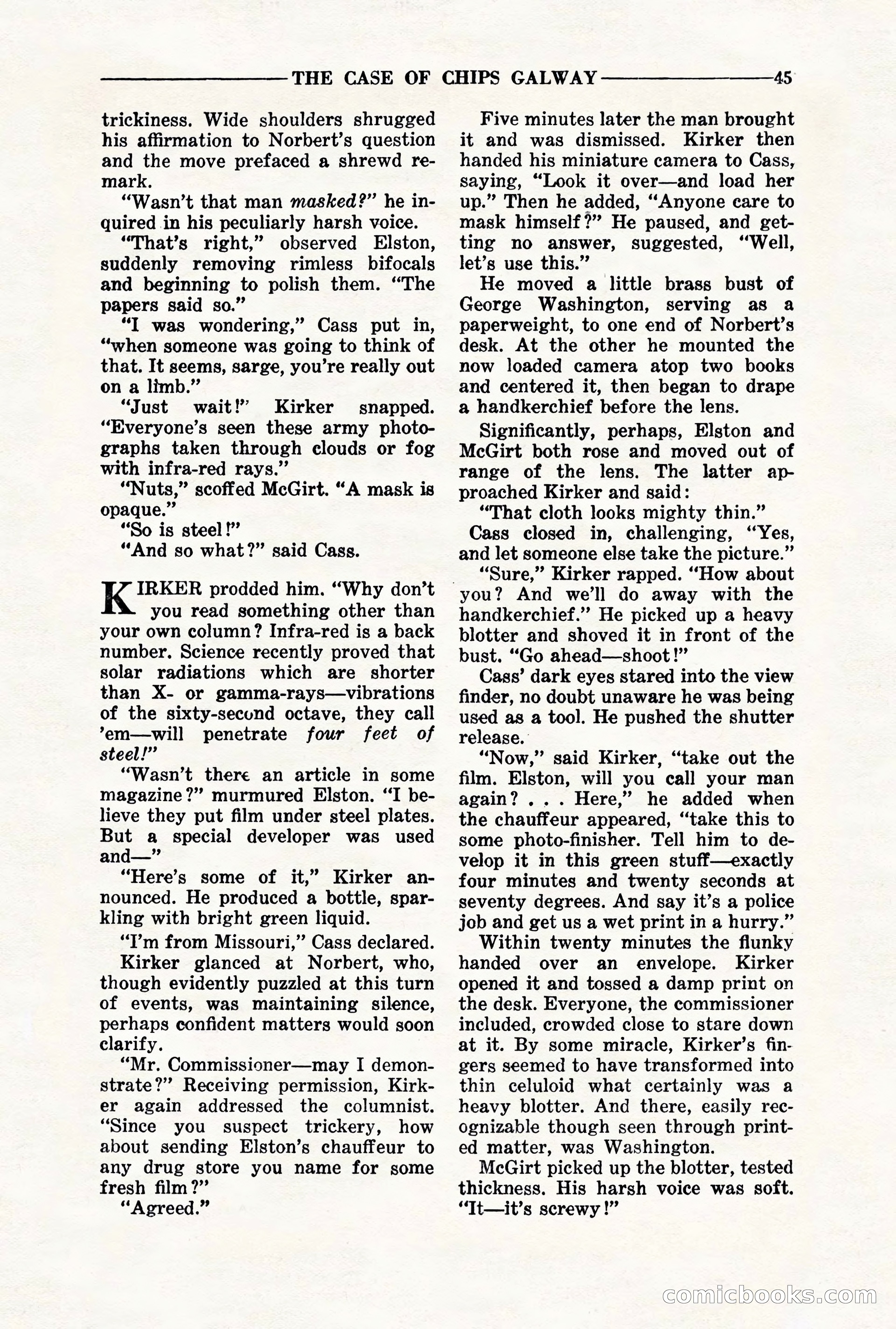
A restored page from Pulp Fiction, 1942. Page through the whole issue in the reader above.
📄 Transcribed text from this page (OCR, searchable)
Machine-transcribed from the original scan — historical spelling and the odd misread are preserved.
THE CASE OF CHIPS GALWAY trickiness. Wide shoulders shrugged his affirmation to Norbert’s question and the move prefaced a shrewd re- mark. “Wasn’t that man masked?” he in- quired in his peculiarly harsh voice. “That’s right,” observed Elston, suddenly removing rimless bifocals and beginning to polish them. “The papers said so.” “I was wondering,” Cass put in, “when someone was going to think of that. It seems, sarge, you’re really out on a limb.” “Just wait! Kirker snapped. “Everyone’s seen these army photo- graphs taken through clouds or fog with infra-red rays.” “Nuts,” scoffed McGirt. “A mask is opaque.” “So is steel!” “And so what?” said Cass. IRKER prodded him. “Why don’t you read something other than your own column? Infra-red is a back number. Science recently proved that solar radiations which are shorter than X- or gamma-rays—vibrations of the sixty-second octave, they call ’em—will penetrate four feet of steel!” “Wasn’t there an article in some magazine?” murmured Elston. “I be- lieve they put film under steel plates. But a special developer was used and—” “Here’s some of it,” Kirker an- nounced. He produced a bottle, spar- kling with bright green liquid. “I’m from Missouri,” Cass declared. Kirker glanced at Norbert, who, though evidently puzzled at this turn of events, was maintaining silence, perhaps confident matters would soon clarify. “Mr. Commissioner—may I demon- strate?” Receiving permission, Kirk- er again addressed the columnist. “Since you suspect trickery, how about sending Elston’s chauffeur to any drug store you name for some fresh film?” “Agreed.” 45 Five minutes later the man brought it and was dismissed. Kirker then handed his miniature camera to Cass, saying, “Look it over—and load her up.” Then he added, ‘‘Anyone eare to mask himself?” He paused, and get- ting no answer, suggested, ‘Well, let’s use this.” He moved a little brass bust of George Washington, serving as a paperweight, to one end of Norbert’s desk. At the other he mounted the now loaded camera atop two books and centered it, then began to drape a handkerchief before the lens. Significantly, perhaps, Elston and McGirt both rose and moved out of range of the lens. The latter ap- proached Kirker and said: “That cloth looks mighty thin.” Cass closed in, challenging, ‘Yes, and let someone else take the picture.” “Sure,” Kirker rapped. ‘““How about you? And we’ll do away with the handkerchief.’ He picked up a heavy blotter and shoved it in front of the bust. “Go ahead—shoot!” Cass’ dark eyes stared into the view finder, no doubt unaware he was being used as a tool. He pushed the shutter release. “Now,” said Kirker, “take out the film. Elston, will you call your man again? ... Here,” he added when the chauffeur appeared, “take this to some photo-finisher. Tell him to de- velop it in this green stuff—exactly four minutes and twenty seconds at seventy degrees. And say it’s a police job and get us a wet print in a hurry.” Within twenty minutes the flunky handed over an envelope. Kirker opened it and tossed a damp print on the desk. Everyone, the commissioner included, crowded close to stare down at it. By some miracle, Kirker’s fin- gers seemed to have transformed into thin celuloid what certainly was a heavy blotter. And there, easily rec- ognizable though seen through print- ed matter, was Washington. McGirt picked up the blotter, tested thickness. His harsh voice was soft. “It— it’s screwy!” DOOLK C©