
Pulp Fiction, 1941 · page 55 of 114
10-Story Detective, September 1941 — page 55: what you’re looking at
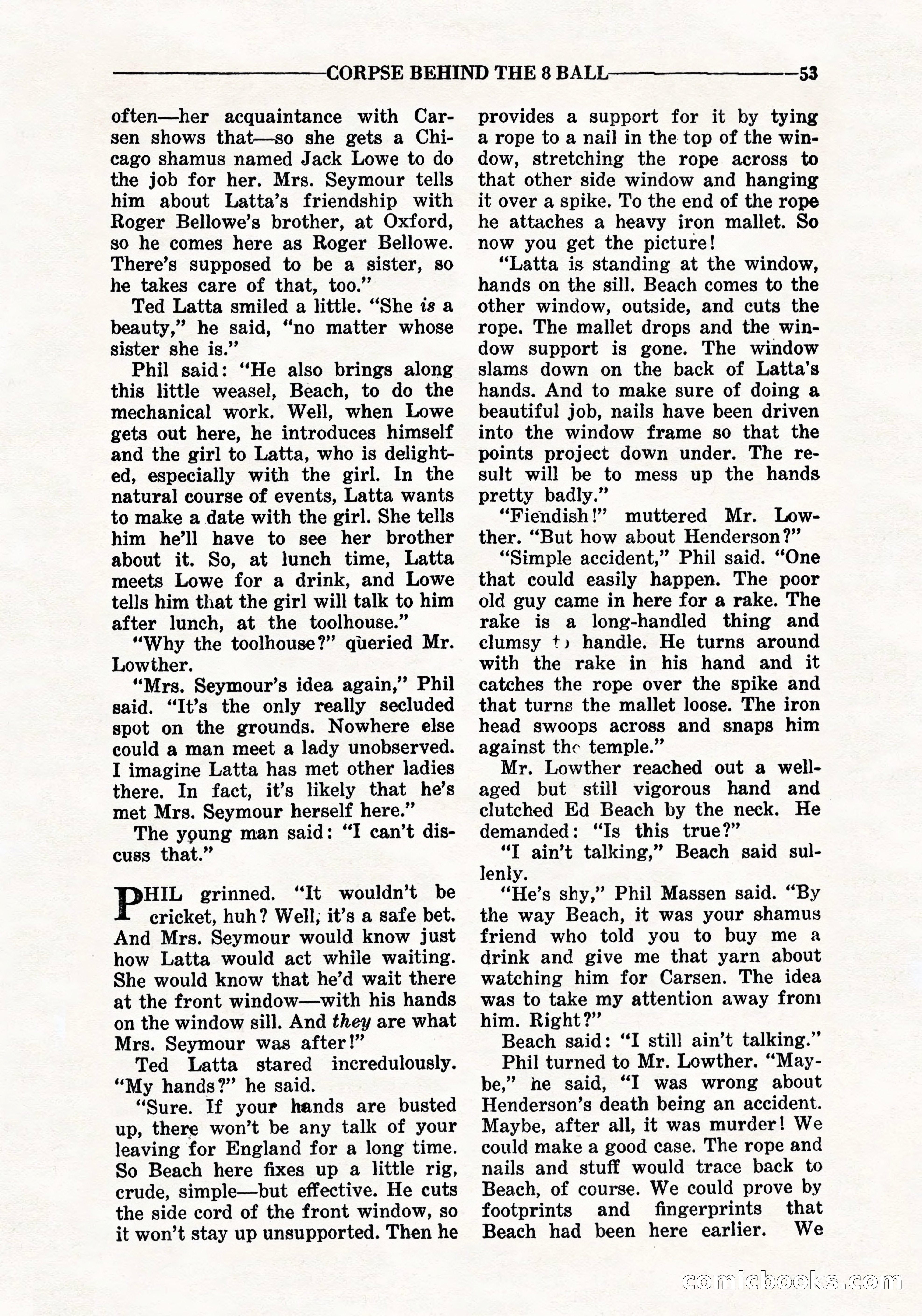
A restored page from Pulp Fiction, 1941. Page through the whole issue in the reader above.
📄 Transcribed text from this page (OCR, searchable)
Machine-transcribed from the original scan — historical spelling and the odd misread are preserved.
—_—_—_——_———_———_CORPSE BEHIND THE 8 BALL often—her acquaintance with Car- sen shows that—so she gets a Chi- cago shamus named Jack Lowe to do the job for her. Mrs. Seymour tells him about Latta’s friendship with Roger Bellowe’s brother, at Oxford, so he comes here as Roger Bellowe. There’s supposed to be a sister, so he takes care of that, too.” Ted Latta smiled a little. “She is a beauty,” he said, “no matter whose sister she is.” Phil said: “He also brings along this little weasel, Beach, to do the mechanical work. Well, when Lowe gets out here, he introduces himself and the girl to Latta, who is delight- ed, especially with the girl. In the natural course of events, Latta wants to make a date with the girl. She tells him he’ll have to see her brother about it. So, at lunch time, Latta meets Lowe for a drink, and Lowe tells him that the girl will talk to him after lunch, at the toolhouse.” “Why the toolhouse?’” queried Mr. Lowther. “Mrs. Seymour’s idea again,” Phil said. “It’s the only really secluded spot on the grounds. Nowhere else could a man meet a lady unobserved. I imagine Latta has met other ladies there. In fact, it’s likely that he’s met Mrs. Seymour herself here.” The young man said: “I can’t dis- cuss that.” HIL grinned. “It wouldn’t be cricket, huh? Well; it’s a safe bet. And Mrs. Seymour would know just how Latta would act while waiting. She would know that he’d wait there at the front window—with his hands on the window sill. And they are what Mrs. Seymour was after!” Ted Latta stared incredulously. “My hands?” he said. “Sure. If your hands are busted up, there won’t be any talk of your leaving for England for a long time. So Beach here fixes up a little rig, crude, simple—but effective. He cuts the side cord of the front window, so it won’t stay up unsupported. Then he —53 provides a support for it by tying a rope to a nail in the top of the win- dow, stretching the rope across to that other side window and hanging it over a spike. To the end of the rope he attaches a heavy iron mallet. So now you get the picture! “Latta is standing at the window, hands on the sill. Beach comes to the other window, outside, and cuts the rope. The mallet drops and the win- dow support is gone. The window slams down on the back of Latta’s hands. And to make sure of doing a beautiful job, nails have been driven into the window frame so that the points project down under. The re- sult will be to mess up the hands pretty badly.” “Fiendish!’ muttered Mr. Low- ther. “But how about Henderson?” “Simple accident,” Phil said. “One that could easily happen. The poor old guy came in here for a rake. The rake is a long-handled thing and clumsy +» handle. He turns around with the rake in his hand and it catches the rope over the spike and that turns the mallet loose. The iron head swoops across and snaps him against the temple.” Mr. Lowther reached out a well- aged but still vigorous hand and clutched Ed Beach by the neck. He demanded: “Is this true?” “I ain’t talking,” Beach said sul- lenly. “He’s shy,” Phil Massen said. “By the way Beach, it was your shamus friend who told you to buy me a drink and give me that yarn about watching him for Carsen. The idea was to take my attention away from him. Right?” Beach said: “I still ain’t talking.” Phil turned to Mr. Lowther. “May- be,” he said, “I was wrong about Henderson’s death being an accident. Maybe, after all, it was murder! We could make a good case. The rope and nails and stuff would trace back to Beach, of course. We could prove by footprints and fingerprints that Beach had been here earlier. We COMICOO® <) ©