
Pulp Fiction, 1941 · page 54 of 114
10-Story Detective, September 1941 — page 54: what you’re looking at
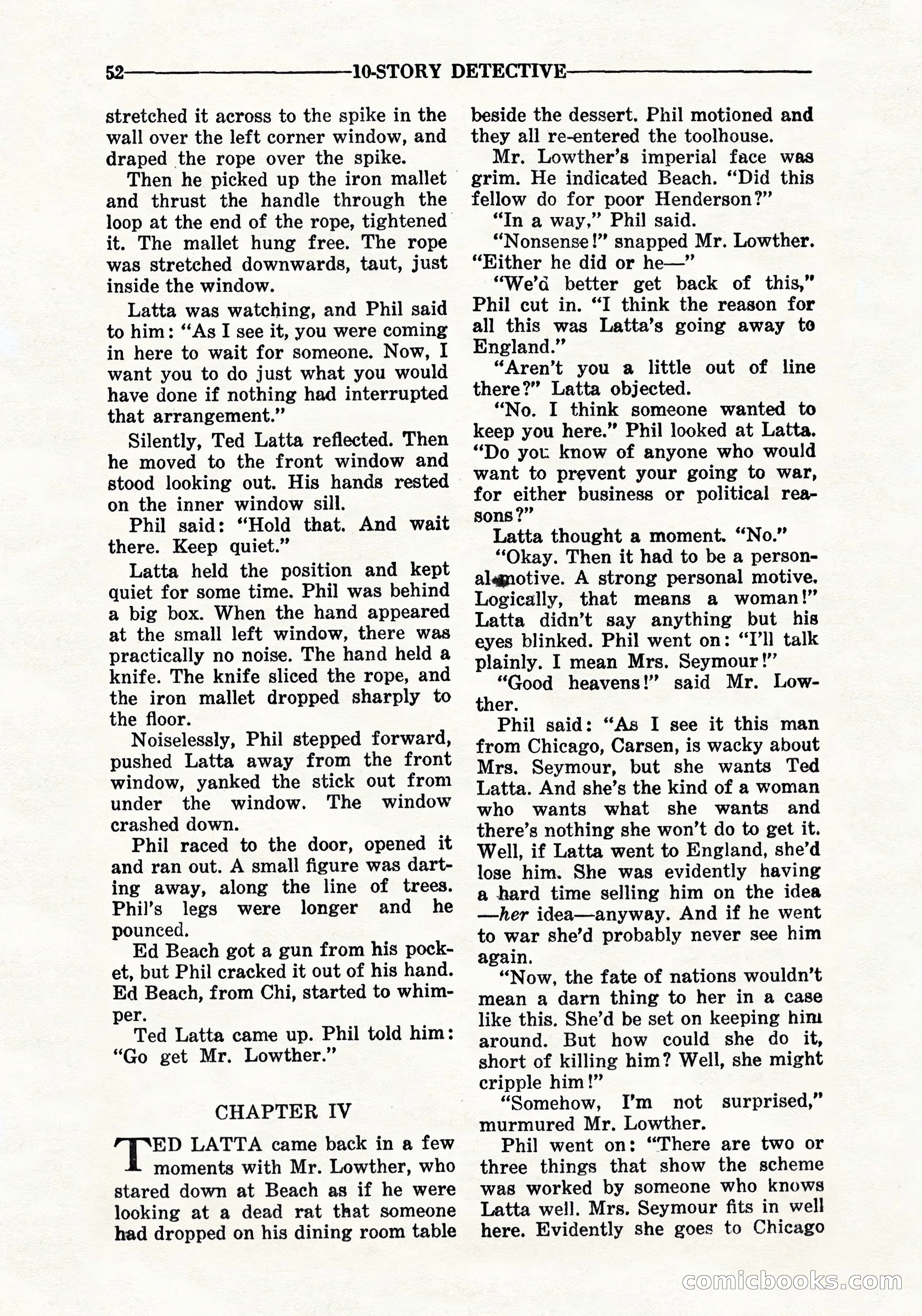
A restored page from Pulp Fiction, 1941. Page through the whole issue in the reader above.
📄 Transcribed text from this page (OCR, searchable)
Machine-transcribed from the original scan — historical spelling and the odd misread are preserved.
52 stretched it across to the spike in the wall over the left corner window, and draped the rope over the spike. Then he picked up the iron mallet — and thrust the handle through the loop at the end of the rope, tightened it. The mallet hung free. The rope was stretched downwards, taut, just inside the window. Latta was watching, and Phil said to him: ‘‘As I see it, you were coming in here to wait for someone. Now, I want you to do just what you would have done if nothing had interrupted that arrangement.” Silently, Ted Latta reflected. Then he moved to the front window and stood looking out. His hands rested on the inner window sill. Phil said: “Hold that. And wait there. Keep quiet.” Latta held the position and kept quiet for some time. Phil was behind a big box. When the hand appeared at the small left window, there was practically no noise. The hand held a knife. The knife sliced the rope, and the iron mallet dropped sharply to the floor. Noiselessly, Phil stepped forward, pushed Latta away from the front window, yanked the stick out from under the window. The window crashed down. Phil raced to the door, opened it and ran out. A small figure was dart- ing away, along the line of trees. Phil’s legs were longer and he pounced. Ed Beach got a gun from his pock- et, but Phil cracked it out of his hand. Ed Beach, from Chi, started to whim- per. Ted Latta came up. Phil told him: “Go get Mr. Lowther.” CHAPTER IV ED LATTA came back in a few moments with Mr. Lowther, who stared down at Beach as if he were looking at a dead rat that someone had dropped on his dining room table 10-STORY DETECTIVE beside the dessert. Phil motioned and they all re-entered the toolhouse. Mr. Lowther’s imperial face was grim. He indicated Beach. ‘‘Did this fellow do for poor Henderson?” “In a way,” Phil said. “Nonsense!” snapped Mr. Lowther. “Hither he did or he—”’ “We'd better get back of this,” Phil cut in. “I think the reason for all this was Latta’s going away to England.” “Aren’t you a little out of line there?” Latta objected. “No. I think someone wanted to keep you here.” Phil looked at Latta. “Do you. know of anyone who would want to prevent your going to war, for either business or political rea- sons?” Latta thought a moment. “No.” “Okay. Then it had to be a person- alanotive. A strong personal motive. Logically, that means a woman!” Latta didn’t say anything but his eyes blinked. Phil went on: “Ill talk plainly. I mean Mrs. Seymour!” “Good heavens!’ said Mr. Low- ther. Phil said: “As I see it this man from Chicago, Carsen, is wacky about Mrs. Seymour, but she wants Ted Latta. And she’s the kind of a woman who wants what she wants and there’s nothing she won’t do to get it. Well, if Latta went to England, she’d lose him. She was evidently having a hard time selling him on the idea —her idea—anyway. And if he went to war she’d probably never see him again. “Now, the fate of nations wouldn’t mean a darn thing to her in a case like this. She’d be set on keeping him around. But how could she do it, short of killing him? Well, she might cripple him!” “Somehow, I’m not surprised,” murmured Mr. Lowther. Phil went on: “There are two or three things that show the scheme was worked by someone who knows Latta well. Mrs. Seymour fits in well here. Evidently she goes to Chicago COMICOO® S (©