
Pulp Fiction, 1941 · page 15 of 114
10-Story Detective, September 1941 — page 15: what you’re looking at
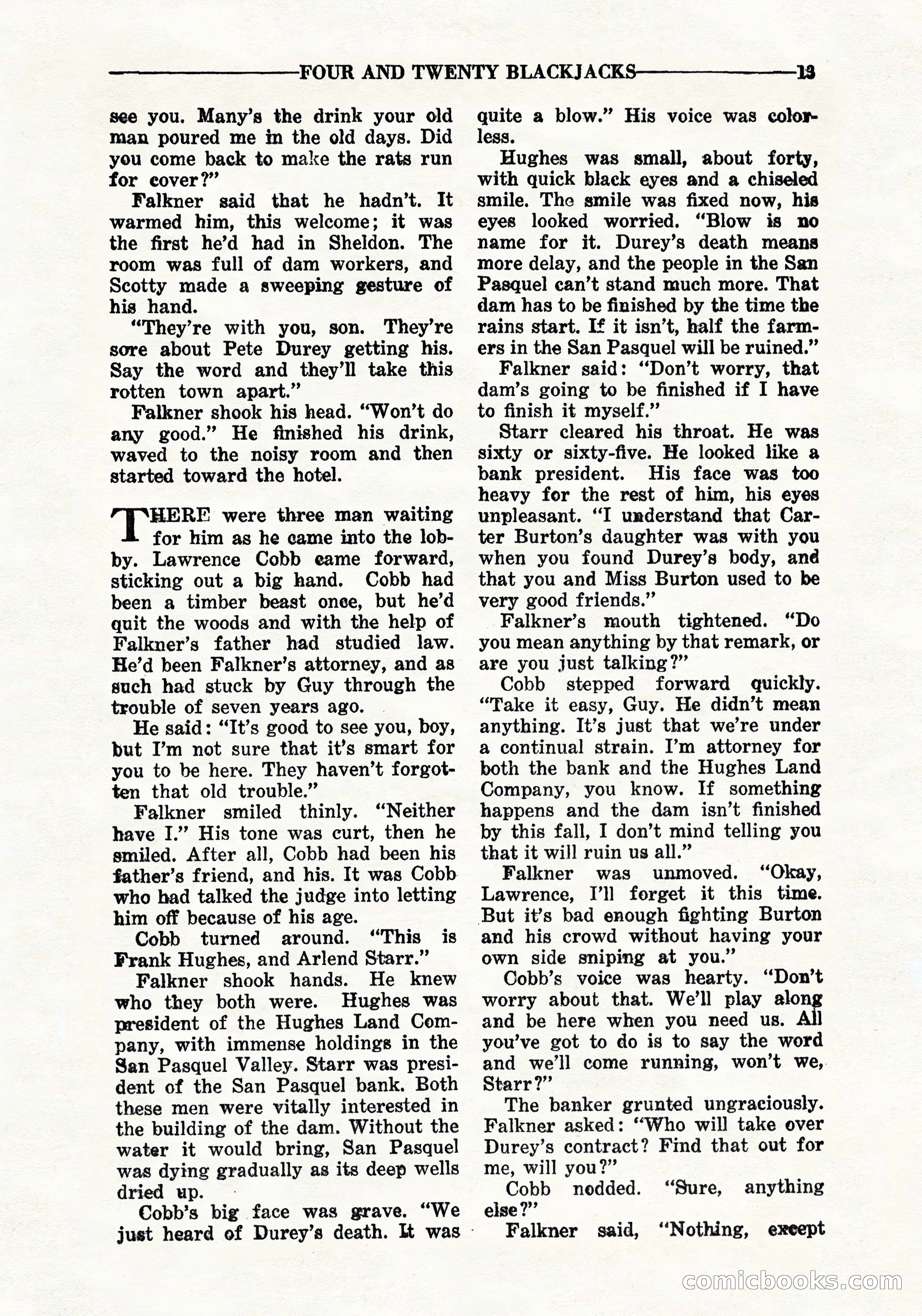
A restored page from Pulp Fiction, 1941. Page through the whole issue in the reader above.
📄 Transcribed text from this page (OCR, searchable)
Machine-transcribed from the original scan — historical spelling and the odd misread are preserved.
FOUR AND TWENTY BLACKJACKS——————————13 see you. Many’s the drink your old man poured me m the old days. Did you come back to make the rats run for cover?” Falkner said that he hadn’t. It warmed him, this welcome; it was the first he’d had in Sheldon. The room was full of dam workers, and Scotty made a sweeping gesture of his hand. “They’re with you, son. They’re sore about Pete Durey getting his. Say the word and they’ll take this rotten town apart.” Falkner shook his head. “Won’t do any good.” He finished his drink, waved to the noisy room and then started toward the hotel. HERE were three man waiting for him as he came into the lob- by. Lawrence Cobb eame forward, sticking out a big hand. Cobb had been a timber beast onee, but he’d quit the woods and with the help of Falkner’s father had studied law. He’d been Falkner’s attorney, and as such had stuck by Guy through the trouble of seven years ago. He said: “It’s good to see you, boy, but I’m not sure that it’s smart for you to be here. They haven’t forgot- ten that old trouble.” Falkner smiled thinly. “Neither have IJ.”’ His tone was curt, then he smiled. After all, Cobb had been his father’s friend, and his. It was Cobb who had talked the judge into letting him off because of his age. Cobb turned around. “This is Frank Hughes, and Arlend Starr.” Falkner shook hands. He knew who they both were. Hughes was president of the Hughes Land Com- pany, with immense holdings in the San Pasquel Valley. Starr was presi- dent of the San Pasquel bank. Both these men were vitally interested in the building of the dam. Without the water it would bring, San Pasquel was dying gradually as its deep wells dried up. Cobb’s big face was grave. “We just heard of Durey’s death. It was - quite a blow.” His voice was color- less. Hughes was small, about forty, with quick black eyes and a chiseled smile. The smile was fixed now, his eyes looked worried. “Blow is no name for it. Durey’s death means more delay, and the people in the San Pasquel can’t stand much more. That dam has to be finished by the time the rains start. If it isn’t, half the farm- ers in the San Pasquel will be ruined.” Falkner said: “Don’t worry, that dam’s going to be finished if I have to finish it myself.” Starr cleared his throat. He was sixty or sixty-five. He looked like a bank president. His face was too heavy for the rest of him, his eyes unpleasant. “I understand that Car- ter Burton’s daughter was with you when you found Durey’s body, and that you and Miss Burton used to be very good friends.” Falkner’s mouth tightened. ‘Do you mean anything by that remark, or are you just talking?” Cobb stepped forward quickly. “Fake it easy, Guy. He didn’t mean anything. It’s just that we’re under a continual strain. I’m attorney for both the bank and the Hughes Land Company, you know. If something happens and the dam isn’t finished by this fall, I don’t mind telling you that it will ruin us all.” Falkner was unmoved. “Okay, Lawrence, I’ll forget it this time. But it’s bad enough fighting Burton and his crowd without having your own side sniping at you.” Cobb’s voice was hearty. “Don’t worry about that. We'll play alon and be here when you need us. All you’ve got to do is to say the word and we’ll come running, won’t we, Starr?” The banker grunted ungraciously. Falkner asked: “Who will take over Durey’s contract? Fimd that out for me, will you?” Cobb nodded. “Sure, anything else ?”’ Falkner said, ‘Nothing, exeept COMICOOO® S (©