
Pulp Fiction, 1941 · page 14 of 114
10-Story Detective, September 1941 — page 14: what you’re looking at
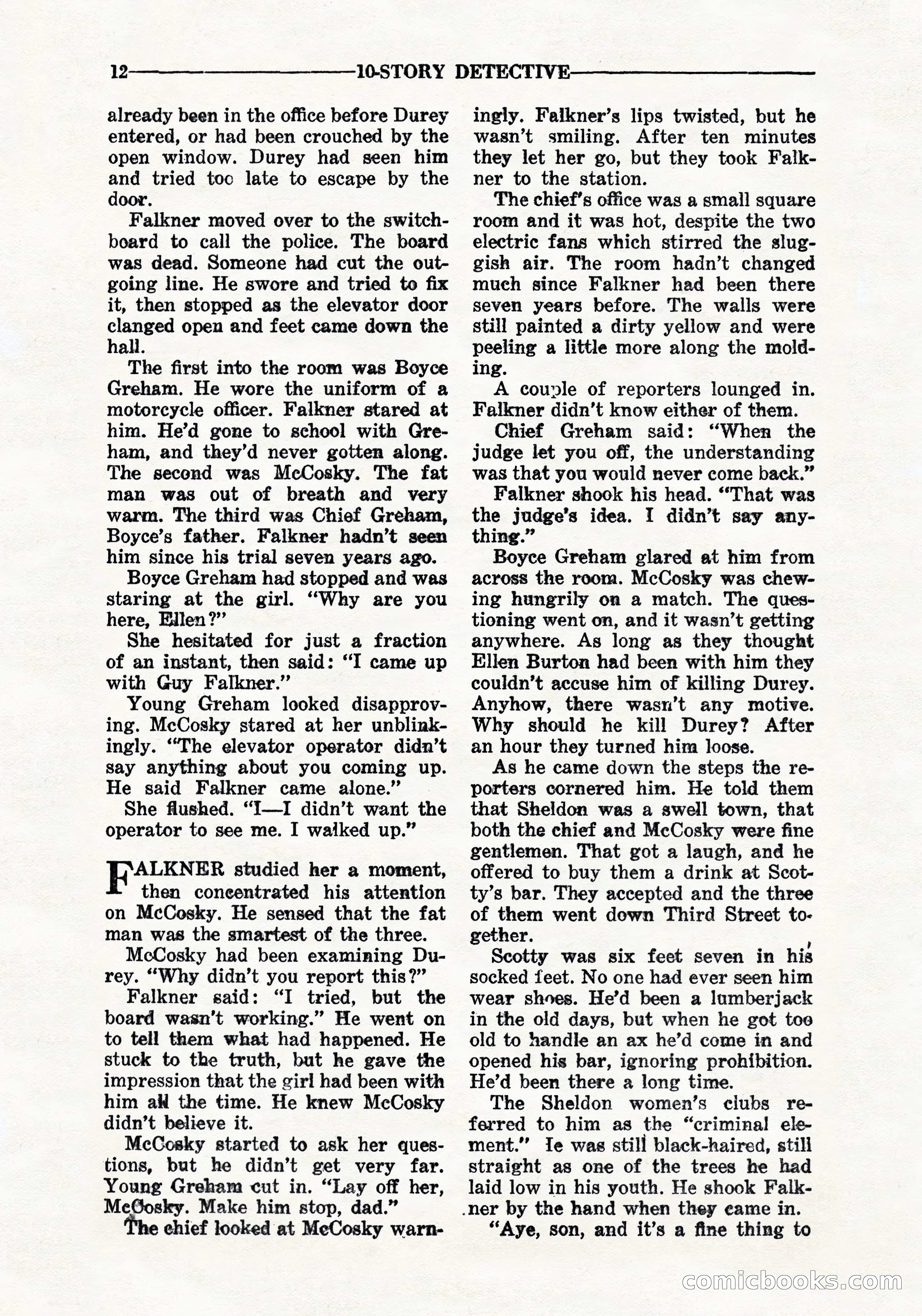
A restored page from Pulp Fiction, 1941. Page through the whole issue in the reader above.
📄 Transcribed text from this page (OCR, searchable)
Machine-transcribed from the original scan — historical spelling and the odd misread are preserved.
= already been in the office before Durey entered, or had been crouched by the open window. Durey had seen him and tried too late to escape by the door. Falkner moved over to the switch- board to call the police. The board was dead. Someone had cut the out- going line. He swore and tried to fix it, then stopped as the elevator door clanged open and feet came down the hall. The first into the room was Boyce Greham. He wore the uniform of a motorcycle officer. Falkner stared at him. He’d gone to school with Gre- ham, and they’d never gotten along. The second was McCosky. The fat man was out of breath and very warm. The third was Chief Greham, Boyce’s father. Falkner hadn’t seen him since his trial seven years ago. Boyce Greham had stopped and was staring at the girl. “Why are you here, Eien?” She hesitated for just a fraction of an instant, then said: “I came up with Guy Falkner.” Young Greham looked disapprov- ing. McCosky stared at her unblink- ingly. ‘The elevator operator didn’t say anything about you coming up. He said Falkner came alone.” She flushed. “I—I didn’t want the operator to see me. I walked up.” ALKNER studied her a moment, then coneentrated his attention on McCosky. He sensed that the fat man was the smartest of the three. McCosky had been examining Du- rey. “Why didn’t you report this?” Falkner said: “I tried, but the board wasn’t working.” He went on to tell them what had happened. He stuck to the truth, but he gave the impression that the girl had been with him all the time. He knew McCosky didn’t believe it. McCosky started to ask her ques- tions, but he didn’t get very far. Young Greham cut in. “Lay off her, McGosky. Make him stop, dad.” chief looked at MeCosky warn- 10-STORY DETECTIVE— ingly. Falkner’s lips twisted, but he wasn’t smiling. After ten minutes they let her go, but they took Falk- ner to the station. The chief's office was a small square room and it was hot, despite the two electric fans which stirred the slug- gish air. The room hadn’t changed mueh since Falkner had been there seven years before. The walls were still painted a dirty yellow and were peeling a little more along the mold- ing. A counvle of reporters lounged in. Falkner didn’t know either of them. Chief Greham said: “When the judge let you off, the understanding was that you would never come back.” Falkner shook his head. “‘That was the judge’s idea. I didn’t say any- thing.” Boyce Greham glared at him from across the room. McCosky was chew- ing hungrily on a match. The ques- tioning went on, and it wasn’t getting anywhere. As long as they thought Ellen Burton had been with him they couldn’t accuse him of killing Durey. Anyhow, there wasn’t any motive. Why should he kill Durey? After an hour they turned him loose. As he came down the steps the re- porters cornered him. He told them that Sheldon was a swell town, that both the chief and McCosky were fine gentlemen. That got a laugh, and he offered to buy them a drink at Scot- ty’s bar. They accepted and the three of them went down Third Street to- gether. Scotty was six feet seven in his socked feet. No one had ever seen him wear shoes. He’d been a lumberjack in the old days, but when he got toe old to handle an ax he’d come in and opened his bar, ignoring prohibition. He’d been there a long time. The Sheldon women’s ciubs re- ferred to him as the “criminal ele- ment.” Ie was still black-haired, still straight as one of the trees he had laid low in his youth. He shook Falk- -ner by the hand when they eame in. “‘Aye, son, and it’s a fine thing to COMM Giook ©