
Pulp Fiction, 1941 · page 11 of 114
10-Story Detective, September 1941 — page 11: what you’re looking at
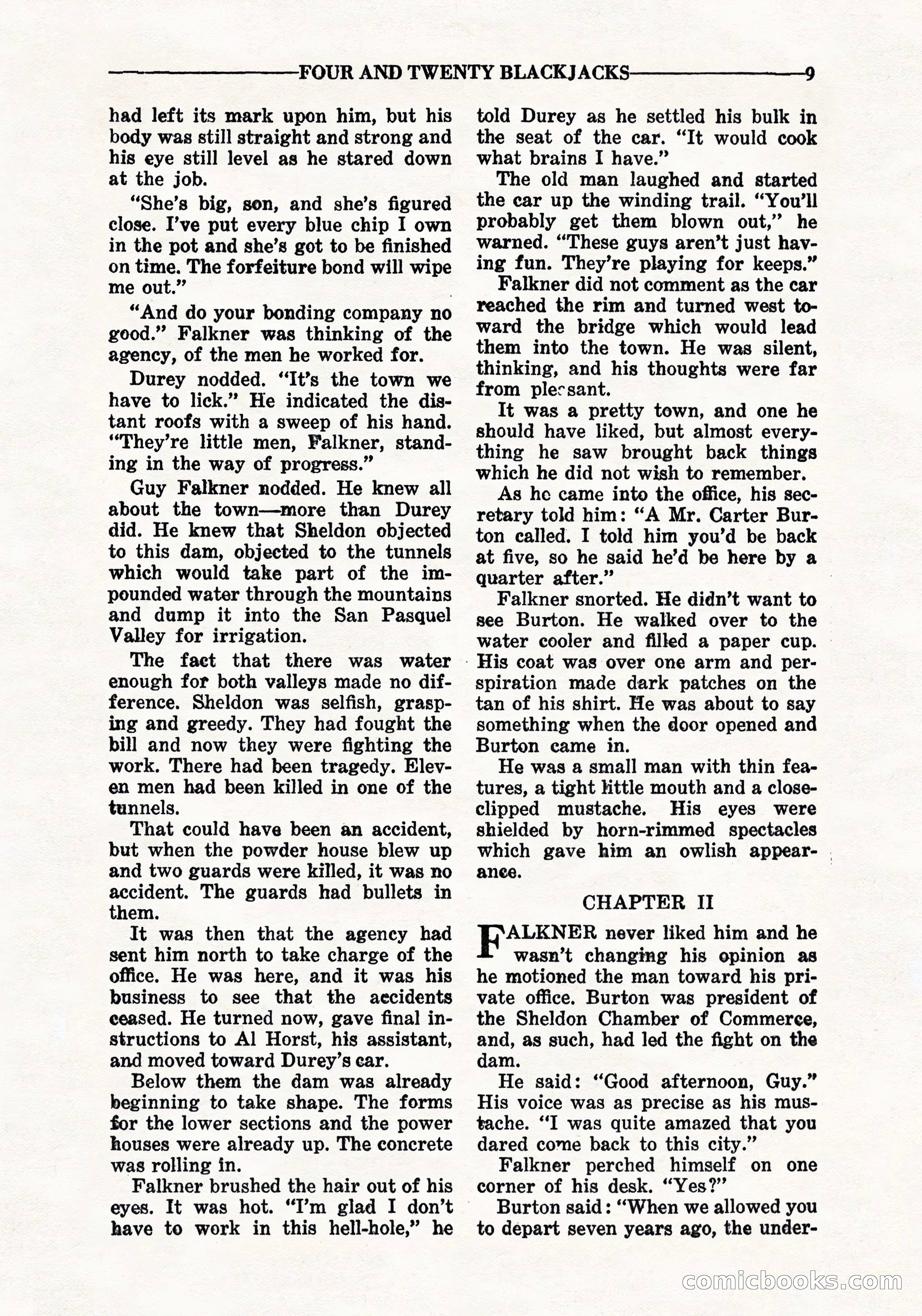
A restored page from Pulp Fiction, 1941. Page through the whole issue in the reader above.
📄 Transcribed text from this page (OCR, searchable)
Machine-transcribed from the original scan — historical spelling and the odd misread are preserved.
FOUR AND TWENTY BLACK] ACKS——————————_9 had left its mark upon him, but his body was still straight and strong and his eye still level as he stared down at the job. “She’s big, son, and she’s figured close. I’ve put every blue chip I own in the pot and she’s got to be finished on time. The forfeiture bond will wipe me out.” . “And do your bonding company no good.” Falkner was thinking of the agency, of the men he worked for. Durey nodded. “It’s the town we have to lick.” He indicated the dis- tant roofs with a sweep of his hand. “They’re little men, Falkner, stand- ing in the way of progress.” Guy Falkner nodded. He knew all about the town—more than Durey did. He knew that Sheldon objected to this dam, objected to the tunnels which would take part of the im- pounded water through the mountains and dump it into the San Pasquel Valley for irrigation. The facet that there was water enough for both valleys made no dif- ference. Sheldon was selfish, grasp- ing and greedy. They had fought the bill and now they were fighting the work. There had been tragedy. Elev- en men had been killed in one of the tunnels. That could have been an accident, but when the powder house blew up and two guards were killed, it was no accident. The guards had bullets in them. It was then that the agency had sent him north to take charge of the office. He was here, and it was his business to see that the accidents ceased. He turned now, gave final in- structions to Al Horst, his assistant, and moved toward Durey’s car. Below them the dam was already beginning to take shape. The forms for the lower sections and the power houses were already up. The concrete was rolling in. Falkner brushed the hair out of his eyes. It was hot. “I’m glad I don’t have to work in this hell-hole,” he told Durey as he settled his bulk in the seat of the car. “It would cook what brains I have.” The old man laughed and started the car up the winding trail. “You’ll probably get them blown out,” he warned. “These guys aren’t just hav- ing fun. They’re playing for keeps.” Falkner did not comment as the car reached the rim and turned west to- ward the bridge which would lead them into the town. He was silent, thinking, and his thoughts were far from plessant. It was a pretty town, and one he should have liked, but almost every- thing he saw brought back things which he did not wish to remember. As he came into the office, his sec- retary told him: “A Mr. Carter Bur- ton called. I told him you’d be back at five, so he said he’d be here by a quarter after.” Falkner snorted. He didn’t want to see Burton. He walked over to the water cooler and filled a paper cup. — - His coat was over One arm and per- spiration made dark patches on the tan of his shirt. He was about to say something when the door opened and Burton came in. He was a small man with thin fea- tures, a tight Hittle mouth and a close- clipped mustache. His eyes were shielded by horn-rimmed spectacles which gave him an owlish appear- . ance. CHAPTER II ALKNER never liked him and he wasn’t changing his opinion as he motioned the man toward his pri- vate office. Burton was president of the Sheldon Chamber of Commerce, and, as such, had led the fight on the dam. He said: “Good afternoon, Guy.” His voice was as precise as his mus- tache. “I was quite amazed that you dared come back to this city.” Falkner perched himself on one corner of his desk. “Yes?” Burton said: “When we allowed you to depart seven years ago, the under- COMICOOO® cS CO