
Pulp Fiction, 1941 · page 10 of 114
10-Story Detective, September 1941 — page 10: what you’re looking at
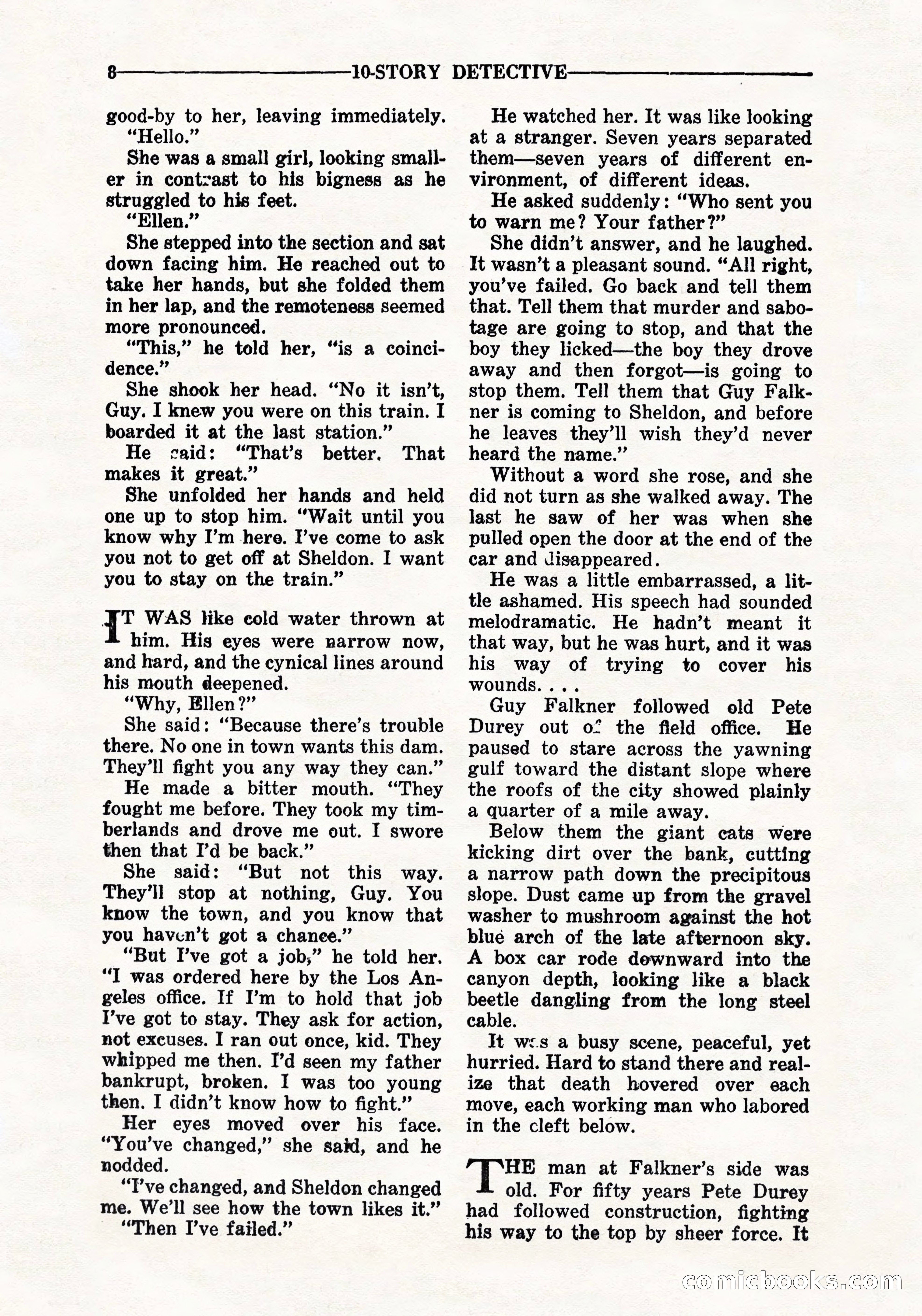
A restored page from Pulp Fiction, 1941. Page through the whole issue in the reader above.
📄 Transcribed text from this page (OCR, searchable)
Machine-transcribed from the original scan — historical spelling and the odd misread are preserved.
§—____—_—_—_—_——————-10-STORY DETECTIVE good-by to her, leaving immediately. “Hello.” She was a small girl, looking small- er in contzast to his bigness as he struggled to his feet. “Ellen.” She stepped into the section and sat down facing him. He reached out to take her hands, but she folded them in her lap, and the remoteness seemed more pronounced. “This,” he told her, “is a coinci- dence.” She shook her head. “No it isn’t, Guy. I knew you were on this train. I boarded it at the last station.” He vaid: “That’s better. makes it great.” She unfolded her hands and held one up to stop him. “Wait until you know why I’m here. I’ve come to ask you not to get off at Sheldon. I want you to stay on the train.” AT WAS like cold water thrown. at him. His eyes were narrow now, and hard, and the cynical lines around his mouth deepened. “Why, Ellen?” She said: ‘Because there’s trouble there. No one in town wants this dam. They’ll fight you any way they can.” He made a bitter mouth. ‘They fought me before. They took my tim- berlands and drove me out. I swore then that I’d be back.” She said: “But not this way. They’ll stop at nothing, Guy. You know the town, and you know that you haven’t got a chanee.”’ “But F’ve got a job,” he told her. “I was ordered here by the Los An- geles office. If I’m to hold that job I’ve got to stay. They ask for action, not excuses. I ran out once, kid. They whipped me then. I’d seen my father bankrupt, broken. I was too young then. I didn’t know how to fight.” Her eyes moved over his face. “You’ve changed,” she said, and he nodded. “T’ve changed, and Sheldon changed me. We’ll see how the town likes it.” “Then I’ve failed.” That He watched her. It was like looking at a stranger. Seven years separated them—seven years of different en- vironment, of different ideas. He asked suddenly: “Who sent you to warn me? Your father?” She didn’t answer, and he laughed. It wasn’t a pleasant sound. “All right, you’ve failed. Go back and tell them that. Tell them that murder and sabo- tage are going to stop, and that the boy they licked—the boy they drove away and then forgot—is going to stop them. Tell them that Guy Falk- ner is coming to Sheldon, and before he leaves they’ll wish they’d never heard the name.” Without a word she rose, and she did not turn as she walked away. The last he saw of her was when she pulled open the door at the end of the car and disappeared. He was a little embarrassed, a lit- tle ashamed. His speech had sounded melodramatic. He hadn’t meant it that way, but he was hurt, and it was his way of trying to cover his wounds.... Guy Falkner followed old Pete Durey out o2 the field office. He paused to stare across the yawning guif toward the distant slope where the roofs of the city showed plainly a quarter of a mile away. Below them the giant cats were kicking dirt over the bank, cutting a narrow path down the precipitous slope. Dust came up from the gravel washer to mushroom against the hot blue arch of the late afternoon sky. A box car rode dewnward into the canyon depth, leoking like a black beetle dangling from the long steel cable. It ws.s a busy scene, peaceful, yet hurried. Hard to stand there and real- ize that death hovered over each move, each working man who labored in the cleft below. HE man at Falkner’s side was old. For fifty years Pete Durey had followed construction, fighting his way to the top by sheer force. Ht CONNMUG NOOK (©