
Pulp Fiction, 1938 · page 97 of 116
10-Story Detective Magazine Cover — page 97: what you’re looking at
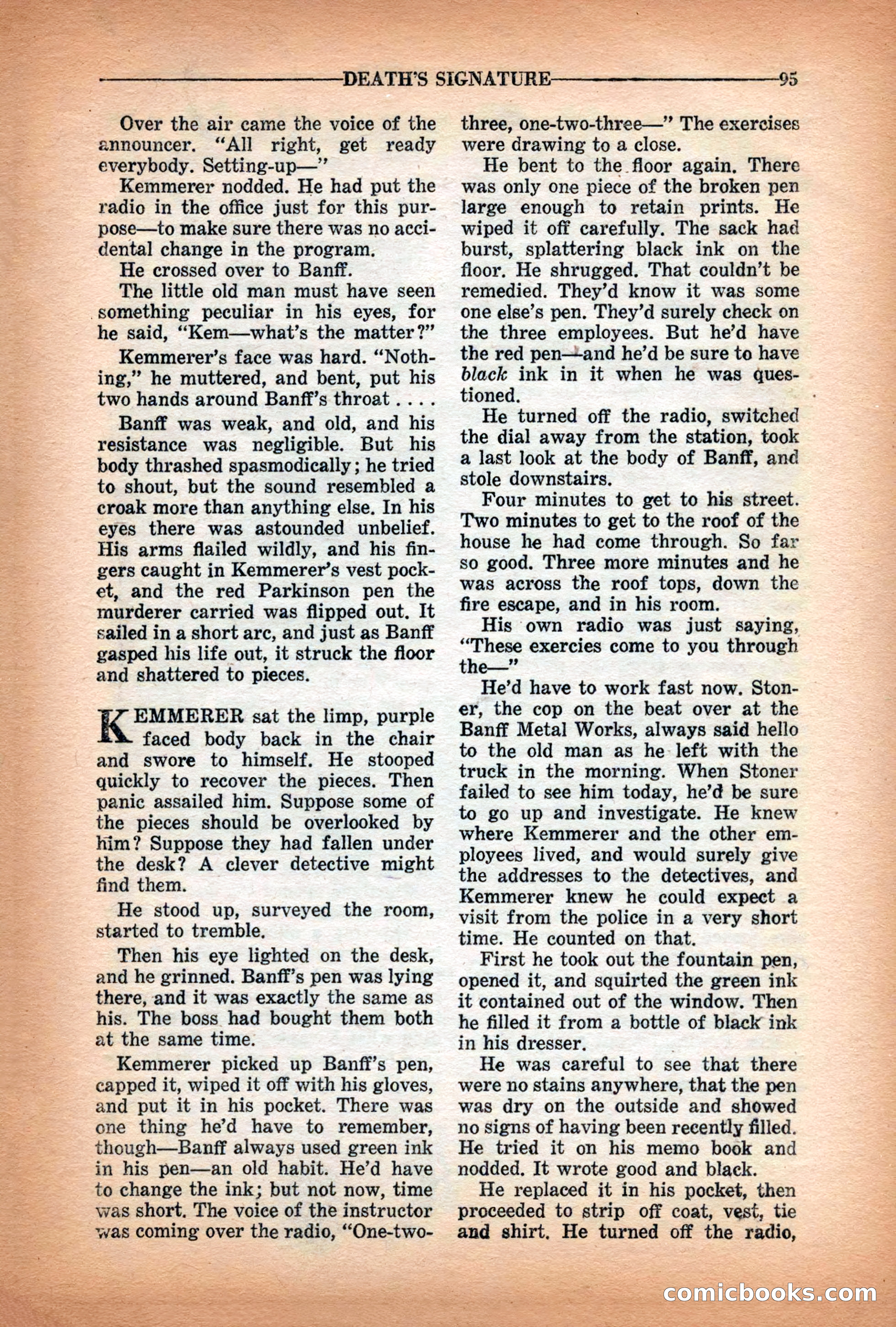
A restored page from Pulp Fiction, 1938. Page through the whole issue in the reader above.
📄 Transcribed text from this page (OCR, searchable)
Machine-transcribed from the original scan — historical spelling and the odd misread are preserved.
b 3 a Ars es Gee 1h his 7 A we at +e A; VI > DEATH’S SIGNATURE———————‘95 Over the air came the voice of the announcer. “All right, get ready everybody. Setting-up—” Kemmerer nodded. He had put the radio in the office just for this pur- pose—to make sure there was no acci- dental change in the program. He crossed over to Banff. The little old man must have seen something peculiar in his eyes, for he said, ““Kem—what’s the matter?” Kemmerer’s face was hard. “Noth- ing,” he muttered, and bent, put his two hands around Banff’s throat.... Banff was weak, and old, and his resistance was negligible. But his body thrashed spasmodically ; he tried to shout, but the sound resembled a croak more than anything else. In his eyes there was astounded unbelief. His arms flailed wildly, and his fin- gers caught in Kemmerer’s vest pock- et, and the red Parkinson pen the murderer carried was flipped out. It sailed in a short arc, and just as Banff gasped his life out, it struck the floor and shattered to pieces. EMMERER sat the limp, purple faced body back in the chair and swore to himself. He stooped quickly to recover the pieces. Then panic assailed him. Suppose some of the pieces should be overlooked by him? Suppose they had fallen under the desk? A clever detective might find them. He stood up, surveyed the room, started to tremble, Then his eye lighted on the desk, and he grinned. Banfi’s pen was lying there, and it was exactly the same as his. The boss had bought them both at the same time. Kemmerer picked up Banff’s pen, capped it, wiped it off with his gloves, and put it in his pocket. There was one thing he’d have to remember, though—Banff always used green ink in his pen—an old habit. He’d have to change the ink; but not now, time was short. The voice of the instructor was coming over the radio, “One-two- three, one-two-three—” The exercises were drawing to a close. He bent to the floor again, There was only one piece of the broken pen large enough to retain prints. He wiped it off carefully. The sack had burst, splattering black ink on the floor. He shrugged. That couldn’t be remedied. They’d know it was some one else’s pen. They’d surely check on the three employees. But he’d have the red pen—-and he’d be sure to have black ink in it when he was ques- tioned. : He turned off the radio, switched the dial away from the station, took a last look at the body of Banff, and stole downstairs. Four minutes to get to his street. Two minutes to get to the roof of the house he had come through. So far so good. Three more minutes and he was across the roof tops, down the fire escape, and in his room. His own radio was just saying, “These exercies come to you through the—” He’d have to work fast now. Ston- er, the cop on the beat over at the Banff Metal Works, always said hello to the old man as he left with the truck in the morning. When Stoner failed to see him today, he’d be sure to go up and investigate. He knew where Kemmerer and the other em- ployees lived, and would surely give the addresses to the detectives, and Kemmerer knew he could expect a visit from the police in a very short time. He counted on that. First he took out the fountain pen, opened it, and squirted the green ink it contained out of the window. Then he filled it from a bottle of black ink in his dresser. , He was careful to see that there were no stains anywhere, that the pen was dry on the outside and showed no signs of having been recently filled. He tried it on his memo book and nodded. It wrote good and black. He replaced it in his pocket, then proceeded to strip off coat, vest, tie and shirt. He turned off the radio, comicbooks