
Pulp Fiction, 1938 · page 96 of 116
10-Story Detective Magazine Cover — page 96: what you’re looking at
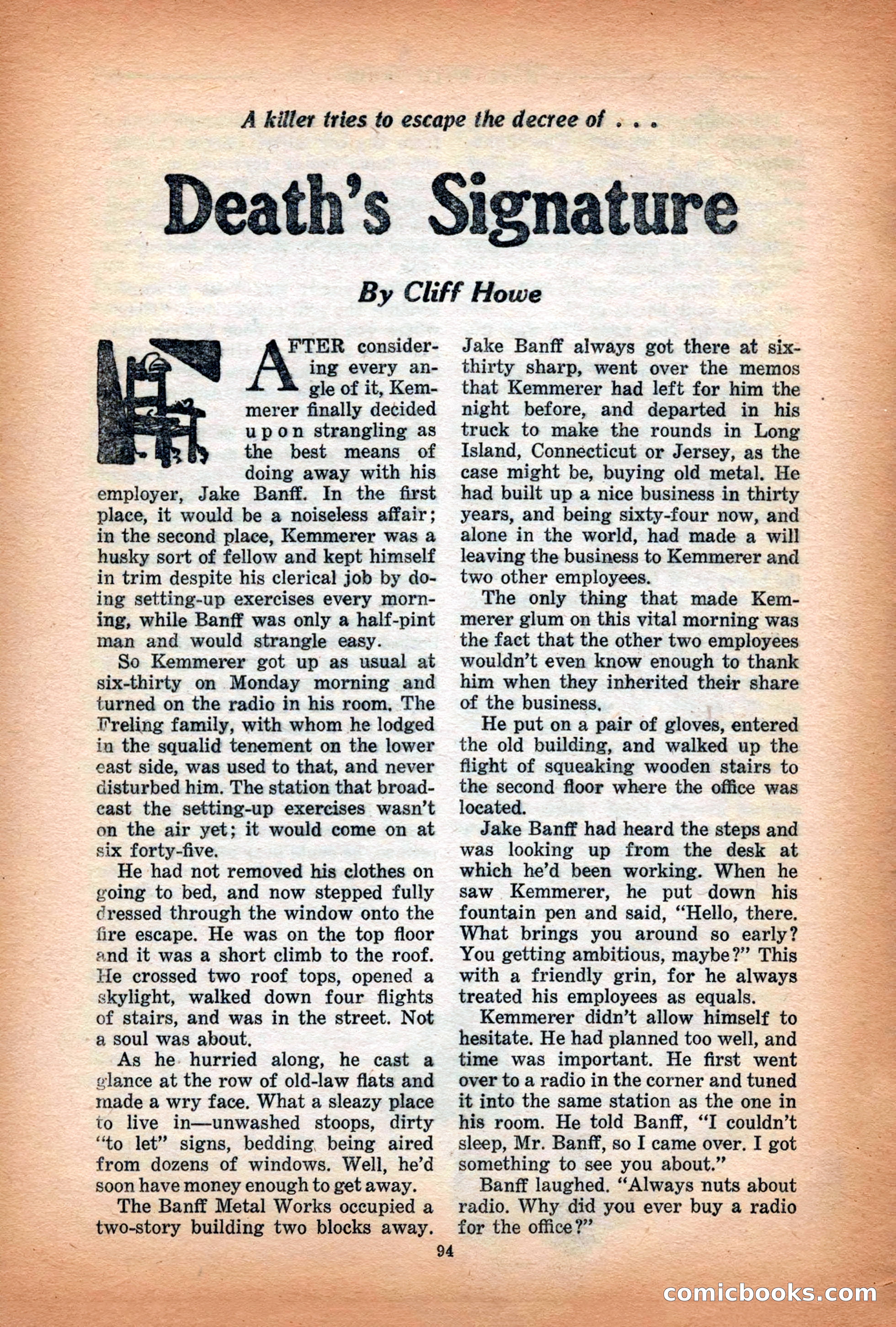
A restored page from Pulp Fiction, 1938. Page through the whole issue in the reader above.
📄 Transcribed text from this page (OCR, searchable)
Machine-transcribed from the original scan — historical spelling and the odd misread are preserved.
A killer tries to escape the decree of . .. Death’s Signature By Cliff Howe FTER consider- ing every an- ae gle of it, Kem- ee ee merer finally decided eR Pe ee upon strangling as g | the best means of doing away with his employer, Jake Banff. In the first place, it would be a noiseless affair; in the second place, Kemmerer was a husky sort of fellow and kept himself in trim despite his clerical job by do- ing setting-up exercises every morn- ing, while Banff was only a half-pint man and would strangle easy. So Kemmerer got up as usual at six-thirty on Monday morning and turned on the radio in his room, The Treling family, with whom he lodged in the squalid tenement on the lower east side, was used to that, and never disturbed him. The station that broad- east the setting-up exercises wasn’t on the air yet; it would come on at six forty-five. He had not removed his clothes on going to bed, and now stepped fully dressed through the window onto the fire escape. He was on the top floor and it was a short climb to the roof. He crossed two roof tops, opened a skylight, walked down four flights of stairs, and was in the street. Not a soul was about, As he hurried along, he cast a glance at the row of old-law flats and made a wry face. What a sleazy place to live in—unwashed stoops, dirty “to let” signs, bedding, being aired from dozens of windows. Well, he’d soon have money enough to get away. The Banff Metal Works occupied a two-story building two blocks away. 94 Jake Banff always got there at six- thirty sharp, went over the memos that Kemmerer had left for him the night before, and departed in his truck to make the rounds in Long Island, Connecticut or Jersey, as the case might be, buying old metal. He had built up a nice business in thirty years, and being sixty-four now, and alone in the world, had made a will leaving the business to Kemmerer and two other employees. The only thing that made Kem- merer glum on this vital morning was the fact that the other two employees wouldn’t even know enough to thank him when they inherited their share of the business, He put on a pair of gloves, entered the old building, and walked up the flight of squeaking wooden stairs to the second floor where the office was loeated. Jake Banff had heard the steps and was looking up from the desk at which he’d been working. When he saw Kemmerer, he put down his fountain pen and said, “Hello, there. What brings you around so early? You getting ambitious, maybe?” This with a friendly grin, for he always treated his employees as equals. Kemmerer didn’t allow himself to hesitate. He had planned too well, and time was important. He first went over to a radio in the corner and tuned it into the same station as the one in his room. He told Banff, “I couldn’t sleep, Mr. Banff, so I came over. I got something to see you about.” Banff laughed. ‘Always nuts about radio. Why did you ever buy a radio for the office?” (e(@) chook