
Penny Dreadfuls, 1900 · page 304 of 399
The Mysteries of the Court of London — page 304: what you’re looking at
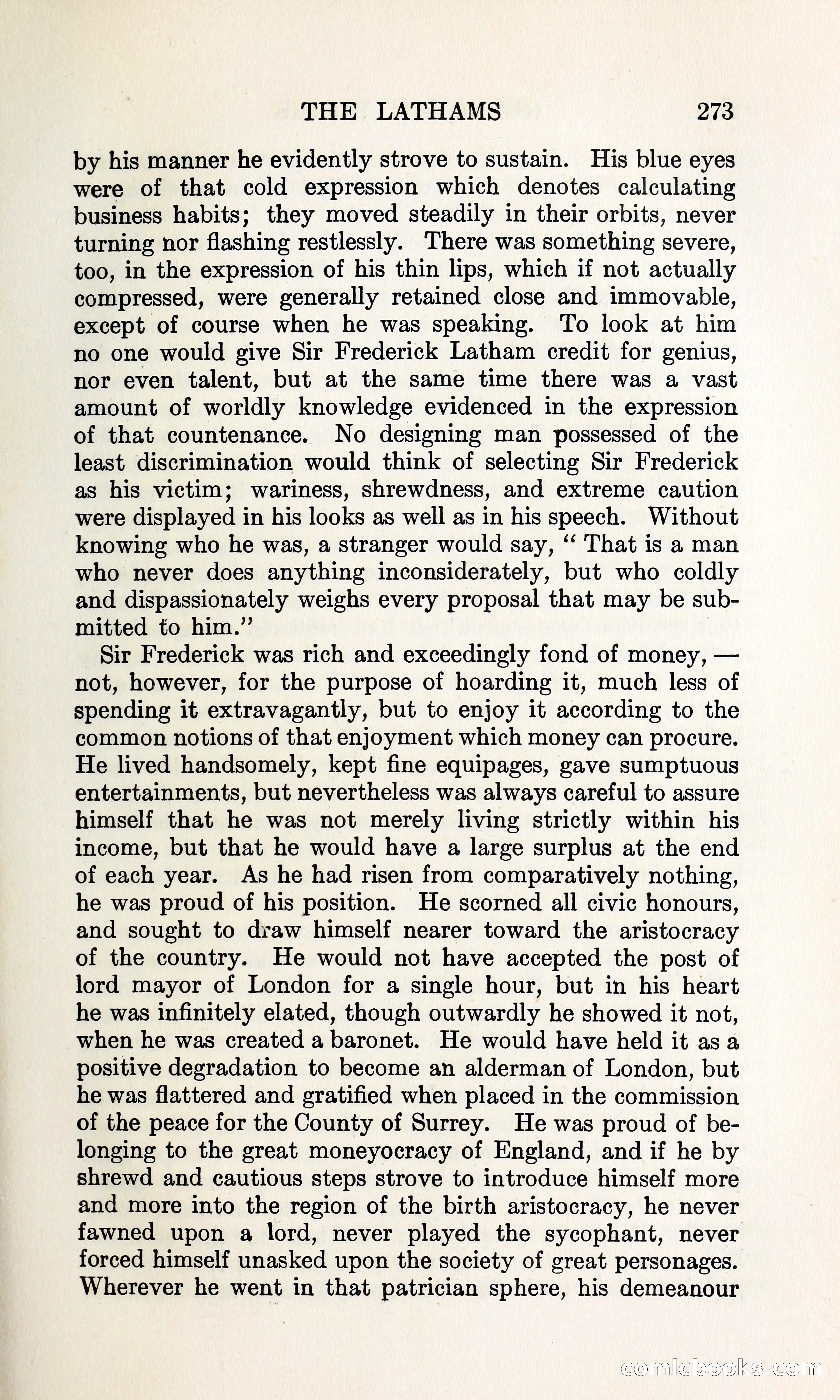
A restored page from Penny Dreadfuls, 1900. Page through the whole issue in the reader above.
📄 Transcribed text from this page (OCR, searchable)
Machine-transcribed from the original scan — historical spelling and the odd misread are preserved.
THE LATHAMS 273 by his manner he evidently strove to sustain. His blue eyes were of that cold expression which denotes calculating business habits; they moved steadily in their orbits, never turning nor flashing restlessly. There was something severe, too, in the expression of his thin lips, which if not actually compressed, were generally retained close and immovable, except of course when he was speaking. To look at him no one would give Sir Frederick Latham credit for genius, nor even talent, but at the same time there was a vast amount of worldly knowledge evidenced in the expression of that countenance. No designing man possessed of the least discrimination would think of selecting Sir Frederick as his victim; wariness, shrewdness, and extreme caution were displayed in his looks as well as in his speech. Without knowing who he was, a stranger would say, “‘ That is a man who never does anything inconsiderately, but who coldly and dispassionately weighs every proposal that may be sub- mitted to him.” Sir Frederick was rich and exceedingly fond of money, — not, however, for the purpose of hoarding it, much less of spending it extravagantly, but to enjoy it according to the common notions of that enjoyment which money can procure. He lived handsomely, kept fine equipages, gave sumptuous entertainments, but nevertheless was always careful to assure himself that he was not merely living strictly within his income, but that he would have a large surplus at the end of each year. As he had risen from comparatively nothing, he was proud of his position. He scorned all civic honours, and sought to draw himself nearer toward the aristocracy of the country. He would not have accepted the post of lord mayor of London for a single hour, but in his heart he was infinitely elated, though outwardly he showed it not, when he was created a baronet. He would have held it as a positive degradation to become an alderman of London, but he was flattered and gratified when placed in the commission of the peace for the County of Surrey. He was proud of be- longing to the great moneyocracy of England, and if he by shrewd and cautious steps strove to introduce himself more and more into the region of the birth aristocracy, he never fawned upon a lord, never played the sycophant, never forced himself unasked upon the society of great personages. Wherever he went in that patrician sphere, his demeanour CORMICOO© <S (CO)