
Penny Dreadfuls, 1900 · page 161 of 392
The Mysteries of the Court of London — page 161: what you’re looking at
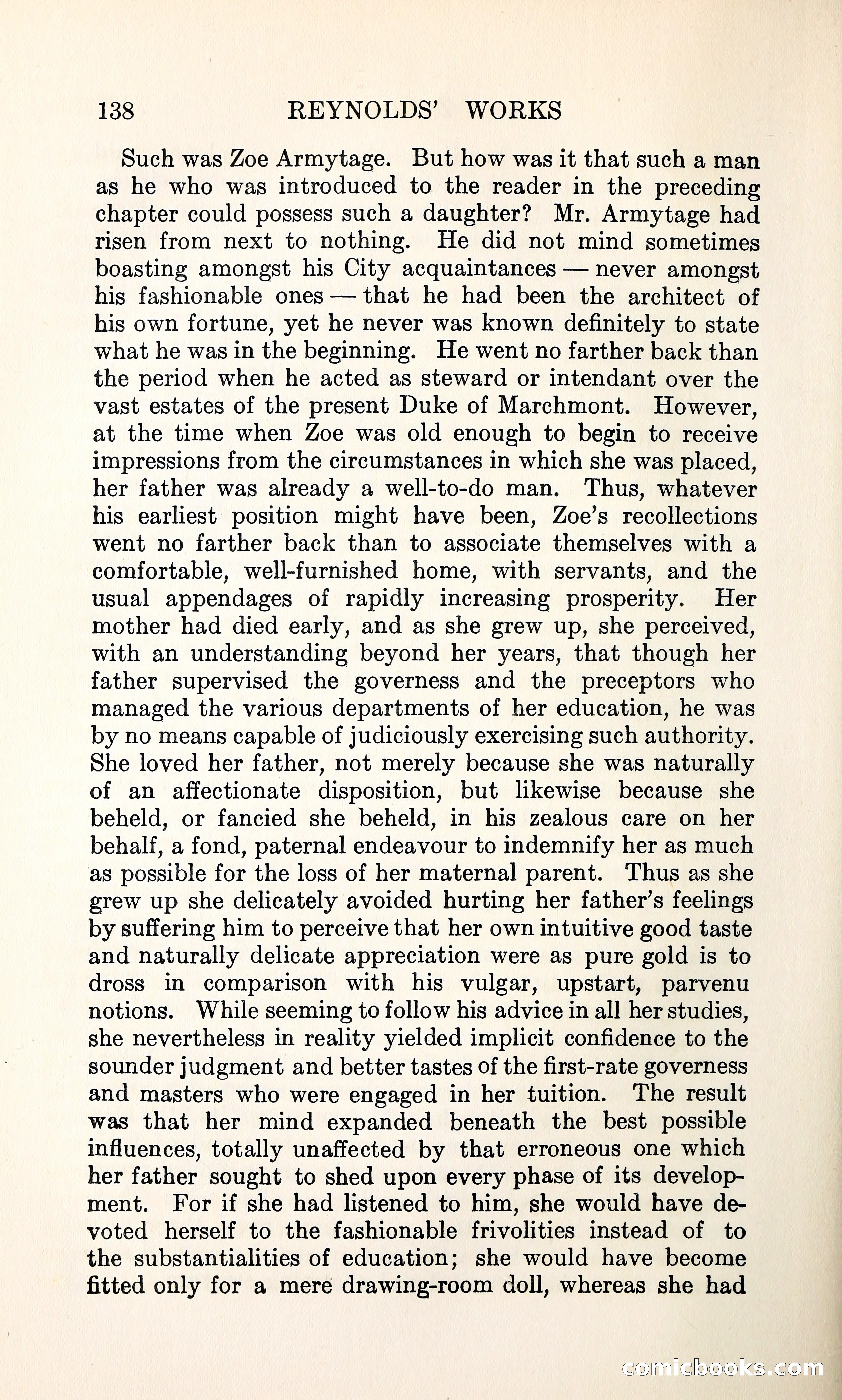
A restored page from Penny Dreadfuls, 1900. Page through the whole issue in the reader above.
📄 Transcribed text from this page (OCR, searchable)
Machine-transcribed from the original scan — historical spelling and the odd misread are preserved.
138 REYNOLDS’ WORKS Such was Zoe Armytage. But how was it that such a man as he who was introduced to the reader in the preceding chapter could possess such a daughter? Mr. Armytage had risen from next to nothing. He did not mind sometimes boasting amongst his City acquaintances — never amongst his fashionable ones — that he had been the architect of his own fortune, yet he never was known definitely to state what he was in the beginning. He went no farther back than the period when he acted as steward or intendant over the vast estates of the present Duke of Marchmont. However, at the time when Zoe was old enough to begin to receive impressions from the circumstances in which she was placed, her father was already a well-to-do man. Thus, whatever his earliest position might have been, Zoe’s recollections went no farther back than to associate themselves with a comfortable, well-furnished home, with servants, and the usual appendages of rapidly increasing prosperity. Her mother had died early, and as she grew up, she perceived, with an understanding beyond her years, that though her father supervised the governess and the preceptors who managed the various departments of her education, he was by no means capable of judiciously exercising such authority. She loved her father, not merely because she was naturally of an affectionate disposition, but likewise because she beheld, or fancied she beheld, in his zealous care on her behalf, a fond, paternal endeavour to indemnify her as much as possible for the loss of her maternal parent. Thus as she erew up she delicately avoided hurting her father’s feelings by suffering him to perceive that her own intuitive good taste and naturally delicate appreciation were as pure gold is to dross in comparison with his vulgar, upstart, parvenu notions. While seeming to follow his advice in all her studies, she nevertheless in reality yielded implicit confidence to the sounder judgment and better tastes of the first-rate governess and masters who were engaged in her tuition. The result was that her mind expanded beneath the best possible influences, totally unaffected by that erroneous one which her father sought to shed upon every phase of its develop- ment. For if she had listened to him, she would have de- voted herself to the fashionable frivolities instead of to the substantialities of education; she would have become fitted only for a mere drawing-room doll, whereas she had Gomichboo Ss) (E(0)