
Penny Dreadfuls, 1900 · page 150 of 392
The Mysteries of the Court of London — page 150: what you’re looking at
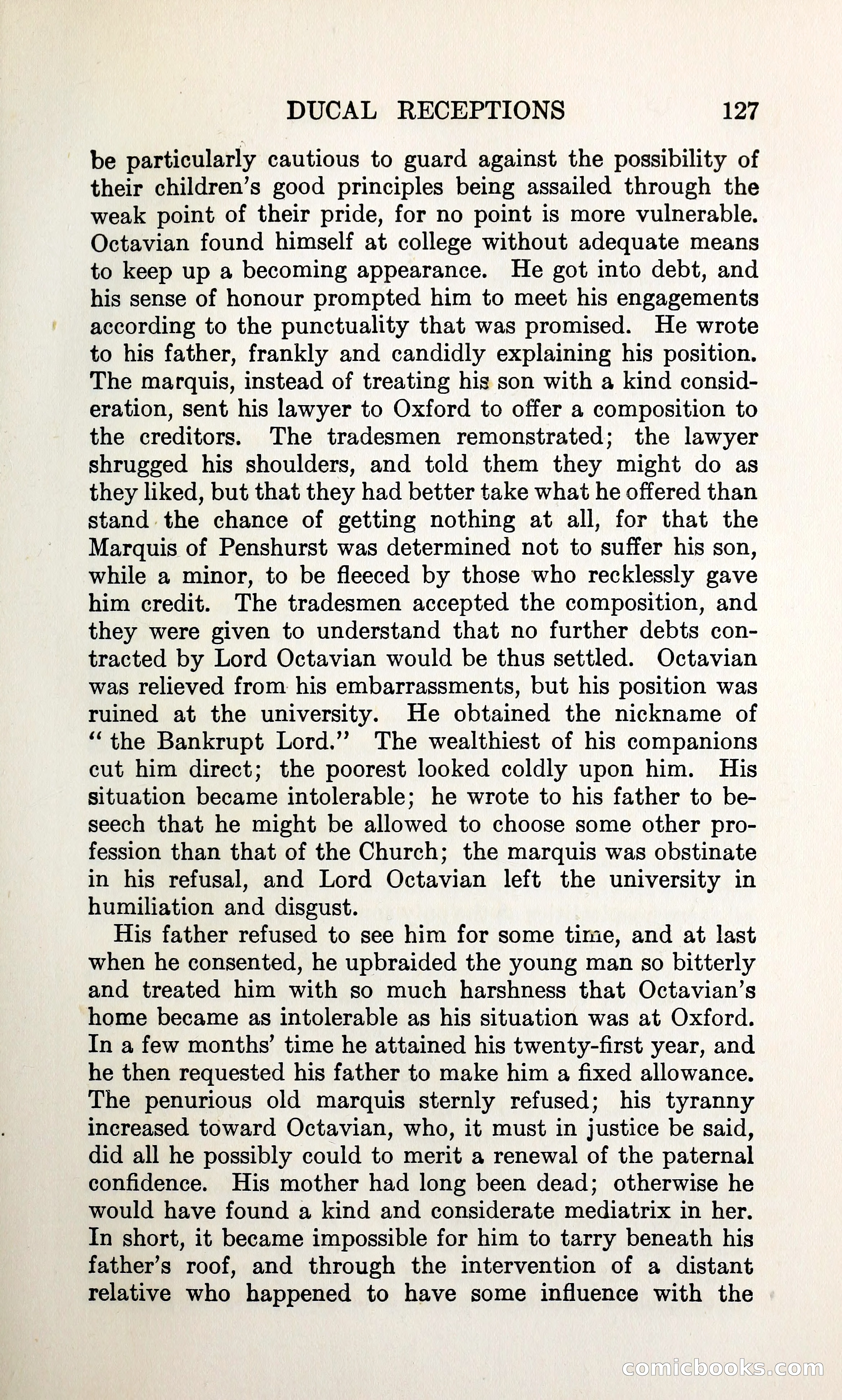
A restored page from Penny Dreadfuls, 1900. Page through the whole issue in the reader above.
📄 Transcribed text from this page (OCR, searchable)
Machine-transcribed from the original scan — historical spelling and the odd misread are preserved.
DUCAL RECEPTIONS 127 be particularly cautious to guard against the possibility of their children’s good principles being assailed through the weak point of their pride, for no point is more vulnerable. Octavian found himself at college without adequate means to keep up a becoming appearance. He got into debt, and his sense of honour prompted him to meet his engagements according to the punctuality that was promised. He wrote to his father, frankly and candidly explaining his position. The marquis, instead of treating his son with a kind consid- eration, sent his lawyer to Oxford to offer a composition to the creditors. The tradesmen remonstrated; the lawyer shrugged his shoulders, and told them they might do as they liked, but that they had better take what he offered than stand the chance of getting nothing at all, for that the Marquis of Penshurst was determined not to suffer his son, while a minor, to be fleeced by those who recklessly gave him credit. The tradesmen accepted the composition, and they were given to understand that no further debts con- tracted by Lord Octavian would be thus settled. Octavian was relieved from his embarrassments, but his position was ruined at the university. He obtained the nickname of “the Bankrupt Lord.” The wealthiest of his companions cut him direct; the poorest looked coldly upon him. His situation became intolerable; he wrote to his father to be- seech that he might be allowed to choose some other pro- fession than that of the Church; the marquis was obstinate in his refusal, and Lord Octavian left the university in humiliation and disgust. His father refused to see him for some time, and at last when he consented, he upbraided the young man so bitterly and treated him with so much harshness that Octavian’s home became as intolerable as his situation was at Oxford. In a few months’ time he attained his twenty-first year, and he then requested his father to make him a fixed allowance. The penurious old marquis sternly refused; his tyranny increased toward Octavian, who, it must in justice be said, did all he possibly could to merit a renewal of the paternal confidence. His mother had long been dead; otherwise he would have found a kind and considerate mediatrix in her. In short, it became impossible for him to tarry beneath his father’s roof, and through the intervention of a distant relative who happened to have some influence with the E@ORNICLOOKS (E(0)