
Penny Dreadfuls, 1900 · page 149 of 392
The Mysteries of the Court of London — page 149: what you’re looking at
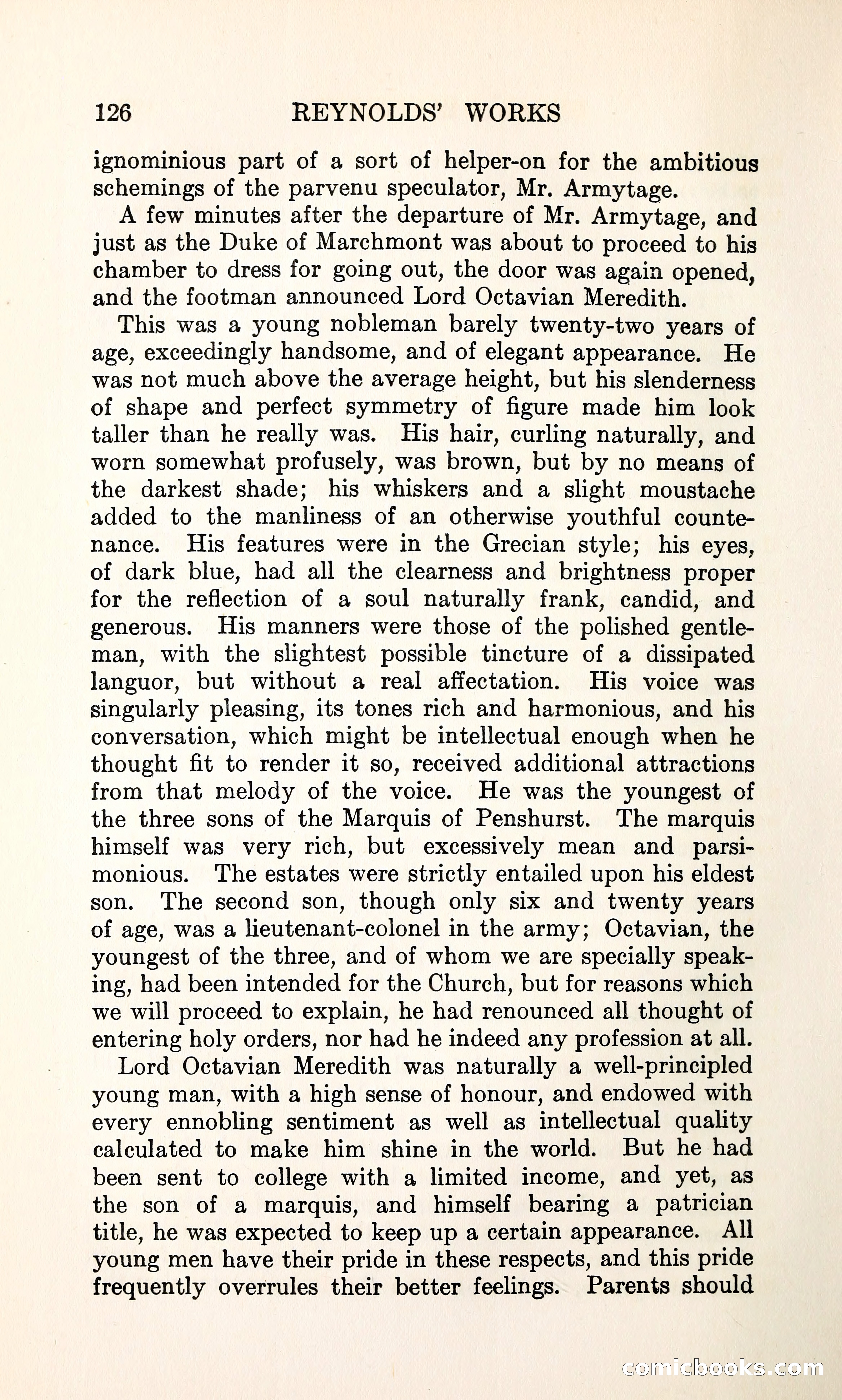
A restored page from Penny Dreadfuls, 1900. Page through the whole issue in the reader above.
📄 Transcribed text from this page (OCR, searchable)
Machine-transcribed from the original scan — historical spelling and the odd misread are preserved.
126 REYNOLDS’ WORKS ignominious part of a sort of helper-on for the ambitious schemings of the parvenu speculator, Mr. Armytage. A few minutes after the departure of Mr. Armytage, and just as the Duke of Marchmont was about to proceed to his chamber to dress for going out, the door was again opened, and the footman announced Lord Octavian Meredith. This was a young nobleman barely twenty-two years of age, exceedingly handsome, and of elegant appearance. He was not much above the average height, but his slenderness of shape and perfect symmetry of figure made him look taller than he really was. His hair, curling naturally, and worn somewhat profusely, was brown, but by no means of the darkest shade; his whiskers and a slight moustache added to the manliness of an otherwise youthful counte- nance. His features were in the Grecian style; his eyes, of dark blue, had all the clearness and brightness proper for the reflection of a soul naturally frank, candid, and generous. His manners were those of the polished gentle- man, with the slightest possible tincture of a dissipated languor, but without a real affectation. His voice was singularly pleasing, its tones rich and harmonious, and his conversation, which might be intellectual enough when he thought fit to render it so, received additional attractions from that melody of the voice. He was the youngest of the three sons of the Marquis of Penshurst. The marquis himself was very rich, but excessively mean and _ parsi- monious. The estates were strictly entailed upon his eldest son. The second son, though only six and twenty years of age, was a lieutenant-colonel in the army; Octavian, the youngest of the three, and of whom we are specially speak- ing, had been intended for the Church, but for reasons which we will proceed to explain, he had renounced all thought of entering holy orders, nor had he indeed any profession at all. Lord Octavian Meredith was naturally a well-principled young man, with a high sense of honour, and endowed with every ennobling sentiment as well as intellectual quality calculated to make him shine in the world. But he had been sent to college with a limited income, and yet, as the son of a marquis, and himself bearing a patrician title, he was expected to keep up a certain appearance. All young men have their pride in these respects, and this pride frequently overrules their better feelings. Parents should CORNICLIIOOKS (E(0)