
Penny Dreadfuls, 1870 · page 236 of 392
The Works of George W. M. Reynolds — page 236: what you’re looking at
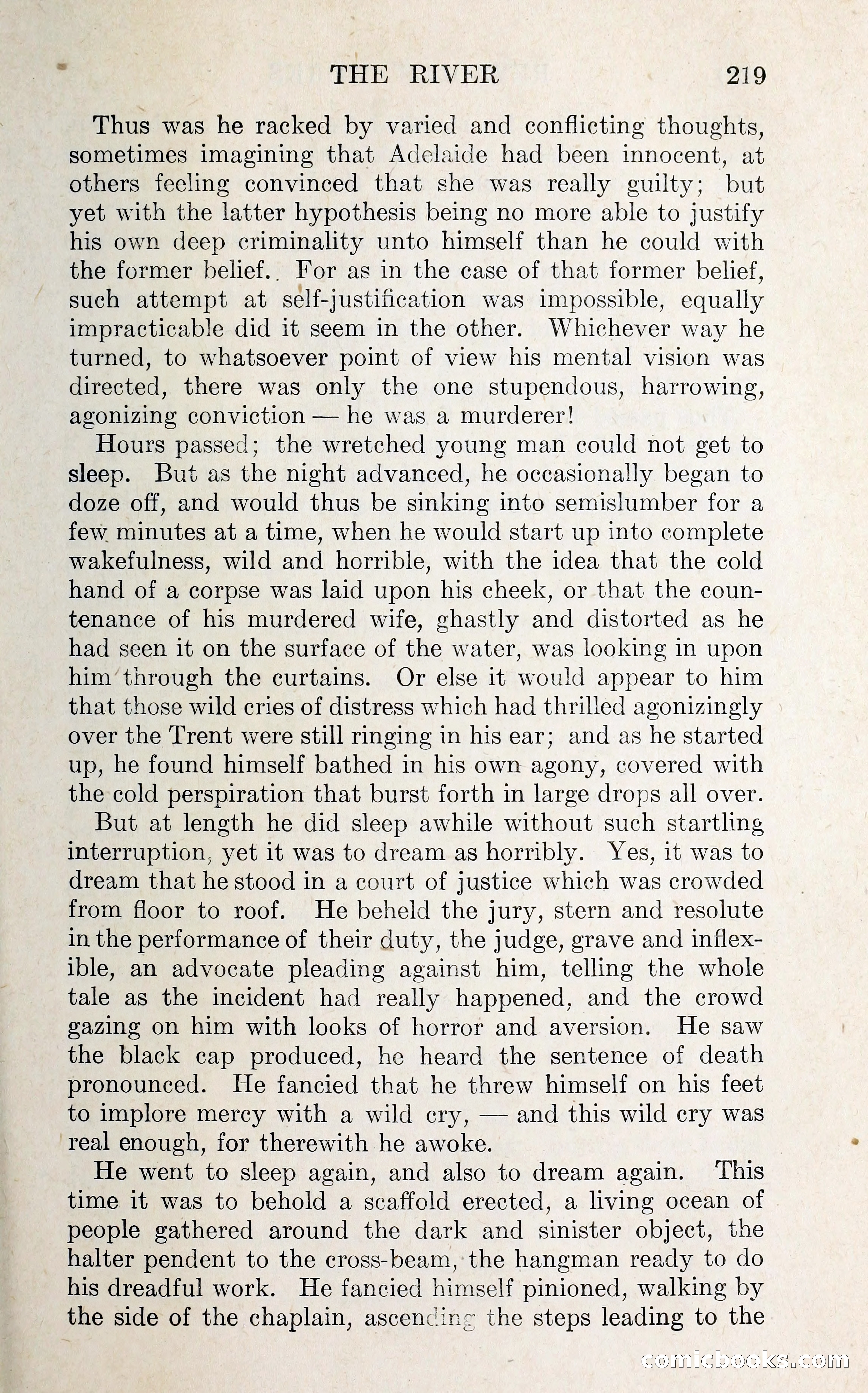
A restored page from Penny Dreadfuls, 1870. Page through the whole issue in the reader above.
📄 Transcribed text from this page (OCR, searchable)
Machine-transcribed from the original scan — historical spelling and the odd misread are preserved.
THE RIVER 219 Thus was he racked by varied and conflicting thoughts, sometimes imagining that Adelaide had been innocent, at others feeling convinced that she was really guilty; but yet with the latter hypothesis being no more able to justify his own deep criminality unto himself than he could with the former belief.. For as in the case of that former belief, such attempt at self-justification was impossible, equally impracticable did it seem in the other. Whichever way he turned, to whatsoever point of view his mental vision was directed, there was only the one stupendous, harrowing, agonizing conviction — he was a murderer! Hours passed; the wretched young man could not get to sleep. But as the night advanced, he occasionally began to doze off, and would thus be sinking into semislumber for a few minutes at a time, when he would start up into complete wakefulness, wild and horrible, with the idea that the cold hand of a corpse was laid upon his cheek, or that the coun- tenance of his murdered wife, ghastly and distorted as he had seen it on the surface of the water, was looking in upon him‘through the curtains. Or else it would appear to him that those wild cries of distress which had thrilled agonizingly over the Trent were still ringing in his ear; and as he started up, he found himself bathed in his own agony, covered with the cold perspiration that burst forth in large drops all over. But at length he did sleep awhile without such startling interruption, yet it was to dream as horribly. Yes, it was to dream that he stood in a court of justice which was crowded from floor to roof. He beheld the jury, stern and resolute in the performance of their duty, the judge, grave and inflex- ible, an advocate pleading against him, telling the whole tale as the incident had really happened, and the crowd gazing on him with looks of horror and aversion. He saw the black cap produced, he heard the sentence of death pronounced. He fancied that he threw himself on his feet to implore mercy with a wild cry, — and this wild cry was real enough, for therewith he awoke. He went to sleep again, and also to dream again. ‘This time it was to behold a scaffold erected, a living ocean of people gathered around the dark and sinister object, the halter pendent to the cross-beam, the hangman ready to do his dreadful work. He fancied himself pinioned, walking by the side of the chaplain, ascending the steps leading to the Gomiicdoo <S (FO)