
Penny Dreadfuls, 1870 · page 229 of 392
The Works of George W. M. Reynolds — page 229: what you’re looking at
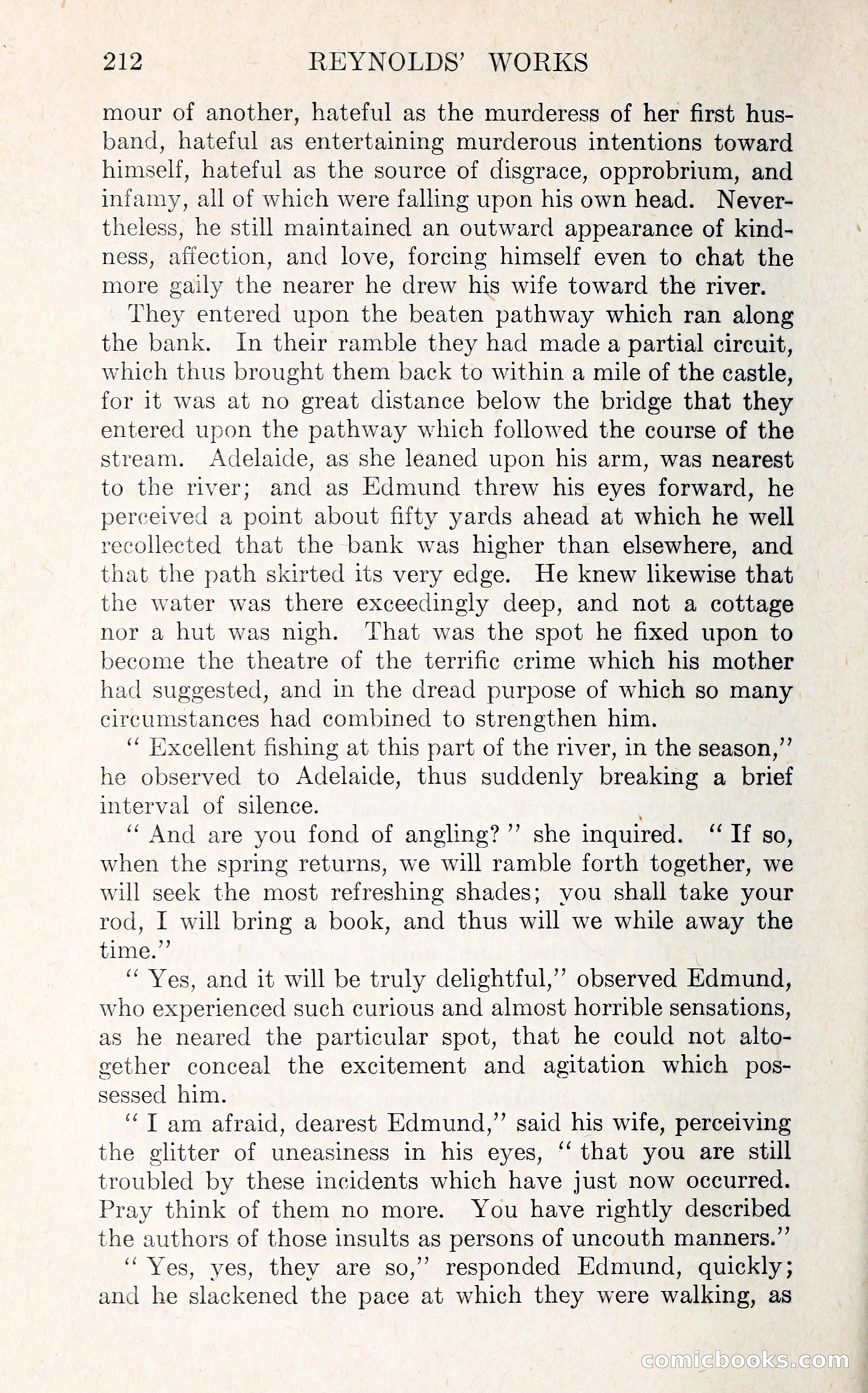
A restored page from Penny Dreadfuls, 1870. Page through the whole issue in the reader above.
📄 Transcribed text from this page (OCR, searchable)
Machine-transcribed from the original scan — historical spelling and the odd misread are preserved.
212 REYNOLDS’ WORKS mour of another, hateful as the murderess of her first hus- band, hateful as entertaining murderous intentions toward himself, hateful as the source of disgrace, opprobrium, and infamy, all of which were falling upon his own head. Never- theless, he still maintained an outward appearance of kind- ness, affection, and love, forcing himself even to chat the more gaily the nearer he drew his wife toward the river. They entered upon the beaten pathway which ran along the bank. In their ramble they had made a partial circuit, which thus brought them back to within a mile of the castle, for it was at no great distance below the bridge that they entered upon the pathway which followed the course of the stream. Adelaide, as she leaned upon his arm, was nearest to the river; and as Edmund threw his eyes forward, he perceived a point about fifty yards ahead at which he well recollected that the bank was higher than elsewhere, and that the path skirted its very edge. He knew likewise that the water was there exceedingly deep, and not a cottage nor a hut was nigh. That was the spot he fixed upon to become the theatre of the terrific crime which his mother had suggested, and in the dread purpose of which so many circumstances had combined to strengthen him. ‘“ Excellent fishing at this part of the river, in the season,” he observed to Adelaide, thus suddenly breaking a brief interval of silence. | “And are you fond of angling?”’ she inquired. ‘“ If so, when the spring returns, we will ramble forth together, we will seek the most refreshing shades; vou shall take your rod, I will bring a book, and thus will we while away the time.”’ “Yes, and it will be truly delightful,’’ observed Edmund, who experienced such curious and almost horrible sensations, as he neared the particular spot, that he could not alto- gether conceal the excitement and agitation which pos- sessed him. ‘““T am afraid, dearest Edmund,” said his wife, perceiving the glitter of uneasiness in his eyes, “ that you are still troubled by these incidents which have just now occurred. Pray think of them no more. You have rightly described the authors of those insults as persons of uncouth manners.”’ ‘Yes, yes, they are so,’ responded Edmund, quickly; and he slackened the pace at which they were walking, as CONNIE OO KS (E(0)