
Penny Dreadfuls, 1870 · page 83 of 392
The Works of George W. M. Reynolds — page 83: what you’re looking at
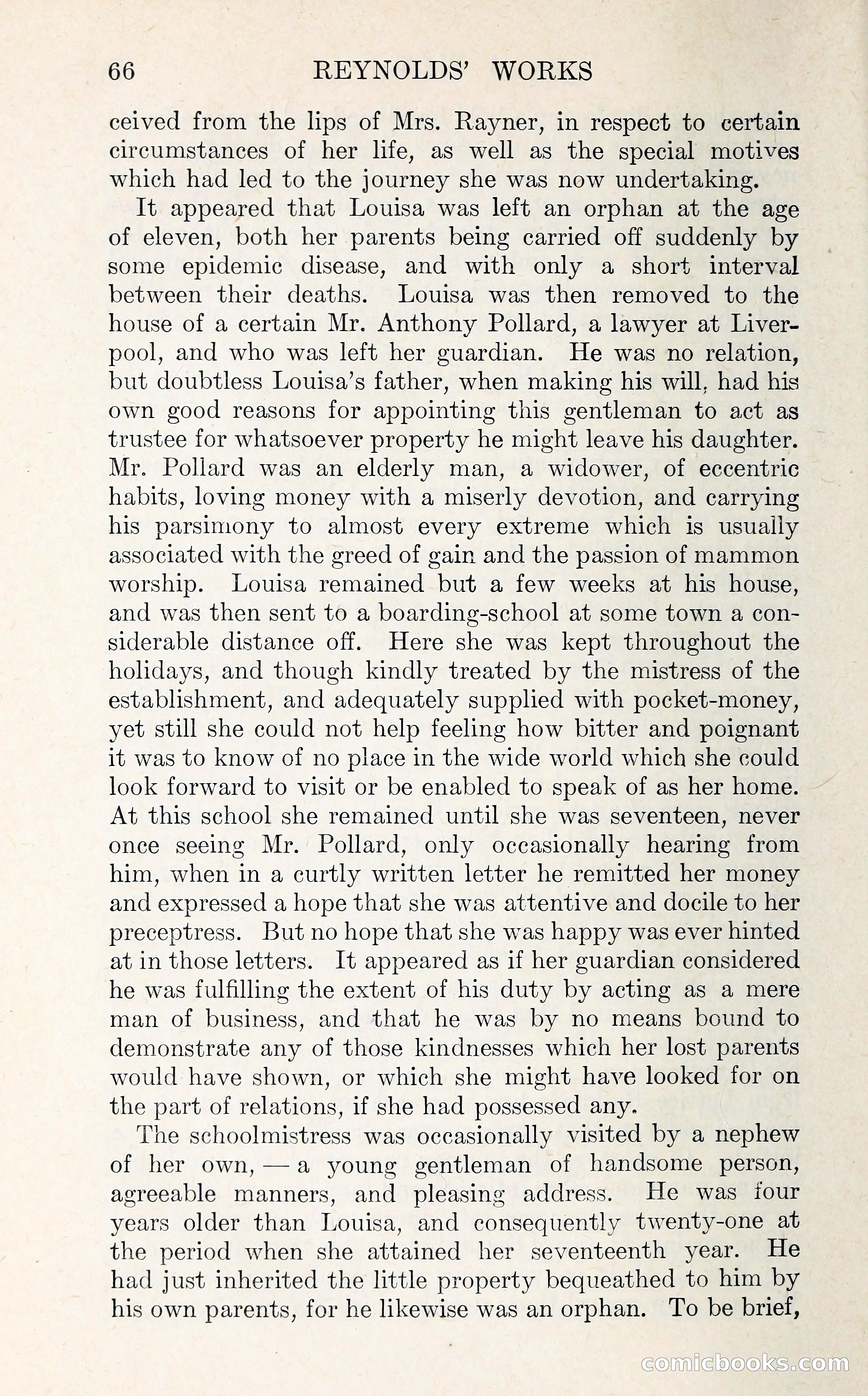
A restored page from Penny Dreadfuls, 1870. Page through the whole issue in the reader above.
📄 Transcribed text from this page (OCR, searchable)
Machine-transcribed from the original scan — historical spelling and the odd misread are preserved.
66 REYNOLDS’ WORKS ceived from the lips of Mrs. Rayner, in respect to certain circumstances of her life, as well as the special motives which had led to the journey she was now undertaking. It appeared that Louisa was left an orphan at the age of eleven, both her parents being carried off suddenly by some epidemic disease, and with only a short interval between their deaths. Louisa was then removed to the house of a certain Mr. Anthony Pollard, a lawyer at Liver- pool, and who was left her guardian. He was no relation, but doubtless Louisa’s father, when making his will, had his own good reasons for appointing this gentleman to act as trustee for whatsoever property he might leave his daughter. Mr. Pollard was an elderly man, a widower, of eccentric habits, loving money with a miserly devotion, and carrying his parsimony to almost every extreme which is usually associated with the greed of gain and the passion of mammon worship. Louisa remained but a few weeks at his house, and was then sent to a boarding-school at some town a con- siderable distance off. Here she was kept throughout the holidays, and though kindly treated by the mistress of the establishment, and adequately supplied with pocket-money, yet still she could not help feeling how bitter and poignant it was to know of no place in the wide world which she could look forward to visit or be enabled to speak of as her home. At this school she remained until she was seventeen, never once seeing Mr. Pollard, only occasionally hearing from him, when in a curtly written letter he remitted her money and expressed a hope that she was attentive and docile to her preceptress. But no hope that she was happy was ever hinted at in those letters. It appeared as if her guardian considered he was fulfilling the extent of his duty by acting as a mere man of business, and that he was by no means bound to demonstrate any of those kindnesses which her lost parents would have shown, or which she might have looked for on the part of relations, if she had possessed any. The schoolmistress was occasionally visited by a nephew of her own, —a young gentleman of handsome person, acreeable manners, and pleasing address. He was iour years older than Louisa, and consequently twenty-one at the period when she attained her seventeenth year. He had just inherited the little property bequeathed to him by his own parents, for he likewise was an orphan. To be briet, CONNIELOOOL<S, EC) m