
Penny Dreadfuls, 1870 · page 82 of 392
The Works of George W. M. Reynolds — page 82: what you’re looking at
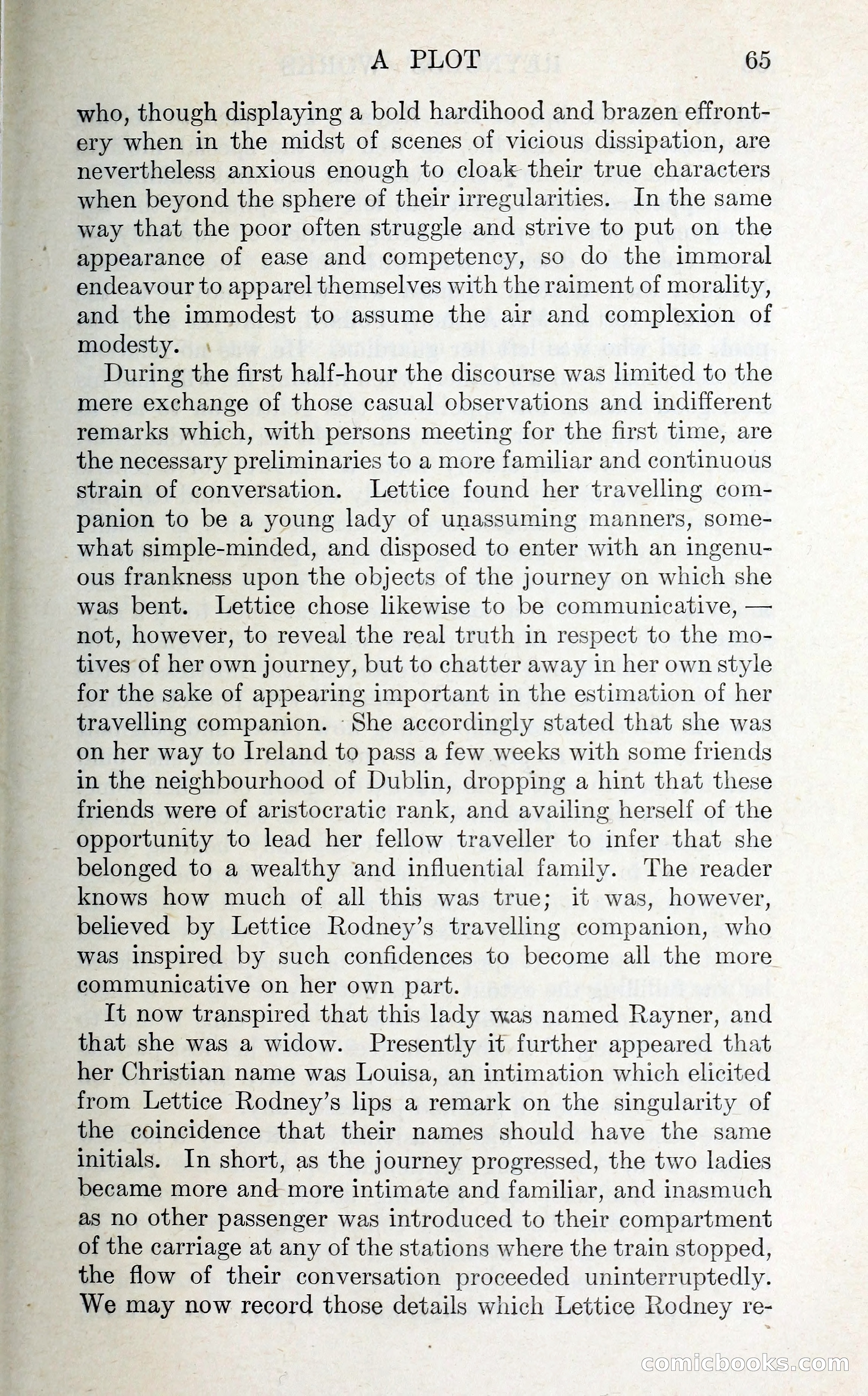
A restored page from Penny Dreadfuls, 1870. Page through the whole issue in the reader above.
📄 Transcribed text from this page (OCR, searchable)
Machine-transcribed from the original scan — historical spelling and the odd misread are preserved.
A PLOT 65 who, though displaying a bold hardihood and brazen effront- ery when in the midst of scenes of vicious dissipation, are nevertheless anxious enough to cloak their true characters when beyond the sphere of their irregularities. In the same way that the poor often struggle and strive to put on the appearance of ease and competency, so do the immoral endeavour to apparel themselves with the raiment of morality, and the immodest to assume the air and complexion of modesty. | During the first half-hour the discourse was limited to the mere exchange of those casual observations and indifferent remarks which, with persons meeting for the first time, are the necessary preliminaries to a more familiar and continuous strain of conversation. Lettice found her travelling com- panion to be a young lady of unassuming manners, some- what simple-minded, and disposed to enter with an ingenu- ous frankness upon the objects of the journey on which she was bent. Lettice chose likewise to be communicative, — not, however, to reveal the real truth in respect to the mo- tives of her own journey, but to chatter away in her own style for the sake of appearing important in the estimation of her travelling companion. She accordingly stated that she was on her way to Ireland to pass a few weeks with some friends in the neighbourhood of Dublin, dropping a hint that these friends were of aristocratic rank, and availing herself of the - opportunity to lead her fellow traveller to infer that she belonged to a wealthy and influential family. The reader knows how much of all this was true; it was, however, believed by Lettice Rodney’s travelling companion, who was inspired by such confidences to become all the more communicative on her own part. It now transpired that this lady was named Rayner, and that she was a widow. Presently it further appeared that her Christian name was Louisa, an intimation which elicited from Lettice Rodney’s lips a remark on the singularity of the coincidence that their names should have the same initials. In short, as the journey progressed, the two ladies became more and more intimate and familiar, and inasmuch as no other passenger was introduced to their compartment of the carriage at any of the stations where the train stopped, the flow of their conversation proceeded uninterruptedly. We may now record those details which Lettice Rodney re- CoOnnicooolkKs (FO) im