
Penny Dreadfuls, 1890 · page 61 of 68
The Armourer's Apprentice — page 61: what you’re looking at
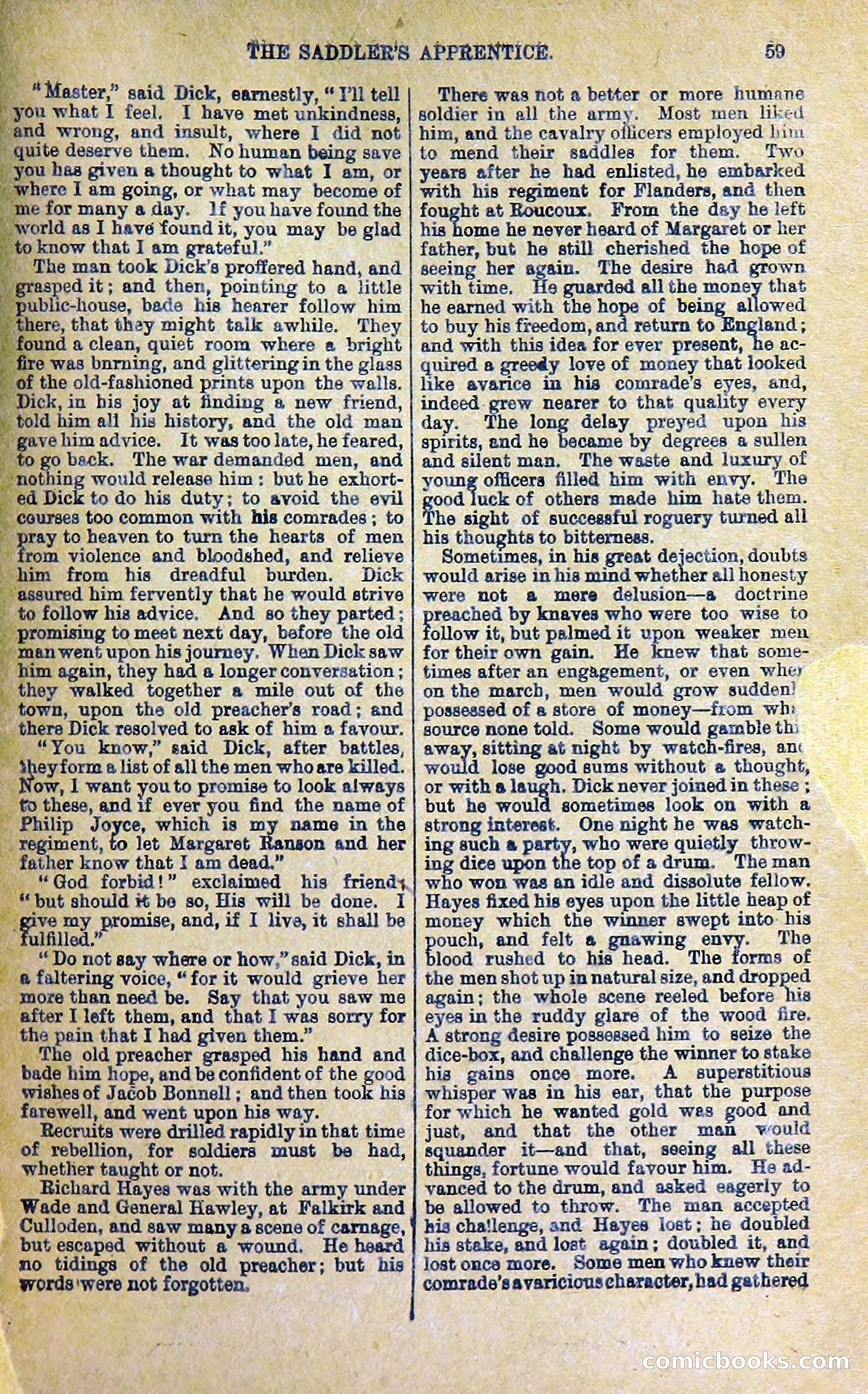
A restored page from Penny Dreadfuls, 1890. Page through the whole issue in the reader above.
📄 Transcribed text from this page (OCR, searchable)
Machine-transcribed from the original scan — historical spelling and the odd misread are preserved.
% - ; +. % ‘. a ot, - wa 4 * ~ , - 4 «.. ss 3 . 1 oie ope OA re SS? : wee ~~Y¥ ao ee sis qf. : : fl wt - p , a. » Ad Fy . , P ae 4 Hee ee aE oes "i ' Master,” said Dick, earnestly, “ ll tell you what I feel. I have met unkindness, ‘and wrong, and insult, where I did not : quite deserve them. No human being save “you has given a thought to what I am, or “where I am going, or what may become of “me for many a day. 1f you have found the world as I havé found it, you may be glad to know that I am grateful.” ' The man took Dick's proffered hand, and ‘grasped it; and then, pointing to a little public-house, bade his hearer follow him there, that they might talk awhile. They found a clean, quiet room where a bright fire was bnrning, and glittering in the glass of the old-fashioned prints upon the walls. | Dick, in his joy at finding a new friend, told him ali his history, and the old man gavehimadvice. It was too late, he feared, t > gO back. The war demanded men, and “nothing would release him: but he exhort- ed Dick to do his duty; to avoid the evil Courses too common with his comrades ; to | pray to heaven to turn the hearts of men “s rom violence and bloodshed, and relieve him from his dreadful burden. Dick assured him fervently that he would strive _ to follow his advice. And so they parted; “promising to meet next day, before the old man went upon his journey, When Dick saw fim again, they had a longer conversation ; _ they walked together a mile out of the _ town, upon the old preacher’s road; and _ there Dick resolved to ask of him a favour. “You know,” said Dick, after battles, ~ Sheyform a list of all the men whoare killed. _ Now, I want youto promise to look always _ to these, and if ever you find the name of _ Philip Joyce, which is my name in the regiment, to let Margaret _ father know that I am dead.” zn . + ‘ , ‘ “God forbid!” exclaimed his friend, “but should % be so, His will be done. I give my promise, and, if I live, it shall be fulfilled.” | _ “Do not say where or how,” said Dick, in a faltering voice, “for it would grieve her _mnore than need be. Say that you saw me _ after I left them, and that I was sorry for _ the pain that I had given them.” hah ‘the old preacher grasped his hand and _ bade him hope, and be confident of the good ; ae shes of Jacob Bonnell ; and then took his _ farewell, and went upon his way. __ Recruits were drilled rapidly in that time of rebellion, for soldiers must be had, _ whether taught or not. _ Bichard Hayes was with the army under ¥ Sulloden, and saw many a scene of carnage, but escaped without a wound. He heard mo t of the old preacher; but his AO Te ee bee oh a APPRE ngon and her _ Wade and General Hawley, at Falkirk and f a 2. 2. . wey, aay ‘ ’ x — mo ' Pa . . o% Ne ‘ By . * “= * . La J ; w j z 7 - s . 59 There was not a better or more humane soldier in all the army. Most men liked him, and the cavalry oflicers employed him to mend their saddles for them. Two years after he had enlisted, he embarked with his regiment for Flanders, anc then fought at Roucoux. From the dsy he left his home he never heard of Margaret or her father, but he still cherished the hope of seeing her again. The desire had grown with time. He guarded all the money that he earned with the hope of being allowed to buy his freedom, and return to land ; and with this idea for ever present, he ac- uired a greedy love of money that looked hke avarice in his comrade’s eyes, and, indeed. grew nearer to that quality every day. The long delay preyed upon his spirits, and he became by degrees a sullen and silent man. The waste and luxury of young officers filled him with envy. The ood luck of others made him hate them. he sight of successful roguery turned all his thoughts to bitterness. Sometimes, in his great dejection, doubts would arise in his mind whether all honesty were not a mere delusion—a doctrine reached by knaves who were too wise to ollow it, but palmed it upon weaker men for their own gain. He knew that some- times after an engagement, or even whe; on the march, men would grow sudden! possessed of a store of money—irom whi: source none told. Some would gambie thi AWAY; sitting at night by watch-fires, anc would lose good sums without a thought, — or with a laugh. Dick never joined in these ; but he would sometimes look on with a strong interest. One night he was watch- ing such @ party, who were quicfly throw- ing diee upon the topofadrum. The man who won was an idle and dissolute fellow. Hayes fixed his eyes upon the little heap of money which the winner swept into: his ouch, and felt a gnawing envy. The lood rushed to his head. The forms of the men shot up in natural size, and dropped again; the whole scene reeled before his eyes in the ruddy glare of the wood fire. A strong desire possessed him to seize the dice-box, and challenge the winner to stake hig gains once more. <A superstitious whisper was in his ear, that the purpose for which he wanted gold wes good and just, and that the other man would squander it—and that, seeing all these things, fortune would favour him. He ad- vanced to the drum, and asked eagerly to be allowed to throw. The man accepted his chatlenge, and Hayes lost; be doubled his stake, and lost again; doubled it, and Jost oncs more. Some men who kuew their comrade’s avaricious character, had gathered (E(@) “COMIEDOO