
Penny Dreadfuls, 1890 · page 60 of 68
The Armourer's Apprentice — page 60: what you’re looking at
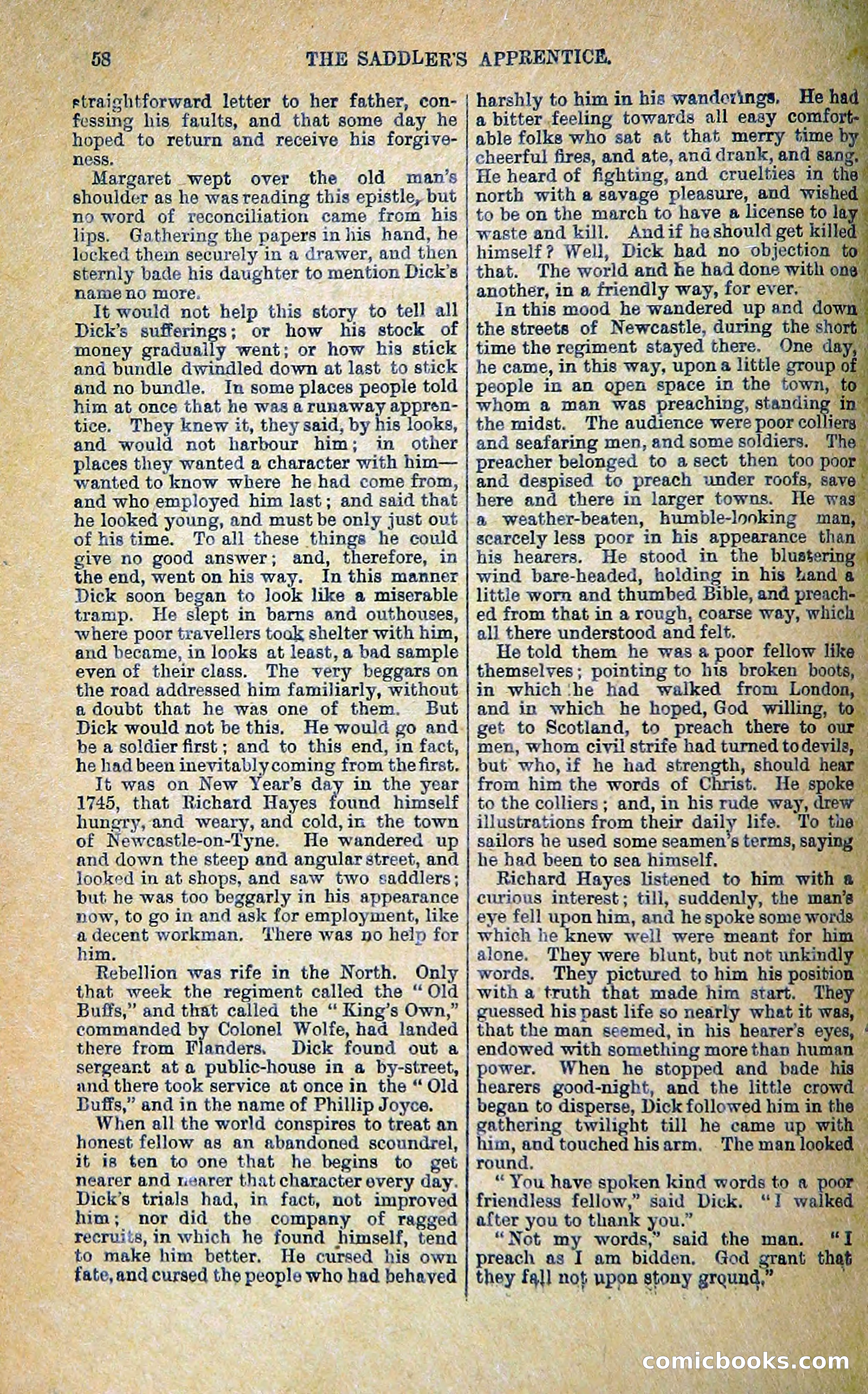
A restored page from Penny Dreadfuls, 1890. Page through the whole issue in the reader above.
📄 Transcribed text from this page (OCR, searchable)
Machine-transcribed from the original scan — historical spelling and the odd misread are preserved.
a Fe “= : +“<* - 7? - - Ld es F ¢ . yee) is ; ye 5 4 © hs straightforward letter to her father, con- fessing his faults, and that some day he hoped to return and receive his forgive- > 2 eSB: 7 > s yee Po din oe oO? ’ and no bundle. him at once that he was a runaway appren- of his time. -— 4 ell 4 ee ast Ve a a Ton de Oe, | ss i? ‘s , Ae’ «ast P \Padid &% Wa ‘ . a ‘ee te lire? it E BEE Pid TSS gh Oe arama Bde ON a 44 iP dts eae aed tg te ts Psi eke. a . aa Rang ; rns « “| 7) n", d ‘> 7 . ya < whe cP - ; 7 +i “ 5 _— ‘ @ Pie Oe a : P ‘ 'y : is ¢ -— Fr . as 4 27 is ° fp. cS ¥ bowel are " Oy a4 ; Te SP Air Ph ead 3 ‘ J Margaret wept over the old man’s shoulder as he was reading this epistle, but no word of reconciliation came from his lips. Gathering the papers in his hand, he locked thein securely in a drawer, and then sternly bade his daughter to mention Dick's _ nameno more. It would not help this story to tell all __ Dick’s sufferings; or how his stock of money graduaily went; or how his stick and bundle dwindled down at last to stick In some places people told tice. They knew it, they said, by his looks, and would not harbour him; in other places they wanted a character with him— wanted to know where he had come from, and who employed him last; and said that he looked young, and must be only just out To all these things he could give no good answer; and, therefore, in the end, went on his way. In this manner Dick soon began to Jook like a miserable tramp. He slept in barns and outhouses, where poor travellers toak shelter with him, and became, in looks at least, a bad sample even of their class. The very beggars on the road addressed him familiarly, without a doubt that he was one of them. But Dick would not be this. he a soldier first ; and to this end, in fact, he had been inevitably coming from the first. It was on New Year’s day in the year 1745, that Richard Hayes found himself hungry, and weary, and cold,in the town of Neweastle-on-Tyne. He wandered up and down the steep and angular street, and looked in at shops, and saw two saddlers; but he was too beggarly in his appearance now, to go in and ask for employment, like a decent workman. ‘There was no help for him. ENS. Rebellion was rife in the North. Only that week the regiment called the “Old Buffs,” and that called the “ King’s Own,” commanded by Colonel Wolfe, had landed there from Flanders. Dick found out a sergeart ata public-house in a by-street, and there took service at once in the “ Old Duffs,” and in the name of Phillip Joyce. When all the world conspires to treat an honest fellow as an abandoned scoundrel, if 18 ten to one that he begins to get nearer and nearer that character every day. Dick’s trials had, in fact, not improved him; nor did the company of ragged _ recruits, in which he found himself, tend to make him better. He cursed his own _ fate, and cursed the people who had behayed | THE SADDLER'S APPRENTICE, _ He would go and. they fal] not upon stony grqund,” harshly to him in his wandevings, He had a bitter feeling towards all easy comf rt able folks who sat at that merry time t ay te f cheerful fires, and ate, and drank, and sang, He heard of fighting, and cruelties in the north with a savage pleasure, and wished to be on the march to have a license to lay waste and kill. Andif heshould get killed himself? Well, Dick had no objection to that. The world and he had done with o ne another, in a friendly way, forever, in this mood he wandered up and down the streets of Newcastle, during the short: time the regiment stayed there. One day, he came, in this way, upon 4 little group of people in an open space in the town, to whom a man was paiement the midst. The audience were poor colliers and seafaring men, and some soldiers. Tf preacher belonged to a sect then too poor and despised to preach under roofs, save: here and there in larger towns. He wag a, weather-beaten, humble-lonking man, scarcely less poor in his appearance than his hearers. He stood in the bluatering wind bare-headed, holding in his hand’ >, 7 little worn and thumbed Bible, and preac ed from that in a rough, coarse way, whic all there understood and felt, “22 He told them he was a poor fellow lil themselves; pointing to his broken boots, in which‘!he had walked from London, and in which he hoped, God willing, to get to Scotland, to preach there to our ¥ © RQ. _ a | "af . ao ’ , J . - 4 4 —_ \ F 7 mn . -L anal Lam 4 ~ at 4 en ee ? = ~ al , = % st ‘+ ™“ rT} ~~ . men, whom civil strife had turned to dey: ERAS h, should hes _ Ft ve » but who,if he had stren ‘hea from him the words of Christ. He spoke to the colliers; and, in his rude way, drey illustrations from their daily , i fe life. To tha sailors he used some seamen’s terms, saying — he had been to sea himself, ) ee Richard Hayes listened to him with a curious interest; till, suddenly, the man’s eye fell upon him, and he spoke some words — which he knew well were meant for him © alone. They were blunt, but not unkindly words. They pictured to him his posit lon with a truth that made him start. They guessed his past life so nearly what it was, that the man seemed, in his hearer’s eyes, | endowed with something more than hi sere | power. When he stopped and bade his hearers good-night, and the little c owd began to disperse, Dick followed him in the — gathering. twilight till he came with | im, and touched his arm. “The man lo a) ced round, | eo ae “You have spoken kind words to a poor. friendless fellow,” said Dick. “I walked after youtothank you” = © “Not my words,” said the man. “I- preach as I am bidden. God grant that : (aM f J P| ‘ iia ‘- vil Nes . « wit ‘ . Sf 5 a il o + =, eee | ‘ é = ~ } ; Bs 7) s * ae oF, - - * | ‘ ' “ D , ¥ . a : ; - : | . y { = Cc rwyp. comicbooks.com | : an’ ‘ 74 = RY r