
Penny Dreadfuls, 1853 · page 45 of 151
The Seamstress; or, The White Slave of England — page 45: what you’re looking at
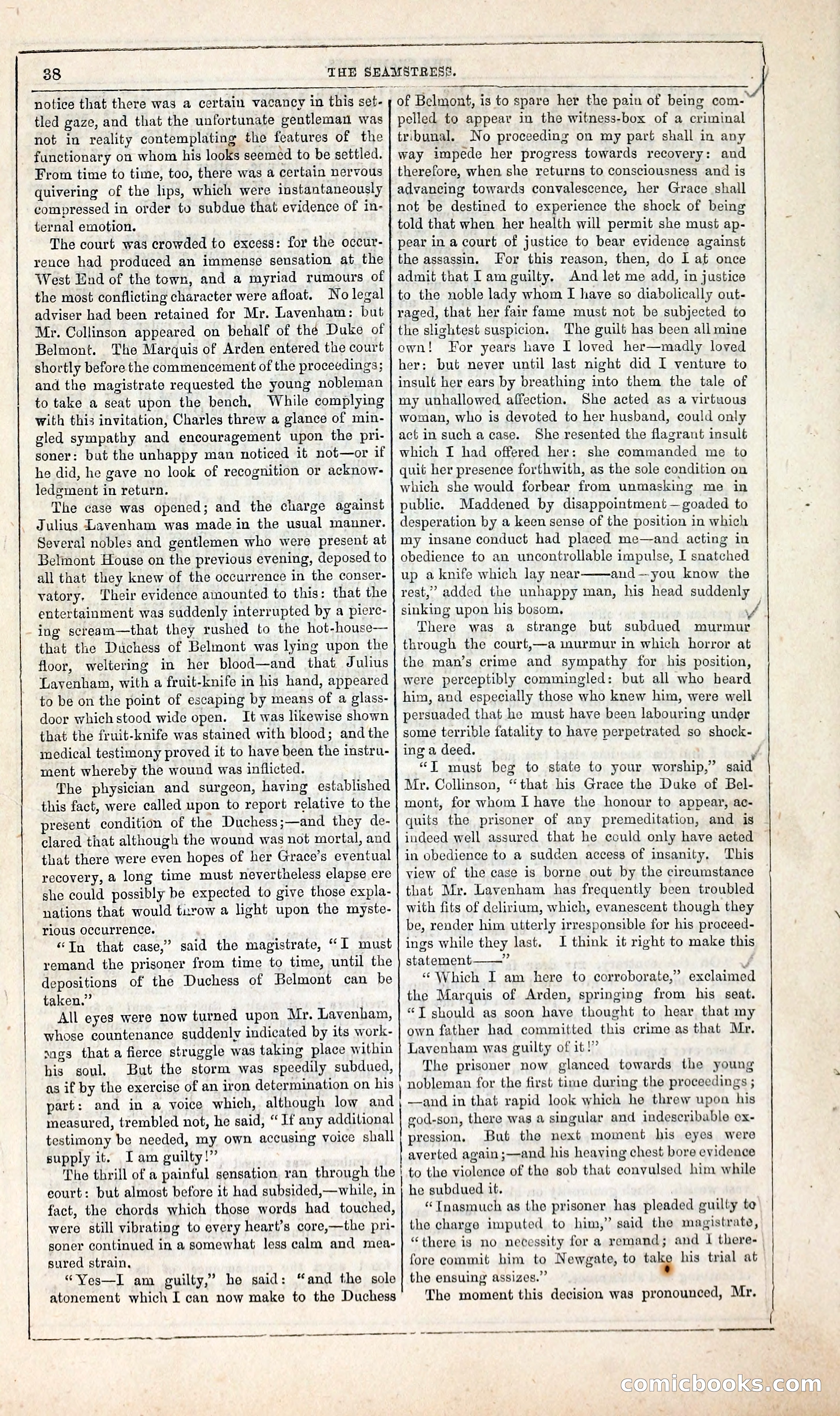
A restored page from Penny Dreadfuls, 1853. Page through the whole issue in the reader above.
📄 Transcribed text from this page (OCR, searchable)
Machine-transcribed from the original scan — historical spelling and the odd misread are preserved.
coments cn EEA ETD OEE O_O LIAL 38 —++ — notice that there was a certain vacancy in this set- tled gaze, and that the unfortunate gentleman was not in reality contemplating the features of the functionary on whom his looks seemed to be settled. From time to time, too, there was a certain nervous quivering of the lips, which were instantaneously compressed in order to subdue that evidence of in- ternal emotion. The court was crowded to excess: for the occur- rence had produced an immense sensation at the West End of the town, and a myriad rumours of the most conflicting character were afloat. No legal adviser had been retained for Mr. Lavenham: but Mr. Collinson appeared on behalf of thé Duke of Belmont. The Marquis of Arden entered the court shortly before the commencement of the proceedings; and the magistrate requested the young nobleman to take a seat upon the bench, While complying with this invitation, Charles threw a glance of min- gled sympathy and encouragement upon the pri- soner: but the unhappy man noticed it not—or if he did, he gave no look of recognition or acknow- ledement in return. The case was opened; and the charge against Julius Lavenham was made in the usual manner. Several nobles and gentlemen who were present at Belmont House on the previous evening, deposed to all that they knew of the occurrence in the conser- vatory. ‘heir evidence amounted to this: that the entertainment was suddenly interrupted by a piere- ing scream—that they rushed to the hot-house— that the Duchess of Belmont was lying upon the floor, weltering in her blood—and that Julius Lavenham, with a fruit-knife in his hand, appeared to be on the point of escaping by means of a glass- door which stood wide open. It was likewise shown that the fruit-knife was stained with blood; andthe medical testimony proved it to have been the instru- ment whereby the wound was inflicted. The physician and surgeon, having established this fact, were called upon to report relative to the present condition of the Duchess;—and they de- clared that although the wound was not mortal, and that there were even hopes of her Grace’s eventual recovery, a long time must nevertheless elapse ere she could possibly be expected to give those expla- nations that would turow a light upon the myste- rious occurrence. “In that case,” said the magistrate, “I must yemand the prisoner from time to time, until the depositions of the Duchess of Belmont can be taken.” All eyes were now turned upon Mr. Lavenham, whose countenance suddenly indicated by its work- sags that a fierce struggle was taking place within his soul. But the storm was speedily subdued, as if by the exercise of an iron determination on his part: and in a voice which, although low and measured, trembled not, he said, “If any additional testimony be needed, my own accusing voice shall supply it. Iam guilty!” The thrill of a painful sensation ran through the | eourt: but almost before it had subsided,—while, in fact, the chords which those words had touched, were still vibrating to every heart’s core,—the pri- soner continued in a somewhat less calm and mea- sured strain, “Yes—I am guilty,’ he said: “and the sole atonement which I can now make to the Duchess es oe te THE SEAMSTRESS. act 1n such a ease. ini ELLE OLA LL A LLL ALLA LLL LLL of Belmont, is to spare her the pain of being com- pelled to appear in the witness-box of a criminal tribunal. No proceeding on my part shall in any way impede her progress towards recovery: and therefore, when she returns to consciousness and is advancing towards convalescence, her Grace shall not be destined to experience the shock of being told that when her health will permit she must ap- pear in a court of justice to bear evidence against the assassin. For this reason, then, do I at once admit that Tam guilty, And let me add, in justice to the noble lady whom I have so diabolically out- raged, that her fair fame must not be subjected to the slightest suspicion. own! The guilt has been all mine For years have I loved her—madly loved her: but never until last night did I venture to insult her ears by breathing into them the tale of my unhallowed affection. She acted as a virtuous woman, who is devoted to her husband, could only She resented the flagrant insult which I had offered her: she commanded me to quit her presence forthwith, as the sole condition on which she would forbear from unmasking me in public. desperation by a keen sense of the position in which my insane conduct had placed me—and acting in Maddened by disappointment — goaded to obedience to an uncontrollable impulse, I snatched up a knife which lay near——and—you know the rest,” added the unhappy man, his head suddenly sinking upon his bosom, | There was a strange but subdued murmur through the court,—a murmur in which horror at the man’s crime and sympathy for his position, were perceptibly commingled: but all who heard him, and especially those who knew him, were well persuaded that he must have been labouring under some terrible fatality to have perpetrated so shock- ing a deed. “T must beg to state to your worship,” said Mr. Collinson, “that his Grace the Duke of Bel- mont, for whom I have the honour to appear, ac- quits the prisoner of any premeditation, and is indeed well assured that he cculd only have acted in obedience to a sudden access of insanity, This view of the case is borne out by the circumstance that Myr. Lavenham has frequently been troubled with fits of delirium, which, evanescent though they be, render him utterly irresponsible for his proceed- ings while they last. I think it right to make this statement———” , “ Which I am here to corroborate,” exclaimed the Marquis of Arden, springing from his seat. *T should as soon have thought to hear that my own father had committed this crime as that Mr. Lavenham was guilty of 16!” The prisoner now glanced towards the young nobleman for the first time during the proceedings ; —and in that rapid look which he threw upon his eod-son, there was a singular and indescribable ex- pression. But the next moment his eyes were averted again ;—and his heaving chest bore evidence to the violence of the sob that conyulsed him while he subdued it. “Tnasmuch as the prisoner has pleaded guilty te the charge imputed to him,” said the magistrate, “there is no necessity for a remand; and 1 there- fore commit him to Newgate, to tale his trial at the ensuing assizes.”’ The moment this decision was pronounced, Mr. EOMIGdoOO ‘S a.