
Penny Dreadfuls, 1853 · page 44 of 151
The Seamstress; or, The White Slave of England — page 44: what you’re looking at
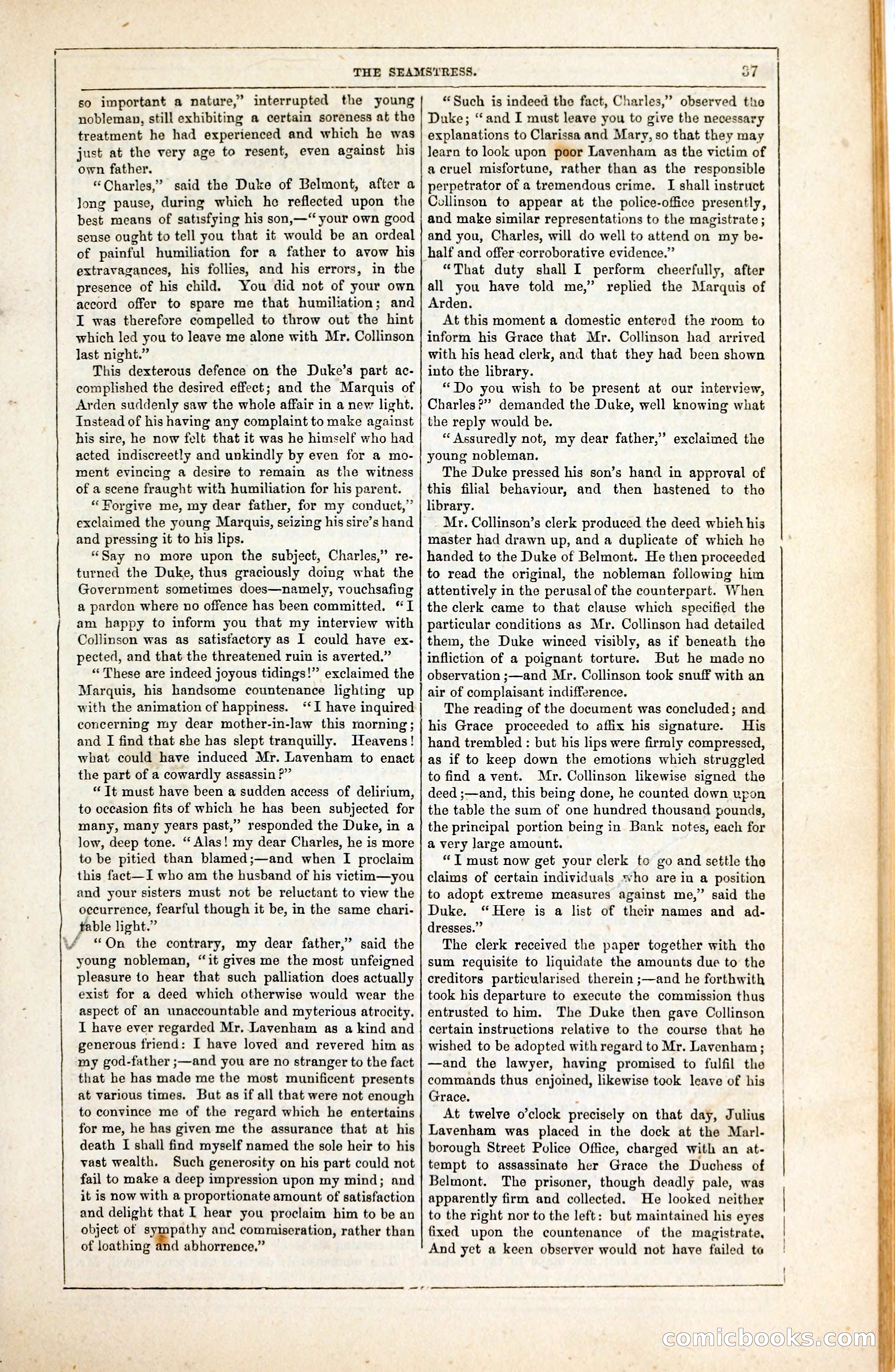
A restored page from Penny Dreadfuls, 1853. Page through the whole issue in the reader above.
📄 Transcribed text from this page (OCR, searchable)
Machine-transcribed from the original scan — historical spelling and the odd misread are preserved.
treatment he had experienced and which he was just at the very age to resent, even against his own father. “Charles,” said the Duke of Belmont, after a Jong pause, during which he reflected upon the best means of satisfying his son,—“ your own good seuse ought to tell you that it would be an ordeal of painful humiliation for a father to avow his extravagances, his follies, and his errors, in the presence of his child. You did not of your own accord offer to spare me that humiliation; and I was therefore compelled to throw out the hint which led you to leave me alone with Mr. Collinson last night.” This dexterous defence on the Duke’s part ac- complished the desired effect; and the Marquis of Arden suddenly saw the whole affair in a new light. Instead of his having any complaint to make against his sire, he now felt that it was he himself who had acted indiscreetly and unkindly by even for a mo- ment evincing a desire to remain as the witness of a scene fraught with humiliation for his parent. “Forgive me, my dear father, for my conduct,” exclaimed the young Marquis, seizing his sire’s hand and pressing it to his lips. “Say no more upon the subject, Charles,” re- turned the Duke, thus graciously doing what the Government sometimes does—namely, vouchsafing a pardon where no offence has been committed. I am happy to inform you that my interview with Collinson was as satistactory as I could have ex- pected, and that the threatened ruin is averted.” “These are indeed joyous tidings!” exclaimed the explanations to Clarissa and Mary, so that they may Jearn to look upon poor Lavenham as the victim of a cruel misfortune, rather than as the responsible perpetrator of a tremendous crime. I shall instruct Collinson to appear at the police-office presently, and make similar representations to the magistrate ; and you, Charles, will do well to attend on my be- half and offer corroborative evidence.” “That duty shall I perform cheerfully, after all you have told me,” replied the Marquis of Arden. At this moment a domestic entered the room to inform his Grace that Mr. Collinson had arrived with his head clerk, and that they had been shown into the library. “Do you wish to be present at our interview, Charles?” demanded the Duke, well knowing what the reply would be. “ Assuredly not, my dear father,’ exclaimed the young nobleman. The Duke pressed his son’s hand in approval of this filial behaviour, and then hastened to tho library. Mr. Collinson’s clerk produced the deed whieh his master had drawn up, and a duplicate of which he handed to the Duke of Belmont. He then proceeded to read the original, the nobleman following him attentively in the perusal of the counterpart. When the clerk came to that clause which specified the particular conditions as Mr. Collinson had detailed them, the Duke winced visibly, as if beneath the infliction of a poignant torture. But he made no observation ;—and Mr. Collinson took snuff with an Marquis, his handsome countenance lighting up | air of complaisant indifference. with the animation of happiness. concerning my dear mother-in-]aw this morning; and I find that she has slept tranquilly. Heavens! what could have induced Mr. Lavenham to enact the part of a cowardly assassin P” * Tt must have been a sudden access of delirium, to occasion fits of which he has been subjected for many, many years past,” responded the Duke, in a low, deep tone. “ Alas! my dear Charles, he is more to be pitied than blamed;—and when I proclaim this fact—I who am the husband of his viectim—you and your sisters must not be reluctant to view the occurrence, fearful though it be, in the same chari- table light.” ‘f “On the contrary, my dear father,’ said the young nobleman, “it gives me the most unfeigned pleasure to hear that such palliation does actually exist for a deed which otherwise would wear the aspect of an unaccountable and myterious atrocity. I have ever regarded Mr. Lavenham as a kind and generous friend: I have loved and revered him as my god-father ;—and you are no stranger to the fact that he has made me the most munificent presents at various times. But as if all that were not enough to convince me of the regard which he entertains for me, he has given me the assurance that at his death I shall find myself named the sole heir to his vast wealth. Such generosity on his part could not fail to make a deep impression upon my mind; and it is now with a proportionate amount of satisfaction and delight that I hear you proclaim him to be an object of sympathy anc commiseration, rather than of loathing and abhorrence.” THE SEAMS‘RESS. o7 so important a nature,” interrupted the young “Such is indeed the fact, Charles,” observed the nobleman, still exhibiting a certain soreness at the | Duke; “and I must leave you to give the necessary **T have inquired | } The reading of the document was concluded; and his Grace proceeded to affix his signature. His hand trembled : but his lips were firmly compressed, as if to keep down the emotions which struggled to find avent. Mr. Collinson likewise signed the deed ;—and, this being done, he counted down upon the table the sum of one hundred thousand pounds, the principal portion being in Bank notes, each for a very large amount. “I must now get your clerk to go and settle the claims of certain individuals ho are in a position to adopt extreme measures against me,” said the Duke. “Here is a list of their names and ad- dresses.” The clerk received the paper together with tho sum requisite to liquidate the amounts due to the creditors particularised therein ;—and he forthwith took his departure to execute the commission thus entrusted to him. The Duke then gave Collinson certain instructions relative to the course that he wished to be adopted with regard to Mr. Lavenham; —and the lawyer, having promised to fulfil the commands thus enjoined, likewise took leave of his Grace. At twelve o’clock precisely on that day, Julius Lavenham was placed in the dock at the Marl- borough Street Police Office, charged with an at- tempt to assassinate her Grace the Duchess of Belmont. The prisoner, though deadly pale, was apparently firm and collected. He looked neither to the right nor to the left: but maintained his eyes fixed upon the countenance of the magistrate, And yet a keen observer would not have failed ta (CO) Cc SS (E@)