
Penny Dreadfuls, 1853 · page 26 of 151
The Seamstress; or, The White Slave of England — page 26: what you’re looking at
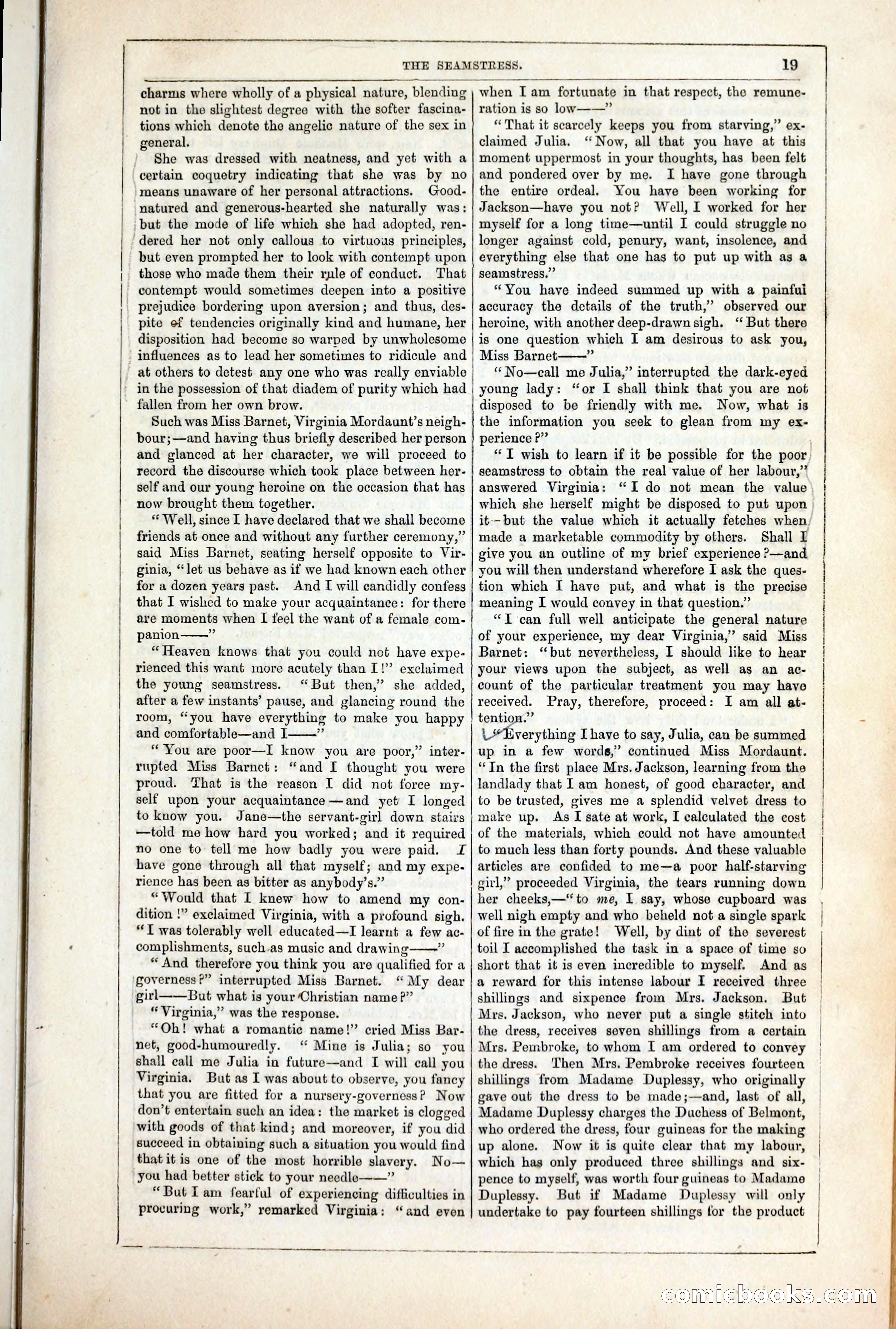
A restored page from Penny Dreadfuls, 1853. Page through the whole issue in the reader above.
📄 Transcribed text from this page (OCR, searchable)
Machine-transcribed from the original scan — historical spelling and the odd misread are preserved.
governess?” interrupted Miss Barnet. THE SEAMSTRESS, charms where wholly of a physical nature, blending not in the slightest degree with the softer fascina- tions which denote the angelic nature of the sex in general. She was dressed with neatness, and yet with a certain coquetry indicating that she was by no means unaware of her personal attractions. Good- natured and generous-hearted she naturally was: ‘but the mode of life which she had adopted, ren- dered her not only callous to virtuous principles, but even prompted her to look with contempt upon those who made them their rule of conduct. That contempt would sometimes deepen into a positive _ prejudice bordering upon aversion; and thus, des- pite ef tendencies originally kind and humane, her disposition had become so warped by unwholesome influences as to lead her sometimes to ridicule and at others to detest any one who was really enviable - in the possession of that diadem of purity which had fallen from her own brow. Such was Miss Barnet, Virginia Mordaunt’s neigh- bour;—and having thus briefly described her person and glanced at her character, we will proceed to record the discourse which took place between her- self and our young heroine on the occasion that has now brought them together. ** Well, since [ have declared that we shall become friends at once and without any further ceremony,” said Miss Barnet, seating herself opposite to Vir- ginia, “let us behave as if we had known each other for a dozen years past. And I will candidly confess that I wished to make your acquaintance: for there are moments when I feel the want of a female com- panion——” “Heaven knows that you could not have expe- rienced this want more acutely than I!’ exclaimed the young seamstress. “But then,” she added, after a few instants’ pause, and glancing round the room, “you have everything to make you happy and comfortable—and I——” You are poor—I know you are poor,” inter- rupted Miss Barnet: “and I thought you were proud. That is the reason I did not force my- self upon your acquaintance —and yet I longed to know you. Jane—the servant-girl down stairs —told me how hard you worked; and it required no one to tell me how badly you were paid. I have gone through all that myself; and my expe- rience has been as bitter as anybody’s.”’ “Would that I knew how to amend my con- dition !” exclaimed Virginia, with a profound sigh. *T was tolerably well educated—I learnt a few ac- complishments, such.as music and drawing——” “And therefore you think you are qualified for a “My dear girl But what is your ‘Christian name ?” Virginia,” was the response. “Oh! what a romantic name!” cried Miss Bar- net, good-humouredly. ‘ Mine is Julia; so you shall call me Julia in future—and I will call you Virginia. But as I was about to observe, you fancy that you are fitted for a nursery-governess? Now don’t entertain such an idea: the market is clogged with goods of that kind; and moreover, if you did succeed in obtaining such a situation you would find that it is one of the most horrible slavery. No— you had better stick to your needle——” “But Tam fearful of experiencing difficulties in procuring work,” remarked Virginia: “and even OS eee ees ee when I am fortunate in that respect, the remune- ration is so low——” “That it scarcely keeps you from starving,” ex- claimed Julia. ‘“ Now, all that you have at this moment uppermost in your thoughts, has been felt and pondered over by me. I have gone through the entire ordeal. You have been working for Jackson—have you not? Well, I worked for her myself for a long time—until I could struggle no longer against cold, penury, want, insolence, and everything else that one has to put up with as a seamstress.” “You have indeed summed up with a painfui accuracy the details of the truth,’ observed our heroine, with another deep-drawn sigh. ‘ But there is one question which I am desirous to ask you, Miss Barnet 7 “ No—call me Julia,” interrupted the dark-eyed young lady: ‘or I shall think that you are not disposed to be friendly with me. Now, what is the information you seek to glean from my ex- perience P” “‘I wish to learn if it be possible for the poor | seamstress to obtain the real value of her labour,’’ answered Virginia: “I do not mean the value which she herself might be disposed to put upon it-—but the value which it actually fetches when. made a marketable commodity by others. Shall I give you an outline of my brief experience ?—and you will then understand wherefore I ask the ques- tion which I have put, and what is the precise meaning I would convey in that question.” “T can full well anticipate the general nature of your experience, my dear Virginia,’ said Miss Barnet: “but nevertheless, L should like to hear your views upon the subject, as well as an ac- count of the particular treatment you may have received. Pray, therefore, proceed: I am all at- tention.” Everything I have to say, Julia, can be summed up in a few words,” continued Miss Mordaunt. “In the first place Mrs. Jackson, learning from the landlady that Iam honest, of good character, and to be trusted, gives me a splendid velvet dress to make up. As I sate at work, I calculated the cost of the materials, which could not have amounted to much less than forty pounds. And these valuable articles are confided to me—a poor half-starving girl,” proceeded Virginia, the tears running down her cheeks,—‘ to me, 1 say, whose cupboard was well nigh empty and who beheld not a single spark of fire in the grate! Well, by dint of the severest toil I accomplished the task in a space of time so short that it is even incredible to myself. And as a reward for this intense labour I received three shillings and sixpence from Mrs. Jackson. But Mrs. Jackson, who never put a single stitch into the dress, receives seven shillings from a certain Mrs. Pembroke, to whom I am ordered to convey the dress. ‘Then Mrs. Pembroke receives fourteen shillings from Madame Duplessy, who originally gave oul the dress to be made;—and, last of all, Madame Duplessy charges the Duchess of Belmont, who ordered the dress, four guineas for the making up alone. Now it is quite clear that my labour, which has only produced three shillings and six- pence to myself, was worth four guineas to Madame Duplessy. But if Madame Duplessy will only undertake to pay fourteen shillings for the product LS Seen A SY NU _ LR SN EE A tL a te i ttt tn tt —_-—_---_ errr + k_— ER ee _ a FOS EE Se neta us — — ae ae ee ee NOOO KS .EO© <S : | GOMmIG