
Penny Dreadfuls, 1853 · page 25 of 151
The Seamstress; or, The White Slave of England — page 25: what you’re looking at
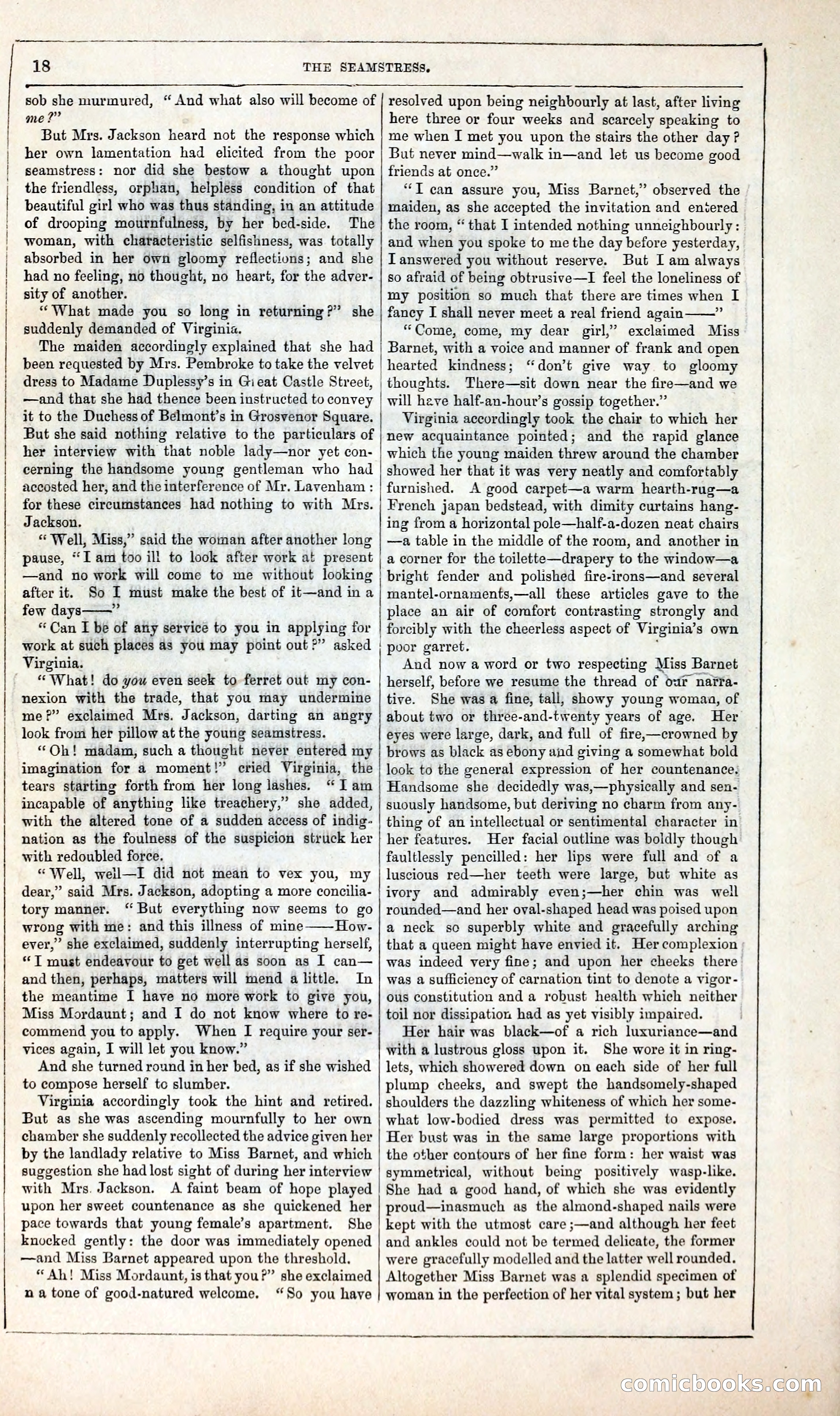
A restored page from Penny Dreadfuls, 1853. Page through the whole issue in the reader above.
📄 Transcribed text from this page (OCR, searchable)
Machine-transcribed from the original scan — historical spelling and the odd misread are preserved.
TL Tc stent eesti -, . Oe A 18 sob she murmured, “And what also will become of me ?” But Mrs. Jackson heard not the response which her own lamentation had elicited from the poor seamstress: nor did she bestow a thought upon the friendless, orphan, helpless condition of that beautiful girl who was thus standing, in an attitude of drooping mournfulness, by her bed-side. The woman, with chatacteristic selfishness, was totally absorbed in her own gloomy reflections; and she had no feeling, no thought, no heart, for the adver- sity of another. “What made you so long in returning?” she suddenly demanded of Virginia. The maiden accordingly explained that she had been requested by Mrs. Pembroke to take the velvet dress to Madame Duplessy’s in Gieat Castle Street, —and that she had thence been instructed to convey it to the Duchess of Belmont’s in Grosvenor Square. But she said nothing relative to the particulars of her interview with that noble lady—nor yet con- cerning the handsome young gentleman who had accosted her, and the interference of Mr. Lavenham : for these circumstances had nothing to with Mrs. Jackson. “ Well, Miss,” said the woman after another long pause, “I am too ill to look after work at present —and no work will come to me without looking after it. So I must male the best of it—and ina few days——” “ Can I be of any service to you in applying for work at such places as you may point out >” asked ‘Virginia. “ What! do you even seek to ferret out my con- nexion with the trade, that you may undermine me?” exclaimed Mrs. Jackson, darting an angry look from her pillow at the young seamstress. “Oh! madam, such a thought never entered my imagination for a moment!” cried Virginia, the tears starting forth from her long lashes. “Iam incapable of anything like treachery,’ she added, with the altered tone of a sudden access of indig- nation as the foulness of the suspicion struck her with redoubled force. “Well, weil—I did not mean to vex you, my dear,” said Mrs. Jackson, adopting a more concilia- tory manner. “ But everything now seems to go wrong with me: and this illness of mine -—~How- ever,” she exclaimed, suddenly interrupting herself, “T must endeavour to get well as soon as I can— and then, perhaps, matters will mend a little. In the meantime I have no more work to give you, Miss Mordaunt; and I do not know where to re- commend you to apply. When I require your ser- vices again, I will let you know.” And she turned round in her bed, as if she wished to compose herself to slumber. Virginia accordingly took the hint and retired. But as she was ascending mournfully to her own chamber she suddenly recollected the advice given her by the landlady relative to Miss Barnet, and which suggestion she had lost sight of during her interview with Mrs. Jackson. A faint beam of hope played upon her sweet countenance as she quickened her pace towards that young female’s apartment. She knocked gently: the door was immediately opened —and Miss Barnet appeared upon the threshold. * Ah! Miss Mordaunt, is that you?” she exclaimed na tone of good-natured welcome. “So you have nme THE SEAMSTRESS, resolved upon being neighbourly at last, after living here three or four weeks and scarcely speaking to me when I met you upon the stairs the other day? But never mind—walk in—and let us become good friends at once.” “‘T can assure you, Miss Barnet,” observed the maiden, as she accepted the invitation and entered the room, “ that I intended nothing unneighbourly: and when you spoke to me the day before yesterday, I answered you without reserve. But I am always so afraid of being obtrusive—I feel the loneliness of my position so much that there are times when I fancy I shall never meet a real friend again 4 “Come, come, my dear girl,” exclaimed Miss Barnet, with a voice and manner of frank and open hearted kindness; “don’t give way to gloomy thoughts. There—sit down near the fire—and we will have half-an-hour’s gossip together.” Virginia accordingly took the chair to which her new acquaintance pointed; and the rapid glance which the young maiden threw around the chamber showed her that it was very neatly and comfortably furnished. A good carpet—a warm hearth-rug—a French japan bedstead, with dimity curtains hang- ing from a horizontal pole—half-a-dozen neat chairs —a table in the middle of the room, and another in a corner for the toilette—drapery to the window—a bright fender and polished fire-irons—and several mantel-ornaments,—all these articles gave to the place an air of comfort contrasting strongly and forcibly with the cheerless aspect of Virginia’s own poor garret. : And now a word or two respecting Miss Barnet herself, before we resume the thread of our nafra- tive. She was a fine, tall, showy young womaa, of about two or three-and-twenty years of age. Her eyes were large, dark, and full of fire,—crowned by brows as black as ebony and giving a somewhat bold look to the general expression of her countenance. Handsome she decidedly was,—physically and sen- suously handsome, but deriving no charm from any- thing of an intellectual or sentimental character in her features. Her facial outline was boldly though faultlessly pencilled: her lips were full and of a luscious red—her teeth were large, but white as ivory and admirably even;—her chin was well rounded—and her oval-shaped head was poised upon a neck so superbly white and gracefully arching that a queen might have envied it. Her complexion was indeed very fine; and upon her cheeks there was a sufficiency of carnation tint to denote a vigor- ous constitution and a robust health which neither toil nor dissipation had as yet visibly impaired. Her hair was black—of a rich luxuriance—and with a lustrous gloss upon it. She wore it in ring- lets, which showered down on each side of her full plump cheeks, and swept the handsomely-shaped shoulders the dazzling whiteness of which her some- what low-bodied dress was permitted to expose. Her bust was in the same large proportions with the other contours of her fine form: her waist was symmetrical, without being positively wasp-like. She had a good hand, of which she was evidently proud—inasmuch as the almond-shaped nails were kept with the utmost care ;—and although her feet and ankles could not be termed delicate, the former were gracefully modelled and the latter well rounded. Altogether Miss Barnet was a splendid specimen of woman in the perfection of her vital system; but her 16)(0)(0) (Q) :