
Penny Dreadfuls, 1853 · page 103 of 151
The Seamstress; or, The White Slave of England — page 103: what you’re looking at
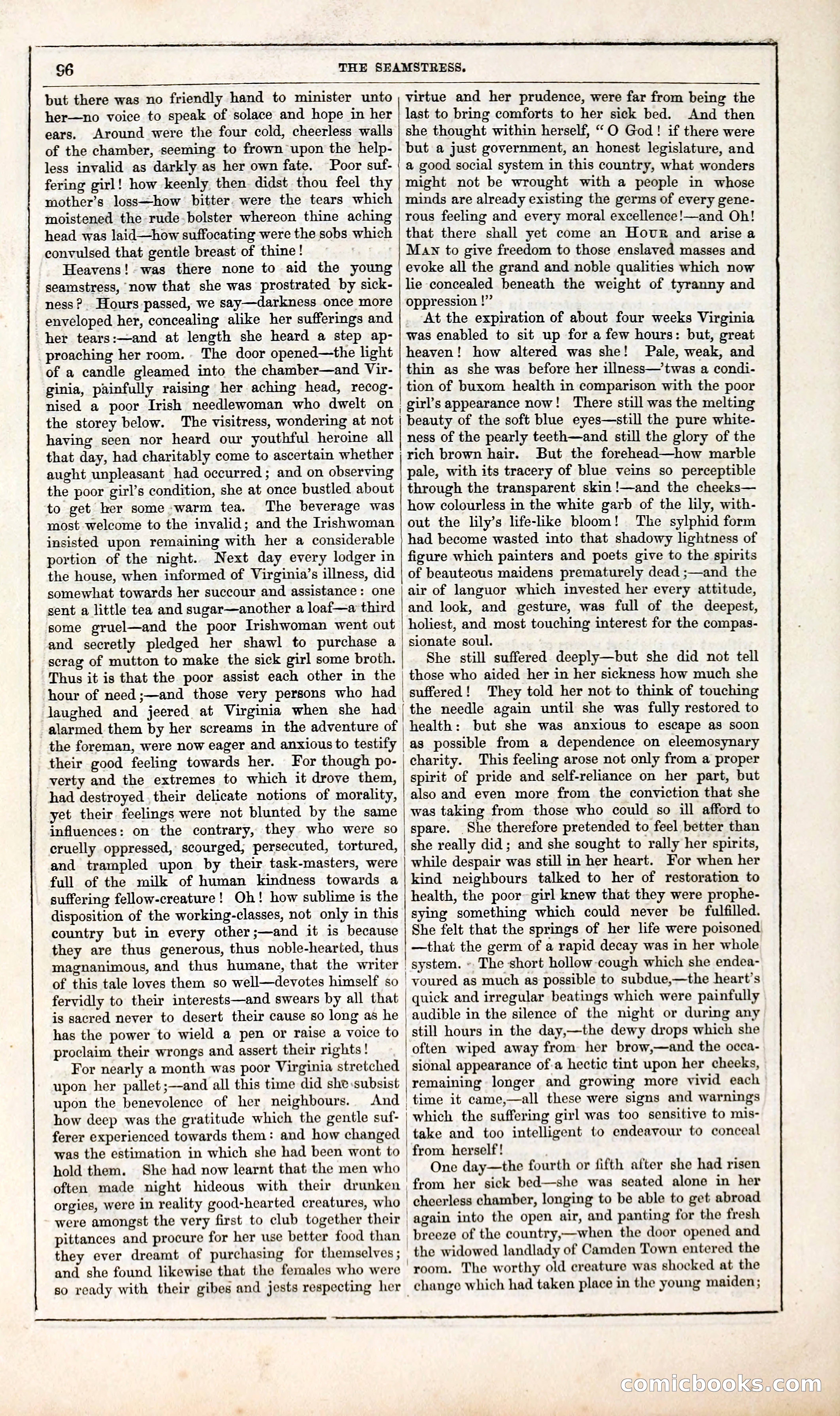
A restored page from Penny Dreadfuls, 1853. Page through the whole issue in the reader above.
📄 Transcribed text from this page (OCR, searchable)
Machine-transcribed from the original scan — historical spelling and the odd misread are preserved.
S6 but there was no friendly hand to minister unto her—no voice to speak of solace and hope in her ears. Around were the four cold, cheerless walls of the chamber, seeming to frown upon the help- less invalid as darkly as her own fate. Poor suf- fering girl! how keenly then didst thou feel thy mother’s loss—how bitter. were the tears which moistened the rude-bolster whereon thine aching head was laid—how suffocating were the sobs which convulsed that gentle breast of thine! Heavens! was there none to aid the young seamstress, now that she was prostrated by sick- ness? Hours passed, we say—darkness once more enveloped her, concealing alike her sufferings and her tears:—and at length she heard a step ap- proaching her room. The door opened—the light of a candle gleamed into the chamber—and Vir- ginia, painfully raising her aching head, recog- nised a poor Irish needlewoman who dwelt on | the storey below. The visitress, wondering at not | having seen nor heard our youthful heroine all that day, had charitably come to ascertain whether | aught unpleasant had occurred ; and on observing the poor girl’s condition, she at once bustled about to get her some warm tea. The beverage was most weleome to the invalid; and the Irishwoman insisted upon remaining with her a considerable portion of the night. Next day every lodger in the house, when informed of Virginia’s illness, did somewhat towards her succour and assistance: one sent a little tea and sugar—another a loaf—a third some gruel—and the poor Irishwoman went out and secretly pledged her shawl to purchase a scrag of mutton to make the sick girl some broth. Thus it is that the poor assist each other in the hour of need ;—and those very persons who had laughed and jeered at Virginia when she had | alarmed them by her screams in the adventure of the foreman, were now eager and anxious to testify their good feeling towards her. For though po- verty and the extremes to which it drove them, had destroyed their delicate notions of morality, yet their feelings were not blunted by the same influences: on the contrary, they who were so cruelly oppressed, scourged, persecuted, tortured, and trampled upon by their task-masters, were full of the milk of human kindness towards a suffering fellow-creature! Oh! how sublime is the disposition of the working-classes, not only in this country but in every other;—and it is because they are thus generous, thus noble-hearted, thus magnanimous, and thus humane, that the writer | of this tale loves them so well—devotes himself so fervidly to their interests—and swears by all that is sacred never to desert their cause so long as he has the power to wield a pen or raise a voice to proclaim their wrongs and assert their rights! For nearly a month was poor Virginia stretched upon her pallet ;—and all this time did she subsist upon the benevolence of her neighbours. And how deep was the gratitude which the gentle suf- ferer experienced towards them: and how changed was the estimation in which she had been wont to hold them. She had now learnt that the men who often made night hideous with their drunken orgies, were in reality good-hearted creatures, who were amongst the very first to club together their pittances and procure for her use better food than they ever dreamt of purchasing for themselves; and she found likewise that the females who were THE SEAMSTRESS, virtue and her prudence, were far from being the last to bring comforts to her sick bed. And then she thought within herself, “O God! if there were but a just government, an honest legislature, and a good social system in this country, what wonders might not be wrought with a people in whose minds are already existing the germs of every gene- rous feeling and every moral excellence!—and Oh! that there shall yet come an Hour and arise a Man to give freedom to those enslaved masses and evoke all the grand and noble qualities which now lie concealed beneath the weight of tyranny and oppression !” At the expiration of about four weeks Virginia was enabled to sit up for a few hours: but, great heaven! how altered was she! Pale, weak, and thin as she was before her illness—’twas a condi- tion of buxom health in comparison with the poor girl’s appearance now! There still was the melting beauty of the soft blue eyes—still the pure white- ness of the pearly teeth—and still the glory of the rich brown hair. But the forehead—how marble pale, with its tracery of blue veins so perceptible through the transparent skin !—and the cheeks— how colourless in the white garb of the lily, with- out the lily’s life-like bloom! The sylphid form had become wasted into that shadowy lightness of figure which painters and poets give to the spirits of beauteous maidens prematurely dead ;—and the air of languor which invested her every attitude, and look, and gesture, was full of the deepest, holiest, and most touching interest for the compas- sionate soul. She still suffered deeply—but she did not tell those who aided her in her sickness how much she suffered! They told her not to think of touching the needle again until she was fully restored to health: but she was anxious to escape as soon as possible from a dependence on eleemosynary charity. This feeling arose not only from a proper spirit of pride and self-reliance on her part, but also and even more from the conviction that she was taking from those who could so ill afford to spare. She therefore pretended to feel better than she really did; and she sought to rally her spirits, while despair was still in her heart. For when her kind neighbours talked to her of restoration to health, the poor girl knew that they were prophe- sying something which could never be fulfilled. She felt that the springs of her life were poisoned —that the germ of a rapid decay was in her whole system. » The short hollow cough which she endea- voured as much as possible to subdue,—the heart’s quick and irregular beatings which were painfully audible in the silence of the night or during any still hours in the day,—the dewy drops which she often wiped away from her brow,—and the occa- sional appearance of-a hectic tint upon her cheeks, remaining longer and growing more vivid each time it came,—all these were signs and warnings which the suffering girl was too sensitive to mis- take and too intelligent to endeavour to conceal from herself! One day—the fourth or fifth after she had risen from her sick bed—she was seated alone in her cheerless chamber, longing to be able to get abroad again into the open air, and panting for the fresh breeze of the country,—when the door opened and the widowed landlady of Camden Town entered the room. The worthy old creature was shocked at the so ready with their gibes and jests respecting her change which had taken place in the young maiden; ibook