
Penny Dreadfuls, 1853 · page 102 of 151
The Seamstress; or, The White Slave of England — page 102: what you’re looking at
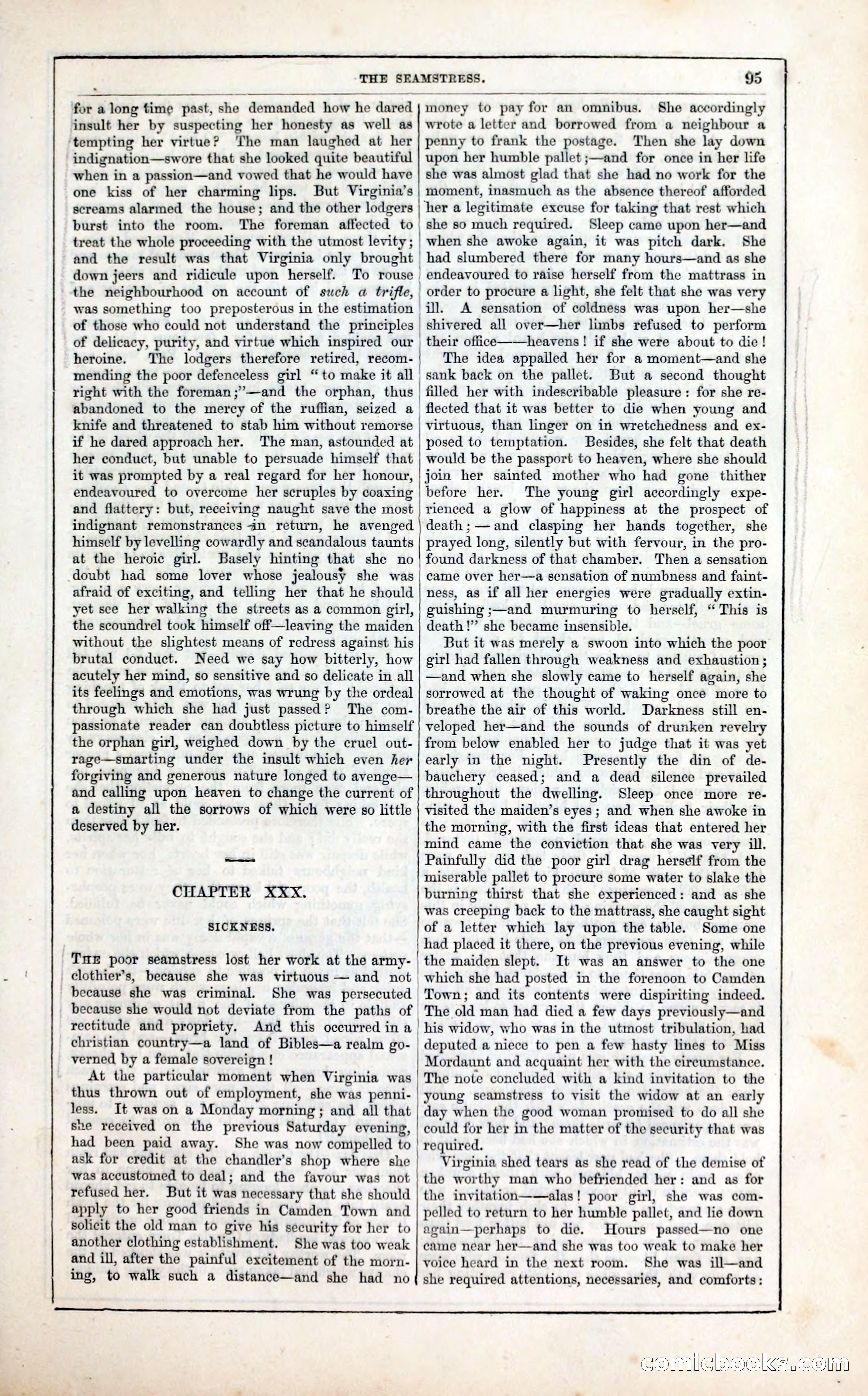
A restored page from Penny Dreadfuls, 1853. Page through the whole issue in the reader above.
📄 Transcribed text from this page (OCR, searchable)
Machine-transcribed from the original scan — historical spelling and the odd misread are preserved.
‘tempting her virtue? THE SEAMSTRESS. for a long time past, she demanded how he dared insult her by suspecting her honesty as well as The man laughed at her indignation—swore that she looked quite beautiful when in a passion—and vowed that he would have 95 money to pay for an omnibus. She accordingly wrote a letter and borrowed from a neighbour a penny to frank the postage. Then she lay down upon her humble pallet ;—and for once in her life she was almost glad that she had no work for the moment, inasmuch as the absence thereof afforded one kiss of her charming lips. But Virginia’s screams alarmed the house; and the other lodgers | her a legitimate excuse for taking that rest which burst into the room. The foreman affected to, she so much required. Sleep came upon her—and treat the whole proceeding with the utmost levity; | when she awoke again, it was pitch dark. She and the result was that Virginia only brought | had slumbered there for many hours—and as she down jeers and ridicule upon herself. To rouse | endeavoured to raise herself from the mattrass in the neighbourhood on account of such a trifle, order to procure a light, she felt that she was very was something too preposterous in the estimation ill. A sensation of coldness was upon her—she of those who could not understand the principles shivered all over—her limbs refused to perform of delicacy, purity, and virtue which inspired our | their office——heavens! if she were about to die! heroine. The lodgers therefore retired, recom-| The idea appalled her for a moment—and she mending the poor defenceless girl “to make it all sank back on the pallet. But a second thought right with the foreman ;’—and the orphan, thus filled her with indescribable pleasure: for she re- abandoned to the mercy of the ruffian, seized a flected that it was better to die when young and knife and threatened to stab him without remorse if he dared approach her. The man, astounded at her conduct, but unable to persuade himself that it was prompted by a real regard for her honour, endeavoured to overcome her scruples by coaxing and flattery: but, receiving naught save the most indignant remonstrances an return, he avenged himself by levelling cowardly and scandalous taunts at the heroic girl. Basely hinting that she no doubt had some lover whose jealousy she was afraid of exciting, and telling her that he should yet see her walking the streets as a common girl, the scoundrel took himself off—leaving the maiden without the slightest means of redress against his brutal conduct. Need we say how bitterly, how acutely her mind, so sensitive and so delicate in all its feelings and emotions, was wrung by the ordeal through which she had just passed? The com- virtuous, than linger on in wretchedness and ex- posed to temptation. Besides, she felt that death would be the passport to heaven, where she should join her sainted mother who had gone thither before her. The young girl accordingly expe- rienced a glow of happiness at the prospect of death; — and clasping her hands together, she prayed long, silently but with fervour, in the pro- ' found darkness of that chamber. Then a sensation came over her—a sensation of numbness and faint- ness, as if all her energies were gradually extin- guishing ;—and murmuring to herself, “ This is death !”’ she became insensible. But it was merely a swoon into which the poor girl had fallen through weakness and exhaustion; —and when she slowly came to herself again, she sorrowed at the thought of waking once more to breathe the air of this world. Darkness still en- passionate reader can doubtless picture to himself | veloped her—and the sounds of drunken revelry the orphan girl, weighed down by the cruel out- rage—smarting under the insult which even her forgiving and generous nature longed to avenge— and calling upon heaven to change the current of a destiny all the sorrows of which were so little deserved by her. CHAPTER XXX. SICKNESS. THE poor seamstress lost her work at the army- clothier’s, because she was virtuous — and not because she was criminal. She was persecuted because she would not deviate from the paths of. rectitude and propriety. And this occurred in a christian country—a land of Bibles—a realm go- verned by a female sovereign ! At the particular moment when Virginia was thus thrown out of employment, she was penni- less. It was on a Monday morning; and all that sne received on the previous Saturday evening, had been paid away. She was now compelled to ask for credit at the chandler’s shop where she was accustomed to deal; and the favour was not refused her. But it was necessary that she should apply to her good friends in Camden Town and solicit the old man to give his security for her to another clothing establishment. She was too weak and ill, after the painful excitement of the morn- ing, to walk such a distance—and she had no from below enabled her to judge that it was yet early in the night. Presently the din of de- bauchery ceased; and a dead silence prevailed throughout the dwelling. Sleep once more re- visited the maiden’s eyes; and when she awoke in the morning, with the first ideas that entered her mind came the conviction that she was very ill. Painfully did the poor girl drag herself from the miserable pallet to procure some water to slake the burning thirst that she experienced: and as she was creeping back to the mattrass, she caught sight of a letter which lay upon the table. Some one had placed it there, on the previous evening, while the maiden slept. It was an answer to the one which she had posted in the forenoon to Camden Town; and its contents were dispiriting indeed. The old man had died a few days previously—and his widow, who was in the utmost tribulation, had deputed a niece to pen a few hasty lines to Miss Mordaunt and acquaint her with the circumstance. The note concluded with a kind invitation to the young seamstress to visit the widow at an early day when the good woman promised to do all she could for her in the matter of the security that was required. Virginia shed tears as she read of the demise of the worthy man who befriended her: and as for the invitation——alas! poor girl, she was com- pelled to return to her humble pallet, and lie down again—perhaps to die. Hours passed—no one came near her—and she was too weak to make her voice heard in the next room. She was ill—and she required attentions, necessaries, and comforts: CORnnIECLOO© oe ——_———— ne (SO)