
Penny Dreadfuls, 1854 · page 390 of 400
Rosa Lambert — page 390: what you’re looking at
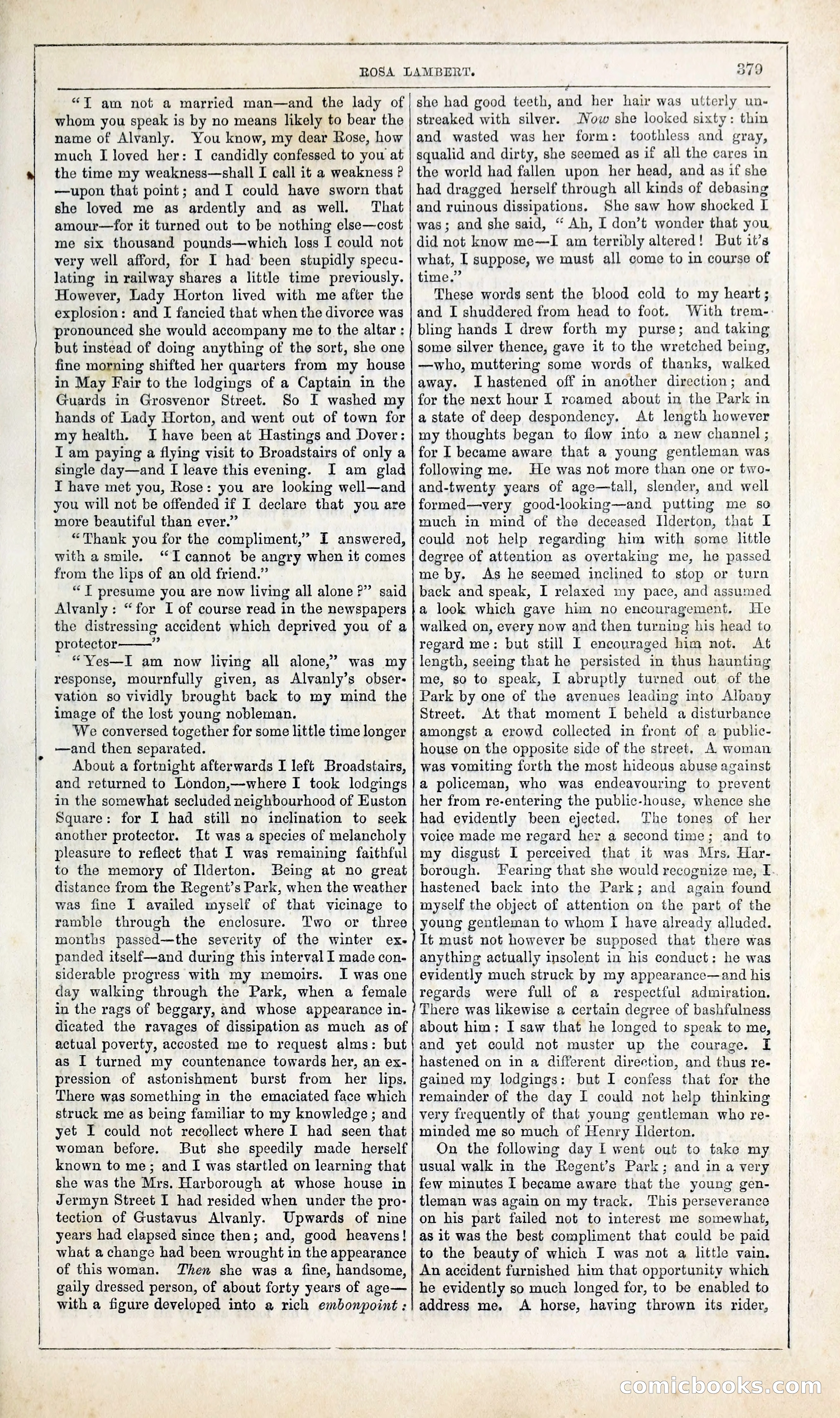
A restored page from Penny Dreadfuls, 1854. Page through the whole issue in the reader above.
📄 Transcribed text from this page (OCR, searchable)
Machine-transcribed from the original scan — historical spelling and the odd misread are preserved.
| ROSA LAMBERT. 379 i NN —— eC “JT am not a married man—and the lady of whom you speak is by no means likely to bear the name of Alvanly. You know, my dear Rose, how much I loved her: I candidly confessed to you at the time my weakness—shall I calli it a weakness P —upon that point; and I could have sworn that she loved me as ardently and as well. That amour—for it turned out to be nothing else—cost me six thousand pounds—which loss I could not very well afford, for I had been stupidly specu- lating in railway shares a little time previously. However, Lady Horton lived with me after the explosion: and I fancied that when the divorce was pronounced she would accompany me to the altar : but instead of doing anything of the sort, she one fine morning shifted her quarters from my house | in May Fair to the lodgings of a Captain in the Guards in Grosvenor Street. So I washed my hands of Lady Horton, and went out of town for my health. I have been at Hastings and Dover: I am paying a flying visit to Broadstairs of only a single day—and I leave this evening. I am glad I have met you, Rose: you are looking well—and you will not be offended if I declare that you are more beautiful than ever.” “Thank you for the compliment,’ I answered, with a smile. ‘I cannot be angry when it comes from the lips of an old friend.” “I presume you are now living all alone ?” said Alvanly: “for I of course read in the newspapers the distressing accident which deprived you of a protector “ “Yes—I am now living all alone,’ was my response, mournfully given, as Alvanly’s obser- vation so vividly brought back to my mind the image of the lost young nobleman. We conversed together for some little time longer —and then separated. About a fortnight afterwards I left Broadstairs, and returned to London,—where I took lodgings in the somewhat secluded neighbourhood of Euston Square: for I had still no inclination to seek another protector. It was a species of melancholy pleasure to reflect that I was remaining faithful to the memory of Ilderton. Being at no great distance from the Regent’s Park, when the weather was fine I availed myself of that vicinage to ramble through the enclosure. Two or three months passed—the severity of the winter ex- panded itself—and during this interval I made con- siderable progress with my memoirs. I was one day walking through the Park, when a female in the rags of beggary, and whose appearance in- dicated the ravages of dissipation as much as of actual poverty, accosted me to request alms: but as I turned my countenance towards her, an ex- pression of astonishment burst from her lips. There was something in the emaciated face which struck me as being familiar to my knowledge; and yet I could not recollect where I had seen that woman before. But she speedily made herself known to me; and I was startled on learning that she was the Mrs. Harborough at whose house in Jermyn Street I had resided when under the pro- tection of Gustavus Alvanly. Upwards of nine years had elapsed since then; and, good heavens! what a change had been wrought in the appearance of this woman. Then she was a fine, handsome, gaily dressed person, of about forty years of age— with a figure developed into a rich embonpoint : she had good teeth, and her hair was utterly un- streaked with silver. Now she looked sixty: thin and wasted was her form: toothless and gray, squalid and dirty, she seemed as if all the cares in the world had fallen upon her head, and as if she had dragged herself through all kinds of debasing and ruinous dissipations. She saw how shocked L was; and she said, “ Ah, I don’t wonder that you. did not know me—I am terribly altered! But it’s what, I suppose, we must all come to in course of time.” | These words sent the blood cold to my heart; and I shuddered from head to foot. Wath trem- bling hands I drew forth my purse; and taking some silver thence, gave it to the wretched being, —who, muttering some words of thanks, walked away. J hastened off in another direction; and for the next hour I roamed about in the Park in a state of deep despondency, At length however my thoughts began to flow into a new channel; for I became aware that a young gentleman was following me. He was not more than one or two- and-twenty years of age—tall, slender, and well formed—very good-looking—and putting me so much in mind of the deceased Ilderton, that I could not help regarding him with some little degree of attention as overtaking me, he passed me by. As he seemed inclined to stop or turn back and speak, I relaxed my pace, and assumed a look which gave him no encouragement. He walked on, every now and then turning his head to regard me: but still I encouraged him not. At length, seeing that he persisted in thus haunting me, so to speak, I abruptly turned out. of the Park by one of the avenues leading into Albany Street. At that moment I beheld a disturbance amongst a erowd collected in front of a public- | house on the opposite side of the street. A woman was vomiting forth the most hideous abuse against a policeman, who was endeavouring to prevent her from re-entering the public-house, whence she had evidently been ejected. The tones of her voice made me regard her a second time; and to my disgust I perceived that it was Mrs, Har- borough. Fearing that she would recognize me, I.. hastened back into the Park; and again found myself the object of attention on the part of the young gentleman to whom I have already alluded. It must not however be supposed that there was anything actually insolent in his conduct: he was evidently much struck by my appearance—and his regards were full of a respectful admiration. There was likewise a certain degree of bashfulness about him; I saw that he longed to speak te me, and yet could not muster up the courage. I hastened on in a different direction, and thus re- gained my lodgings: but I confess that for the remainder of the day I could not help thinking very frequently of that young gentleman who re- minded me so much of Henry Iiderton. On the following day I went out to take my usual walk in the Regent’s Park; and in a very few minutes I became aware that the young gen- tleman was again on my track. This perseverance on his part failed not to interest me somewhat, as it was the best compliment that could be paid to the beauty of which I was not a little vain. An accident furnished him that opportunity which he evidently so much longed for, to be enabled to address me. A horse, haying thrown its rider, IOOK US