
Penny Dreadfuls, 1854 · page 389 of 400
Rosa Lambert — page 389: what you’re looking at
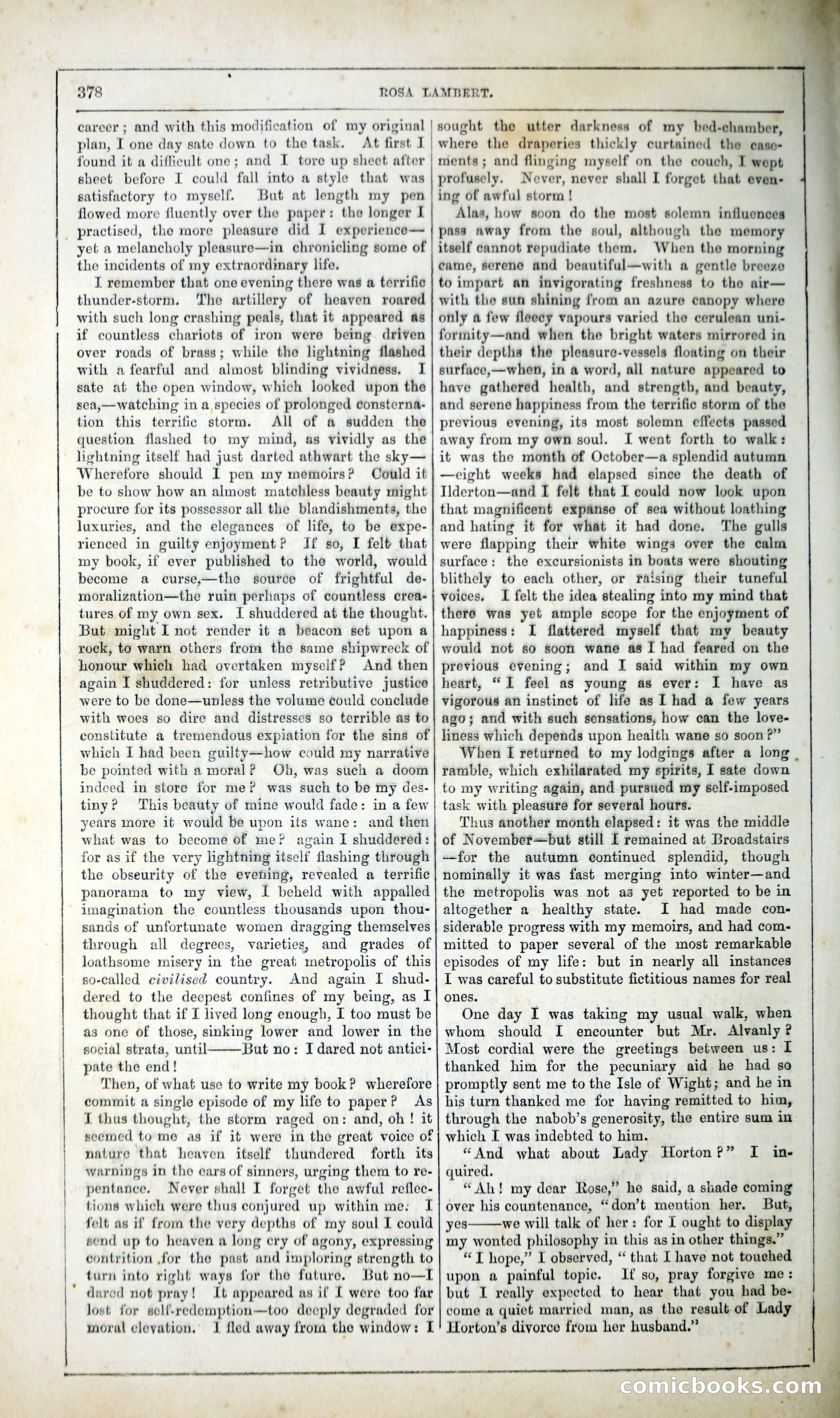
A restored page from Penny Dreadfuls, 1854. Page through the whole issue in the reader above.
📄 Transcribed text from this page (OCR, searchable)
Machine-transcribed from the original scan — historical spelling and the odd misread are preserved.
’ dared not pray ! ake Oe ee Re EE ET Ee AES LT ST AS eI tt iin, te | 378 es A ROSA LAMBERT. ey: Fs at . . i > - PS eee ts” career ; and with this modification of my original | sought the utter darkness of my bed-chamber, plan, I one day sate down to the task. At first J found it a difficult one; and I tore up sheet after sheet before I could fall into a style that was satisfactory to myself. But at length my pen flowed more fluently over the paper: the longer I practised, the more pleasure did I experience yet a melancholy pleasure—in chronicling some of the incidents of my extraordinary life. I remember that one evening there was a terrific thunder-storm. The artillery of heaven roared with such long crashing peals, that if appeared as if countless chariots of iron were being driven over roads of brass; while the lightning flashed with a fearful and almost blinding vividness. I sate at the open window, which looked upon the sea,—watching in a species of prolonged consterna- tion this terrific storm. All of a sudden the question flashed to my mind, as vividly as the lirhtning itself had just darted athwart the sky— Wherefore should I pen my memoirs? Could it be to show how an almost matchless beauty might procure for its possessor all the blandishments, the luxuries, and the elegances of life, to be expe- rienced in guilty enjoyment? If so, I felt that my book, if ever published to the world, would become a curse,—the source of frightful de- moralization—the ruin perhaps of countless crea- tures of my own sex. I shuddered at the thought. But might I not render it a beacon set upon a rock, to warn others from the same shipwreck of honour which had overtaken myself? And then again I shuddered: for unless retributive justice were to be done—unless the volume could conclude with woes so dire and distresses so terrible as to constitute a tremendous expiation for the sins of which I had been guilty—how could my narrative be pointed with a moral? Ob, was such a doom indeed in store for me? was such to be my des- tiny? This beauty of mine would fade: in a few years more it would be upon its wane: and then what was to become of me? again I shuddered: for as if the very lightning itself flashing through the obseurity of the evening, revealed a terrific panorama to my view, I beheld with appalled imagination the countless thousands upon thou- sands of unfortunate women dragging themselves through all degrees, varieties, and grades of loathsome misery in the great; metropolis of this so-called civilised country. And again I shud- dered to the deepest confines of my being, as I thought that if I lived long enough, I too must be as one of those, sinking lower and lower in the social strata, until But no: Idared not antici- pate the end! Then, of what use to write my book? wherefore commit a single episode of my life to paper? As I thus thought, the storm raged on: and, oh! it seemed tome as if it were in the great voice of nature that heaven itself thundered forth its warnings in the ears of sinners, urging them to re- pentance. Never shall I forget the awful reflec- tions which were thus conjured up within me. I felt as if from the very depths of my soul I could send up to heaven a long cry of agony, expressing contrition for the past and imploring strength to turn into right ways for the future. But no—LI [t appeared as if L were too far lost for self-redemption—too deeply degraded for moral cleyation. J fled away from the window: I where the draperies thickly curtained the case- ments; and flinging myself on the couch, I wept profusely. Never, never shall I forget that even- ing of awful storm ! Alas, how soon do the most solemn influences pass away from the soul, although the memory itself cannot repudiate them, When the morning came, serene and beautiful—with a gentle breeze to impart an invigorating freshness to the air— with the sun shining from an azure canopy where only a few fleecy vapours varied the cerulean uni- formity—and when the bright waters mirrored in their depths the pleasure-vessels floating on their surface,—when, in a word, all nature appeared to have gathered health, and strength, and beauty, and serene happiness from the terrific storm of the previous evening, its most solemn effects passed away from my own soul. I went forth to walk: it was the month of October—a splendid autumn —cight weeks had elapsed since the death of Ilderton—and I felt that I could now look upon that magnificent expanse of sea without loathing and hating it for what it had done. The gulls were flapping their white wings over the calm surface: the excursionists in boats were shouting blithely to each other, or raising their tuneful voices, LI felt the idea stealing into my mind that there was yet ample scope for the enjoyment of happiness: I flattered myself that my beauty would not so soon wane as I had feared on the previous evening; and I said within my own heart, “I feel as young as ever: I have as vigorous an instinct of life as I had a few years ago; and with such sensations, how can the love- liness which depends upon health wane so soon?” When I returned to my lodgings after a long . ramble, which exhilarated my spirits, I sate down to my writing again, and purstied my self-imposed task with pleasure for several hours. Thus another month elapsed: it was the middle of Novembetbut still I remained at Broadstairs for the autumn continued splendid, though nominally it was fast merging into winter—and the metropolis was not as yet reported to be in altogether a healthy state. I had made con- siderable progress with my memoirs, and had com- mitted to paper several of the most remarkable episodes of my life: but in nearly all instances I was careful to substitute fictitious names for real ones. One day I was taking my usual walk, when whom should I encounter but Mr. Alvanly? Most cordial were the greetings between us: L thanked him for the pecuniary aid he had so promptly sent me to the Isle of Wight; and he in his turn thanked me for having remitted to him, through the nabob’s generosity, the entire sum in which I was indebted to him. “And what about Lady Horton?” I in quired. “Ah! my dear Rose,” he said, a shade coming over his countenance, “don’t mention her. But, yes we will talk of her: for I ought to display my wonted philosophy in this as in other things.” “T hope,” I observed, “ that I have not touched upon a painful topic. If so, pray forgive me: but I really expected to hear that you had be- come a quiet married man, as the result of Lady Horton’s divorce from her husband.”