
Penny Dreadfuls, 1854 · page 207 of 400
Rosa Lambert — page 207: what you’re looking at
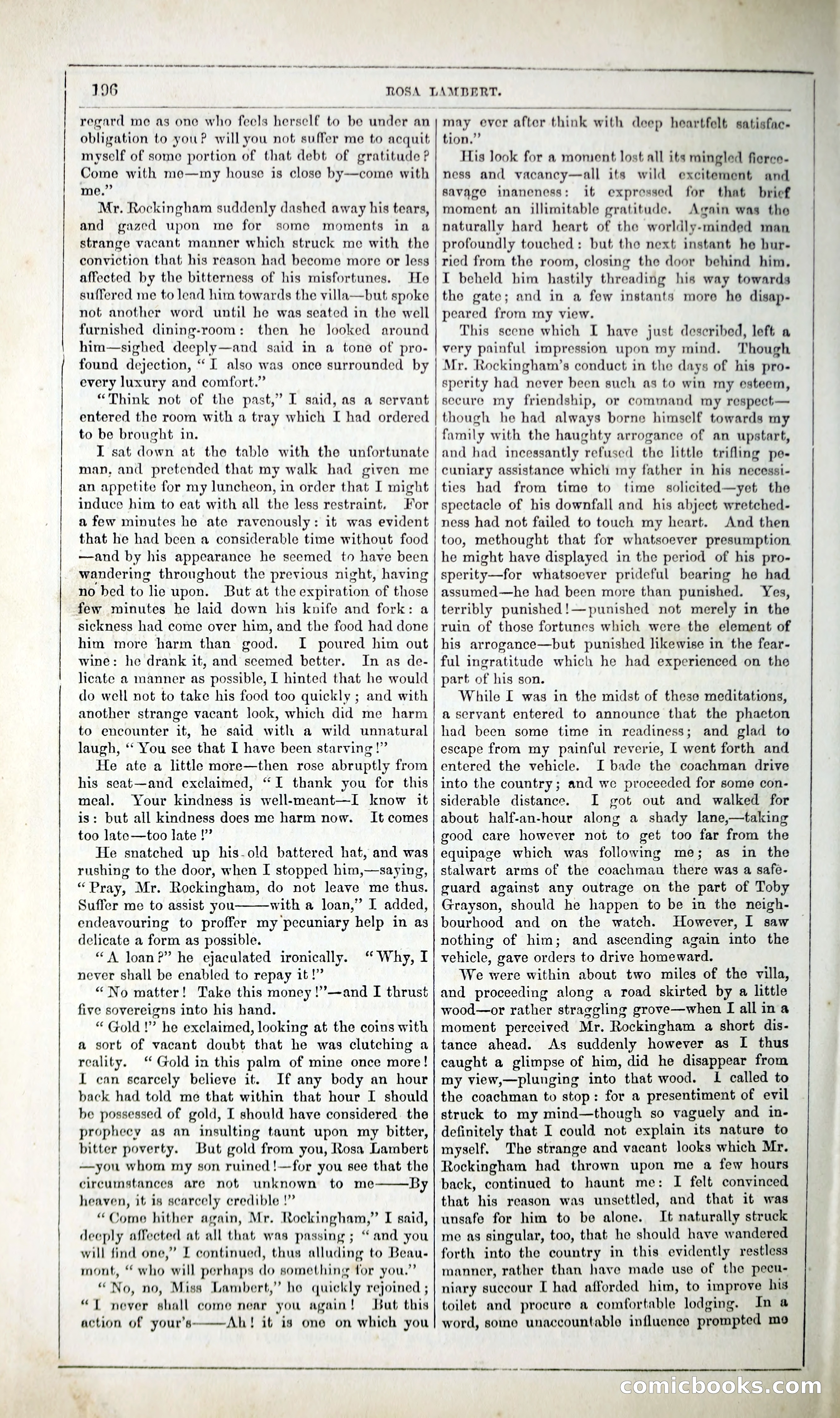
A restored page from Penny Dreadfuls, 1854. Page through the whole issue in the reader above.
📄 Transcribed text from this page (OCR, searchable)
Machine-transcribed from the original scan — historical spelling and the odd misread are preserved.
196 ee _ — ee —, — regard me as one who feels herself to be under an obligation to youP will you not suffer me to acquit myself of some portion of that debt of gratitude P Come with me—my house is close by—come with me.” Mr. Rockingham suddenly dashed away his tears, and gazed upon me for some moments in a strange vacant manner which struck me with the conviction that his reason had become more or less affected by the bitterness of his misfortunes. He suffered me to lead him towards the villa—but spoke not another word until he was seated in the well furnished dining-room: then he looked around him—sighed deeply—and said in a tone of pro- found dejection, “I also was once surrounded by every luxury and comfort.” “Think not of the past,” I said, as a servant entered the room with a tray which I had ordered to be brought in. I sat down at tho table with the unfortunate man, and pretended that my walk had given me an appetite for my luncheon, in order that I might induce him to eat with all the less restraint. For a few minutes he ate ravenously: it was evident that he had been a considerable time without food —and by his appearance he seemed to have been wandering throughout the previous night, having no bed to lie upon. But at the expiration of those few minutes he laid down his knife and fork: a sickness had come over him, and the food had done him more harm than good. I poured him out wine: he drank it, and seemed better. In as de- licate a manner as possible, [ hinted that he would do well not to take his food too quickly ; and with another strange vacant look, which did me harm to encounter it, he said with a wild unnatural laugh, ‘‘ You see that I have been starving!” He ate a little more—then rose abruptly from his seat—and exclaimed, “I thank you for this meal. Your kindness is well-meant—I know it is: but all kindness does me harm now. It comes too late —too late !”’ He snatched up his-old battered hat, and was rushing to the door, when I stopped him,—saying, “Pray, Mr. Rockingham, do not leave me thus. Suffer me to assist you with a loan,” I added, endeavouring to proffer my pecuniary help in as delicate a form as possible. “A loan?” he ejaculated ironically. never shall be enabled to repay 1t!” “No matter! Take this money !’—and I thrust five sovereigns into his hand. “ Gold!” he exclaimed, looking at the coins with a sort of vacant doubt that he was clutching a reality. “ Gold in this palm of mine once more! I can scarcely believe it. If any body an hour back had told me that within that hour I should be possessed of gold, I should have considered. the prophecy as an insulting taunt upon my bitter, bitter poverty. But gold from you, Rosa Lambert —yon whom my son ruined!—for you see that the circumstances are not unknown to me By heaven, it is scarcely credible !” “Oome hither again, Mr. Rockingham,” I said, deeply affected at all that was passing ; “ and you will find one,” I continued, thus alluding to Beau- mont, “ who will perhaps do something for you.” “No, no, Miss Lambert,” ho quickly rejoined ; “1 never shall come near you again! But this action of your’s Ah! it is one on which you “Why, I NOSA LAMBERT. ee ee ee may ever after think with deep tion,” His look for a moment lost all its mingled fierce- ness and vacancy—all its wild excitement and savage inaneness: it expressed for that brief moment an illimitable gratitude. Again was the naturally hard heart of the worldly-minded man profoundly touched: but the next instant he hur- ried from the room, closing the door behind him, I beheld him hastily threading his way towards the gate; and in a few instants more he disap- peared from my view. This scene which I have just described, left a very painful impression upon my mind. Though Mr. Rockingham’s conduct in the days of his pro- sperity had never been such as to win my esteem, secure my friendship, or command my respect— though he had always borne himself towards my family with the haughty arrogance of an upstart, and had incessantly refused the little trifling pe- cunlary assistance which my father in his necessi- ties had from time to time solicited—yet the spectacle of his downfall and his abject wretched- ness had not failed to touch my heart. And then too, methought that for whatsoever presumption he might have displayed in the period of his pro- sperity—for whatsoever prideful bearing he had assumed—he had been more than punished. Yes, terribly punished!—punished not merely in the ruin of those fortunes which were the element of his arrogance—but punished likewise in the fear- ful ingratitude which he had experienced on the part of his son. While I was in the midst of these meditations, a servant entered to announce that the phaeton had been some time in readiness; and glad to escape from my painful reverie, 1 went forth and entered the vehicle. I bade the coachman drive into the country; and we proceeded for some con- siderable distance. I got out and walked for about half-an-hour along a shady lane,—taking good care however not to get too far from the equipage which was following me; as in the stalwart arms of the coachman there was a safe- guard against any outrage on the part of Toby Grayson, should he happen to be in the neigh- bourhood and on the watch. However, 1 saw nothing of him; and ascending again into the vehicle, gave orders to drive homeward. We were within about two miles of the villa, and proceeding along a road skirted by a little wood—or rather straggling grove—when I allina moment perceived Mr. Rockingham a short dis- tance ahead. As suddenly however as I thus caught a glimpse of him, did he disappear from my view,—plunging into that wood. IL called to the coachman to stop: for a presentiment of evil struck to my mind—though so vaguely and in- definitely that I could not explain its nature to myself, The strange and vacant looks which Mr. Rockingham had thrown upon me a few hours back, continued to haunt me: I felt convinced that his reason was unsettled, and that it was unsafe for him to be alone. It naturally struck me as singular, too, that he should have wandered forth into the country in this evidently restless manner, rather than have made use of the pecu- niary succour I had afforded him, to improve his toilet and procure a comfortable lodging. In a word, some unaccountable influence prompted me heartfelt satisfac. Eo ,IOOKS ’ (ele)