
Penny Dreadfuls, 1854 · page 206 of 400
Rosa Lambert — page 206: what you’re looking at
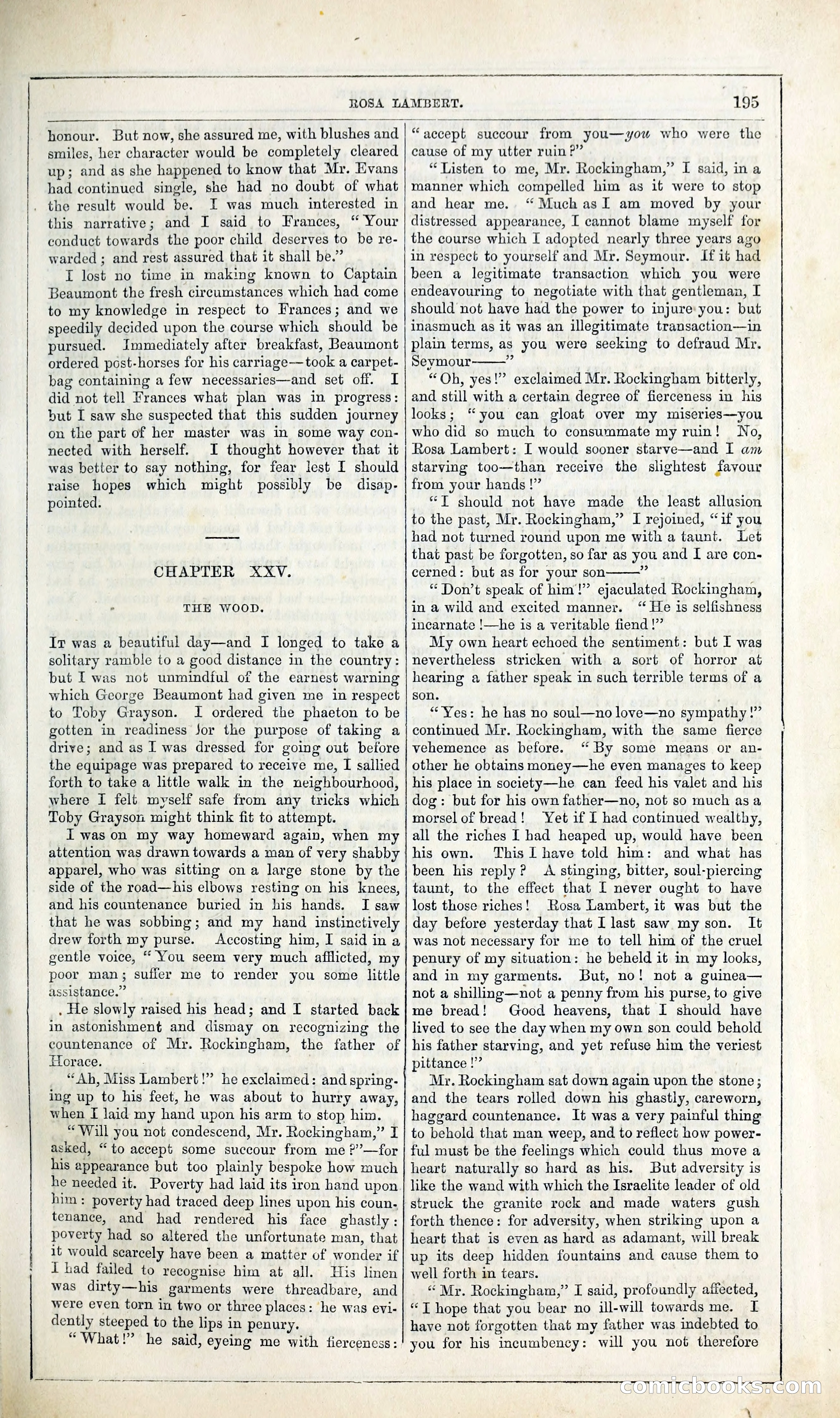
A restored page from Penny Dreadfuls, 1854. Page through the whole issue in the reader above.
📄 Transcribed text from this page (OCR, searchable)
Machine-transcribed from the original scan — historical spelling and the odd misread are preserved.
. the result would be. Ne men en ee ee ROSA LAMBERT. honour. But now, she assured me, with blushes and smiles, her character would be completely cleared up; and as she happened to know that Mr. Evans had continued single, she had no doubt of what T was much interested in this narrative; and I said to Frances, “ Your conduct towards the poor child deserves to be re- warded ; and rest assured that it shall be.” I lost no time in making known to Captain Beaumont the fresh circumstances which had come to my knowledge in respect to Frances; and we speedily decided upon the course which should be pursued. Immediately after breakfast, Beaumont ordered post-horses for his carriage-—took a carpet- bag containing a few necessaries—and set off. I did not tell Frances what plan was in progress: but I saw she suspected that this sudden journey on the part of her master was in some way con- nected with herself. I thought however that it was better to say nothing, for fear lest I should raise hopes which might possibly be disap- pointed. CHAPTER XXYV. . THE WOOD. Ir was a beautiful day—and I longed to take a solitary ramble to a good distance in the country: but IT was not unmindful of the earnest warning which George Beaumont had given me in respect to Toby Grayson. Jl ordered the phaeton to be gotten in readiness Jor the purpose of taking a drive; and as I was dressed for going out before the equipage was prepared to receive me, I sallied forth to take a little walk m the neighbourhood, where I felt myself safe from any tricks which Toby Grayson might think fit to attempt. I was on my way homeward again, when my attention was drawn towards a man of very shabby apparel, who was sitting on a large stone by the side of the road—his elbows resting on his knees, and his countenance buried in his hands. I saw that he was sobbing; and my hand instinctively drew forth my purse. Accosting him, I said in a gentle voice, “ You seem very much afflicted, my poor man; suffer me to render you some little assistance.” , He slowly raised his head; and I started back in astonishment and dismay on recognizing the countenance of Mr. Rockingham, the father of Horace. “Ah, Miss Lambert!” he exclaimed: and spring- ing up to his feet, he was about to hurry away, when I laid my hand upon his arm to stop him. “ Will you not condescend, Mr. Rockingham,” I asked, “to accept some succour from me ?”—for his appearance but too plainly bespoke how much he needed it. Poverty had laid its iron hand upon him: poverty had traced deep lines upon his coun- tenance, and had rendered his face ghastly: poverty had so altered the unfortunate man, that it would scarcely have been a matter of wonder if i lad failed to recognise him at all. His linen was dirty—his garments were threadbare, and were even torn in two or three places: he was evi- dently steeped to the lips in penury. “What!” he said, eyeing me with fierceness: ns Oe ee oe ree em 195 “accept succour from you—youw who were the cause of my utter ruin P” “Listen to me, Mr. Rockingham,” I said, in a manner which compelled him as it were to stop and hear me. “Much asI am moved by your distressed appearance, [ cannot blame myself for the course which I adopted nearly three years ago in respect to yourself and Mr. Seymour. If it had been a legitimate transaction which you were endeavouring to negotiate with that gentleman, I should not have had the power to injure:you: but inasmuch as it was an illegitimate transaction—in plain terms, as you were seeking to defraud Myr. Seymour y “Oh, yes!” exclaimed Mr. Rockingham bitterly, and still with a certain degree of fierceness in his looks; “you can gloat over my miseries—you who did so much to consummate my ruin! No, Rosa Lambert: I would sooner starve—and I am starving too—than receive the slightest fayour from your hands !” “T should not have made the least allusion to the past, Mr. Rockingham,” I rejoined, “if you had not turned round upon me with a taunt. Let that past be forgotten, so far as you and I are con- cerned: but as for your son + “Don’t speak of him!” ejaculated Rockingham, in a wild and excited manner. “ He 1s selfishness incarnate !—he is a veritable fiend !”’ My own heart echoed the sentiment: but I was nevertheless stricken with a sort of horror at hearing a father speak in such terrible terms of a son. | “Yes: he has no soul—no love—no sympathy!” continued Mr. Rockingham, with the same fierce vehemence as before. “ By some means or an- other he obtains money—he even manages to keep his place in society—he can feed his valet and his dog: but for his own father—no, not so much asa morsel of bread! Yet if I had continued wealthy, all the riches [ had heaped up, would have been his own. This I have told him: and what has been his reply? A stinging, bitter, soul-piercing taunt, to the effect that I never ought to have lost those riches! Rosa Lambert, it was but the day before yesterday that I last saw my son. It was not necessary for me to tell him of the cruel penury of my situation: he beheld it in my looks, and in my garments. But, no! not a guinea— not a shilling—not a penny from his purse, to give me bread! Good heavens, that I should have lived to see the day when my own son could behold his father starving, and yet refuse him the veriest pittance !” My. Rockingham sat down again upon the stone; and the tears rolled down his ghastly, careworn, haggard countenance. It was a very painful thing to behold that man weep, and to reflect how power- ful must be the feelings which could thus move a heart naturally so hard as his. But adversity is like the wand with which the Israelite leader of old struck the granite rock and made waters gush forth thence: for adversity, when striking upon a heart that is even as hard as adamant, will break up its deep hidden fountains and cause them to well forth im tears. “Mr. Rockingham,” I said, profoundly affected, “T hope that you bear no ill-will towards me. I have not forgotten that my father was indebted to you for his incumbency: will you not therefore