
Penny Dreadfuls, 1857 · page 379 of 400
Pickwick Abroad; or, The Tour in France — page 379: what you’re looking at
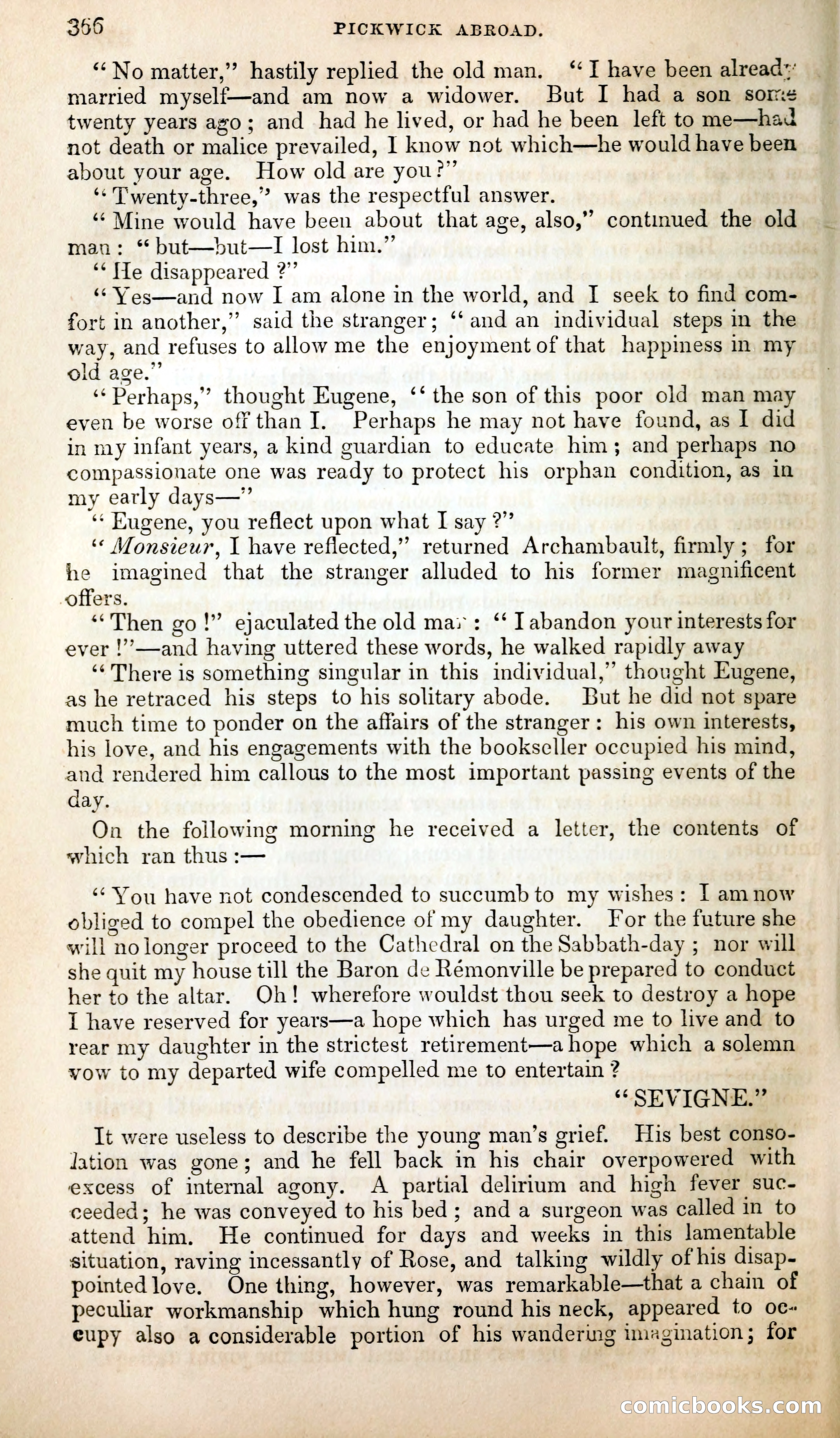
A restored page from Penny Dreadfuls, 1857. Page through the whole issue in the reader above.
📄 Transcribed text from this page (OCR, searchable)
Machine-transcribed from the original scan — historical spelling and the odd misread are preserved.
356 PICKWICK ABROAD. “No matter,” hastily replied the old man. ‘‘I have been alread: married myself—and am now a widower. But I had a son some twenty years ago; and _ had he lived, or had he been left to me—had not death or malice prevailed, I know not which—he would have been about your age. How old are you?” ‘‘ Twenty-three,” was the respectful answer. ‘‘ Mine would have been about that age, also,’ man: “ but—but—lI lost him.” ‘* T1e disappeared ?” ‘¢ Yes—and now I am alone in the world, and I seek to find com- fort in another,” said the stranger; ‘‘ and an individual steps in the way, and refuses to allow me the enjoyment of that happmess in my old age.” ‘‘Perhaps,” thought Eugene, ‘‘ the son of this poor old man may even be worse off than J. Perhaps he may not have found, as I did in my infant years, a kind guardian to educate him; and perhaps no compassionate one was ready to protect his orphan condition, as in my early days—’’ ‘“‘ Kugene, you reflect upon what I say ?” ‘¢ Monsieur, I have reflected,’”’ returned Archambault, firmly; for he imagined that the stranger alluded to his former magnificent Offers. ‘“‘Then go!” ejaculated the old mai: ‘‘ abandon your interests for ever !’’—and having uttered these words, he walked rapidly away ‘¢There is something singular in this individual,” thought Eugene, as he retraced his steps to his solitary abode. But he did not spare much time to ponder on the affairs of the stranger: his own interests, his love, and his engagements with the bookseller occupied his mind, and rendered him callous to the most important passing events of the day. On the following morning he received a letter, the contents of which ran thus :— ? continued the old ‘¢You have not condescended to succumb to my wishes: I am now obliged to compel the obedience of my daughter. For the future she will nolonger proceed to the Cathedral on the Sabbath-day ; nor will she quit my house till the Baron de Réemonville be prepared to conduct her to the altar. Oh! wherefore wouldst thou seek to destroy a hope I have reserved for years—a hope which has urged me to live and to rear my daughter in the strictest retirement—a hope which a solemn vow to my departed wife compelled me to entertain ? “ SEVIGNE.” It were useless to describe the young man’s grief. His best conso- lation was gone; and he fell back in his chair overpowered with excess of internal agony. A partial delirium and high fever suc- ceeded; he was conveyed to his bed; and a surgeon was called in to attend him. He continued for days and weeks in this lamentable situation, raving incessantly of Rose, and talking wildly of his disap- pointed love. One thing, however, was remarkable—that a chain of peculiar workmanship which hung round his neck, appeared to oc- eupy also a considerable portion of his wandering imagination; for Eomichbooks.co