
Penny Dreadfuls, 1857 · page 373 of 400
Pickwick Abroad; or, The Tour in France — page 373: what you’re looking at
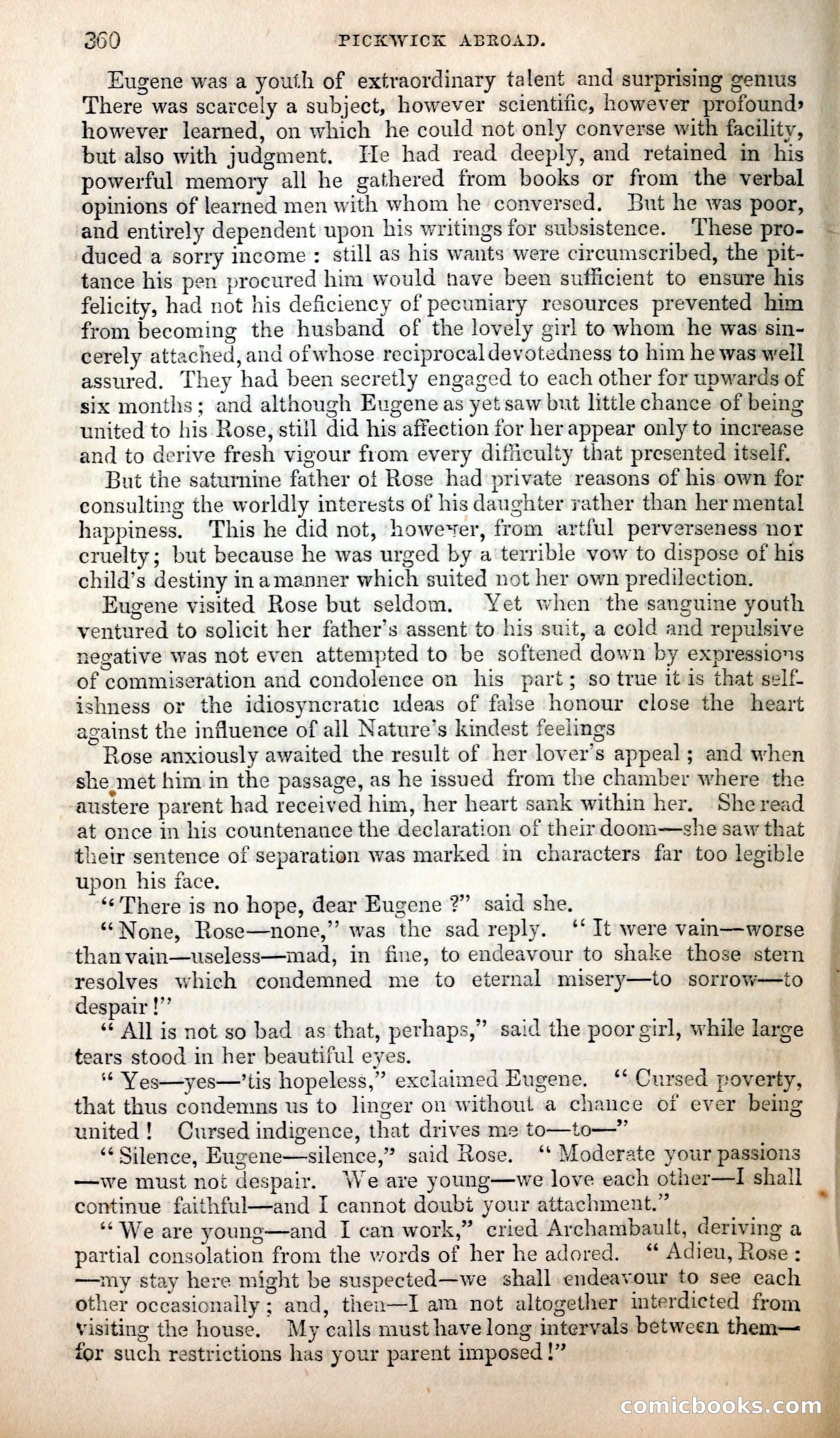
A restored page from Penny Dreadfuls, 1857. Page through the whole issue in the reader above.
📄 Transcribed text from this page (OCR, searchable)
Machine-transcribed from the original scan — historical spelling and the odd misread are preserved.
360 PICKWICK ABROAD. Eugene was a youth of extraordinary talent and surprising genius There was scarcely a subject, however scientific, however profound» however learned, on which he could not only converse with facility, but also with judgment. He had read deeply, and retained in his powerful memory all he gathered from books or from ‘the verbal opinions of learned men with whom he conversed. But he was poor, and entirely dependent upon his writings for subsistence. ‘These pro- duced a sorry income: still as his wants were circumscribed, the 'pit- tance his pen procured him would have been sufficient to ensure his felicity, had not his deficiency of pecuniary resources prevented him from becoming the husband of the lovely girl to whom he was sin- cerely attached, and of whose reciprocal devotedness to him he was well assured. They had been secretly engaged to each other for upwards of six months; and although Eugene as yet saw but little chance of being united to his Rose, still did his affection for her appear only to increase and to derive fresh vigour from every difficulty that presented itself. But the saturnine father of Rose had private reasons of his own for consulting the worldly interests of his daughter rather than her mental happiness. This he did not, however, from artful perverseness nor cruelty; but because he was urged by a'terrible vow to dispose of his child’s destiny inamenner which suited not her own predilection. Eugene visited Rose but seldom. Yet when the sanguine youth ventured to solicit her father’s assent to his suit, a cold and repulsive negative was not even attempted to be softened down by expressions of commiseration and condolence on his part; so true itis that self ishness or the idiosyncratic ideas of faise honour close the heart against the influence of all Nature’s kindest feelings Rose anxiously awaited the result of her lover's appeal; and when she met him in the passage, as he issued from the chamber where the austere parent had received him, her heart sank within her. Sheread at once in his countenance the declaration of their doom—she saw that their sentence of separation was marked in characters far too legible upon his face. ‘There is no hope, dear Eugene ?” said she. ‘None, Rose—none,’”’ was the sad reply. ‘* It were vain—worse than vain—useless—mad, in fine, to endeavour to shake those stern resolves which condemned me to eternal misery—to sorrow—to despair !”’ | ‘“¢ All is not so bad as that, perhaps,” said the poor girl, while large tears stood in her beautiful eyes. | ‘* Yes—yes—’tis hopeless,” exclaimed Eugene. ‘‘ Cursed poverty, that thus condemns us to linger on without a chance of ever being united! Cursed indigence, that drives me to—to—” ‘¢ Silence, Eugene—silence,” said Rose. ‘‘ Moderate your passions —we must not despair. Weare young—we love each other—I shall continue faithful—and I cannot doubi your attachment.” ‘¢We are young—and I can work,” eried Archambault, deriving a partial consolation from the words of her he adored. “ Adieu, Rose : —my stay here might be suspected—we shall endeavour to see each other occasionally ; and, thena—I am not altogether mterdicted from visiting the house. My calls must have long intervals between them— zor such restrictions has your parent imposed !” , GComicbooks.com — * —, = =