
Penny Dreadfuls, 1857 · page 372 of 400
Pickwick Abroad; or, The Tour in France — page 372: what you’re looking at
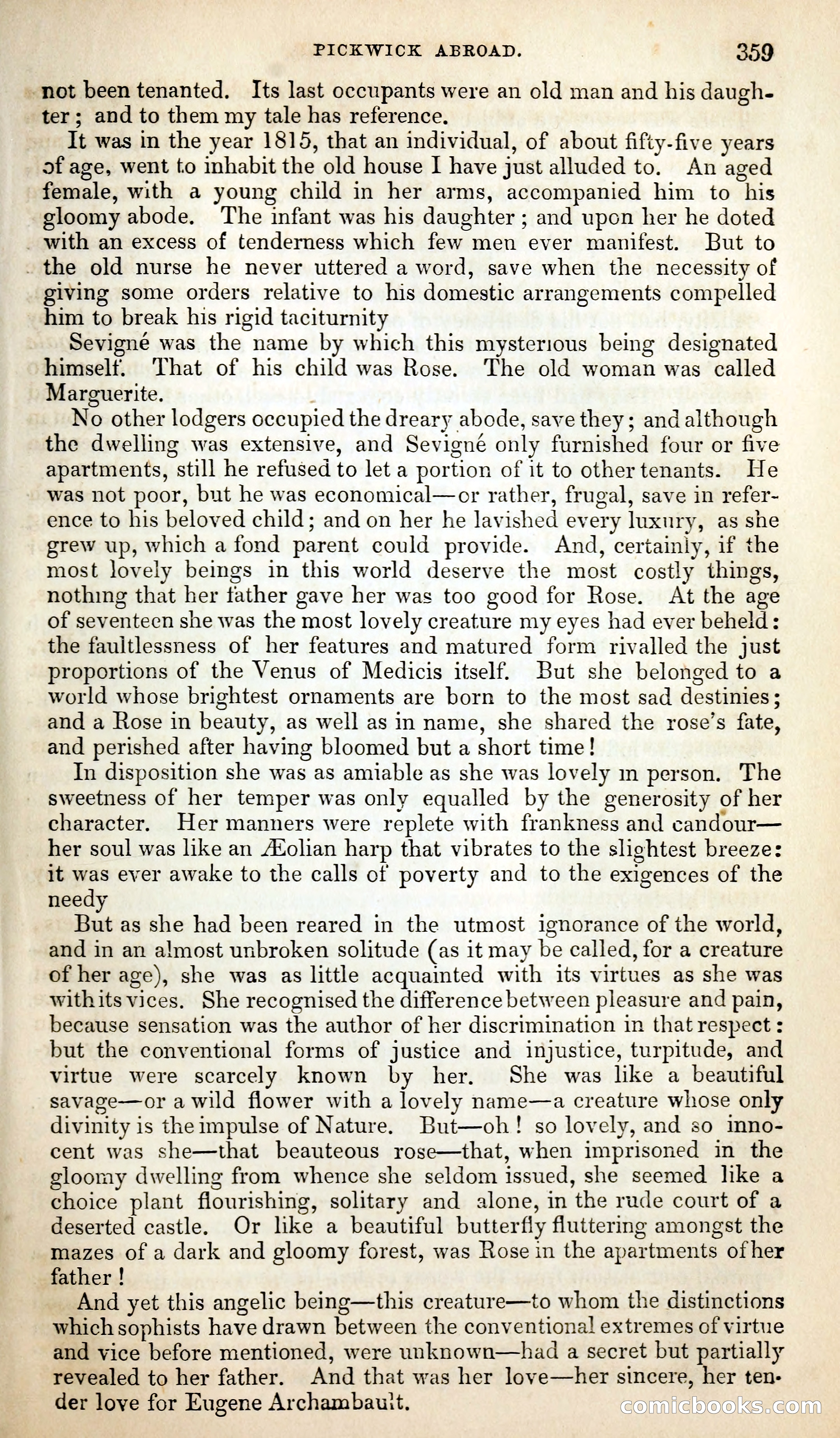
A restored page from Penny Dreadfuls, 1857. Page through the whole issue in the reader above.
📄 Transcribed text from this page (OCR, searchable)
Machine-transcribed from the original scan — historical spelling and the odd misread are preserved.
PICKWICK ABROAD. 359 not been tenanted. Its last occupants were an old man and his daugh- ter; and to them my tale has reference. It was in the year 1815, that an individual, of about fifty-five years of age, went to inhabit the old house I have just alluded to. An aged female, with a young child in her arms, accompanied him to his gloomy abode. ‘The infant was his daughter ; and upon her he doted _ with an excess of tenderness which few men ever manifest. But to _ the old nurse he never uttered a word, save when the necessity of giving some orders relative to his domestic arrangements compelled him to break his rigid taciturnity Sevigne was the name by which this mysterious being designated himself. That of his child was Rose. The old woman was called Marguerite. | No other lodgers occupied the dreary abode, save they; and although the dwelling was extensive, and Sevigneé only furnished four or five apartments, still he refused to let a portion of it to other tenants. He was not poor, but he was economical—or rather, frugal, save in refer- ence to his beloved child; and on her he lavished every luxury, as she grew up, which a fond parent could provide. And, certainly, if the most lovely beings in this world deserve the most costly things, nothing that her father gave her was too good for Rose. At the age of seventeen she was the most lovely creature my eyes had ever beheld: the fauitlessness of her features and matured form rivalled the just proportions of the Venus of Medicis itself. But she belonged to a world whose brightest ornaments are born to the most sad destinies ; and a Rose in beauty, as well as in name, she shared the rose’s fate, and perished after having bloomed but a short time! In disposition she was as amiable as she was lovely m person. The sweetness of her temper was only equalled by the generosity of her character. Her manners were replete with frankness and candour— her soul was like an AXolian harp that vibrates to the slightest breeze: it was ever awake to the calls of poverty and to the exigences of the needy But as she had been reared in the utmost ignorance of the world, and in an almost unbroken solitude (as it may be called, for a creature of her age), she was as little acquainted with its virtues as she was withits vices. She recognised the difference between pleasure and pain, because sensation was the author of her discrimination in that respect : but the conventional forms of justice and injustice, turpitude, and virtue were scarcely known by her. She was like a beautiful savage—or a wild flower with a lovely name—a creature whose only divinity is the impulse of Nature. But—oh! so lovely, and so mno- cent was she—that beauteous rose—that, when imprisoned in the gloomy dwelling from whence she seldom issued, she seemed like a choice plant flourishing, solitary and alone, in the rude court of a deserted castle. Or like a beautiful butterfly fluttermg amongst the mazes of a dark and gloomy forest, was Rose in the apartments of her father ! And yet this angelic being—this creature—to whom the distinctions which sophists have drawn between the conventional extremes of virtue and vice before mentioned, were unknown—had a secret but partially revealed to her father. And that was her love—her sincere, her ten- der love for Eugene Archambauit. COME ool KS.eo) =)