
Penny Dreadfuls, 1800 · page 270 of 400
Pickwick Abroad: A Companion to the Pickwick Papers — page 270: what you’re looking at
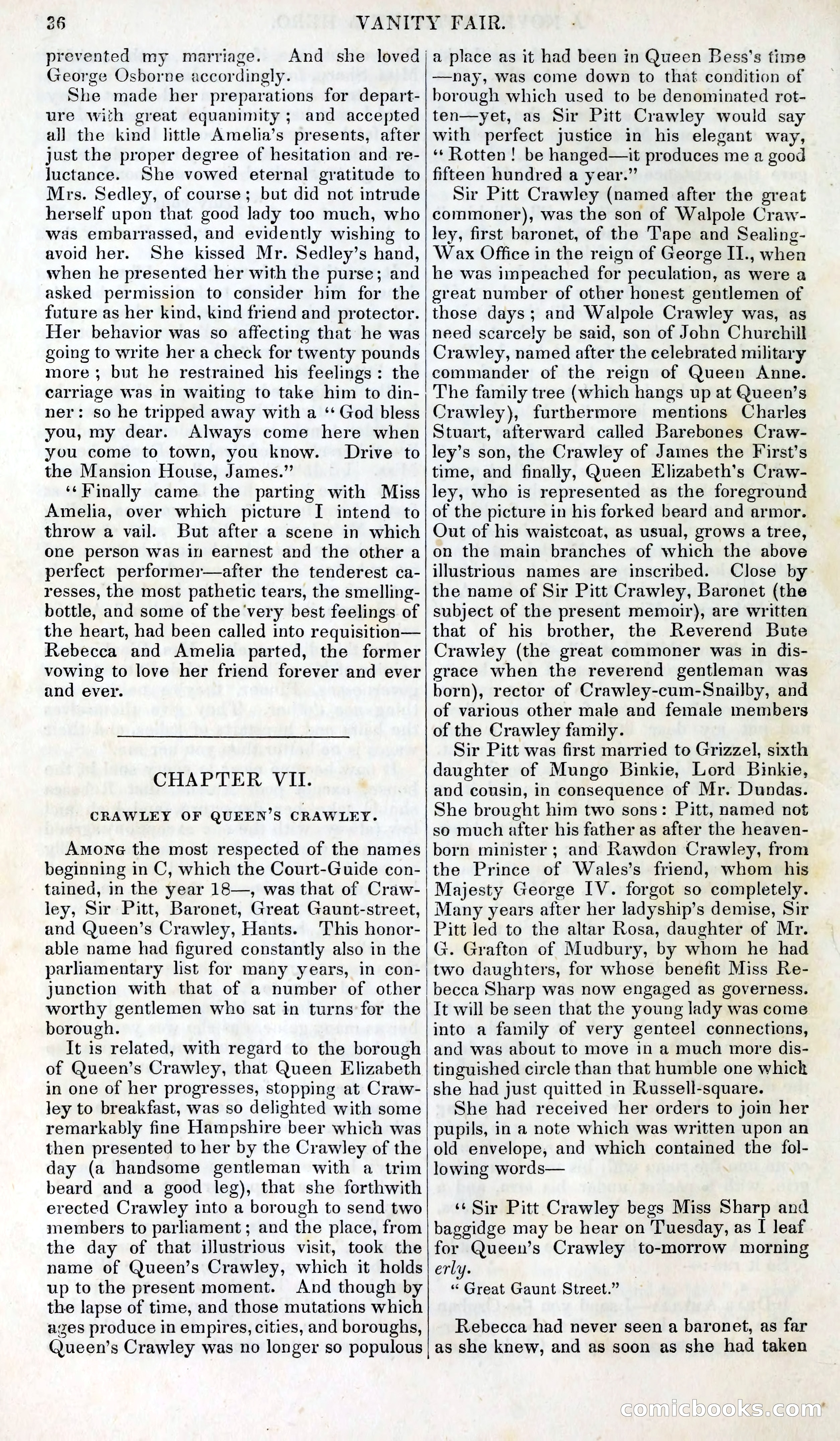
A restored page from Penny Dreadfuls, 1800. Page through the whole issue in the reader above.
📄 Transcribed text from this page (OCR, searchable)
Machine-transcribed from the original scan — historical spelling and the odd misread are preserved.
36 prevented my marriage. And she loved George Osborne accordingly. She made her preparations for depart- ure with great equanimity ; and accepted all the kind little Amelia’s presents, after just the proper degree of hesitation and re- Juctance. She vowed eternal gratitude to Mrs. Sedley, of course; but did not intrude herself upon that good lady too much, who was embarrassed, and evidently wishing to avoid her. She kissed Mr. Sedley’s hand, when he presented her with the purse; and asked permission to consider him for the future as her kind, kind friend and protector. Her behavior was so affecting that he was going to write her a check for twenty pounds more ; but he restrained his feelings: the carriage Was in waiting to take him to din- ner: so he tripped away with a ‘* God bless you, my dear. Always come here when you come to town, you know. Drive to the Mansion House, James.” ‘‘Finally came the parting with Miss Amelia, over which picture I intend to throw a vail. But after a scene in which one person was in earnest and the other a perfect performer—after the tenderest ca- resses, the most pathetic tears, the smelling- bottle, and some of the'very best feelings of the heart, had been called into requisition— Rebecca and Amelia parted, the former vowing to love her friend forever and ever and ever. CHAPTER VII. CRAWLEY OF QUEEN’S CRAWLEY. Amone the most respected of the names beginning in C, which the Court-Guide con- tained, in the year 18—, was that of Craw- ley, Sir Pitt, Baronet, Great Gaunt-street, and Queen’s Crawley, Hants. ‘This honor- able name had figured constantly also in the parliamentary list for many years, in con- junction with that of a number of other worthy gentlemen who sat in turns for the borough. It is related, with regard to the borough of Queen’s Crawley, that Queen Elizabeth in one of her progresses, stopping at Craw- ley to breakfast, was so delighted with some remarkably fine Hampshire beer which was then presented to her by the Crawley of the day (a handsome gentleman with a trim beard and a good leg), that she forthwith erected Crawley into a borough to send two members to parliament; and the place, from the day of that iJlustrious visit, took the name of Queen’s Crawley, which it holds up to the present moment. And though by the lapse of time, and those mutations which azes produce in empires, cities, and boroughs, Queen’s Crawley was no longer so populous VANITY FAIR. |a place as it had been in Queen Bess’s time —nay, was come down to that condition of borough which used to be denominated rot- ten—yet, as Sir Pitt Crawley would say with perfect justice in his elegant way, ‘‘ Rotten! be hanged—it produces me a good fifteen hundred a year.” Sir Pitt Crawley (named after the great commoner), was the son of Walpole Craw- ley, first baronet, of the Tape and Sealing- Wax Office in the reign of George II., when he was impeached for peculation, as were a great number of other honest gentlemen of those days; and Walpole Crawley was, as need scarcely be said, son of John Churchill Crawley, named after the celebrated military commander of the reign of Queen Anne. The family tree (which hangs up at Queen’s Crawley), furthermore mentions Charles Stuart, afterward called Barebones Craw- ley’s son, the Crawley of James the First’s time, and finally, Queen Elizabeth’s Craw- ley, who is represented as the foreground of the picture in his forked beard and armor. Out of his waistcoat, as usual, grows a tree, on the main branches of which the above illustrious names are inscribed. Close by the name of Sir Pitt Crawley, Baronet (the subject of the present memoir), are written that of his brother, the Reverend Bute Crawley (the great commoner was in dis- grace when the reverend gentleman was born), rector of Crawley-cum-Snailby, and of various other male and female members of the Crawley family. Sir Pitt was first married to Grizzel, sixth daughter of Mungo Binkie, Lord Binkie, and cousin, in consequence of Mr. Dundas. She brought him two sons: Pitt, named not so much after his father as after the heaven- born minister; and Rawdon Crawley, from the Prince of Wales’s friend, whom his Majesty George IV. forgot so completely. Many years after her ladyship’s demise, Sir Pitt led to the altar Rosa, daughter of Mr. G. Grafton of Mudbury, by whom he had two daughters, for whose benefit Miss Re- becca Sharp was now engaged as governess. It will be seen that the young lady was come into a family of very genteel connections, and was about to move in a much more dis- tinguished circle than that humble one whick she had just quitted in Russell-square. She had received her orders to join her pupils, in a note which was written upon an old envelope, and which contained the fol- lowing words— ‘¢ Sir Pitt Crawley begs Miss Sharp and baggidge may be hear on Tuesday, as I leaf for Queen’s Crawley to-morrow morning erly. “ Great Gaunt Street.” Rebecca had never seen a baronet, as far as she knew, and as soon as she had taken (EORAIELNCK) HAE ms