
Penny Dreadfuls, 1800 · page 269 of 400
Pickwick Abroad: A Companion to the Pickwick Papers — page 269: what you’re looking at
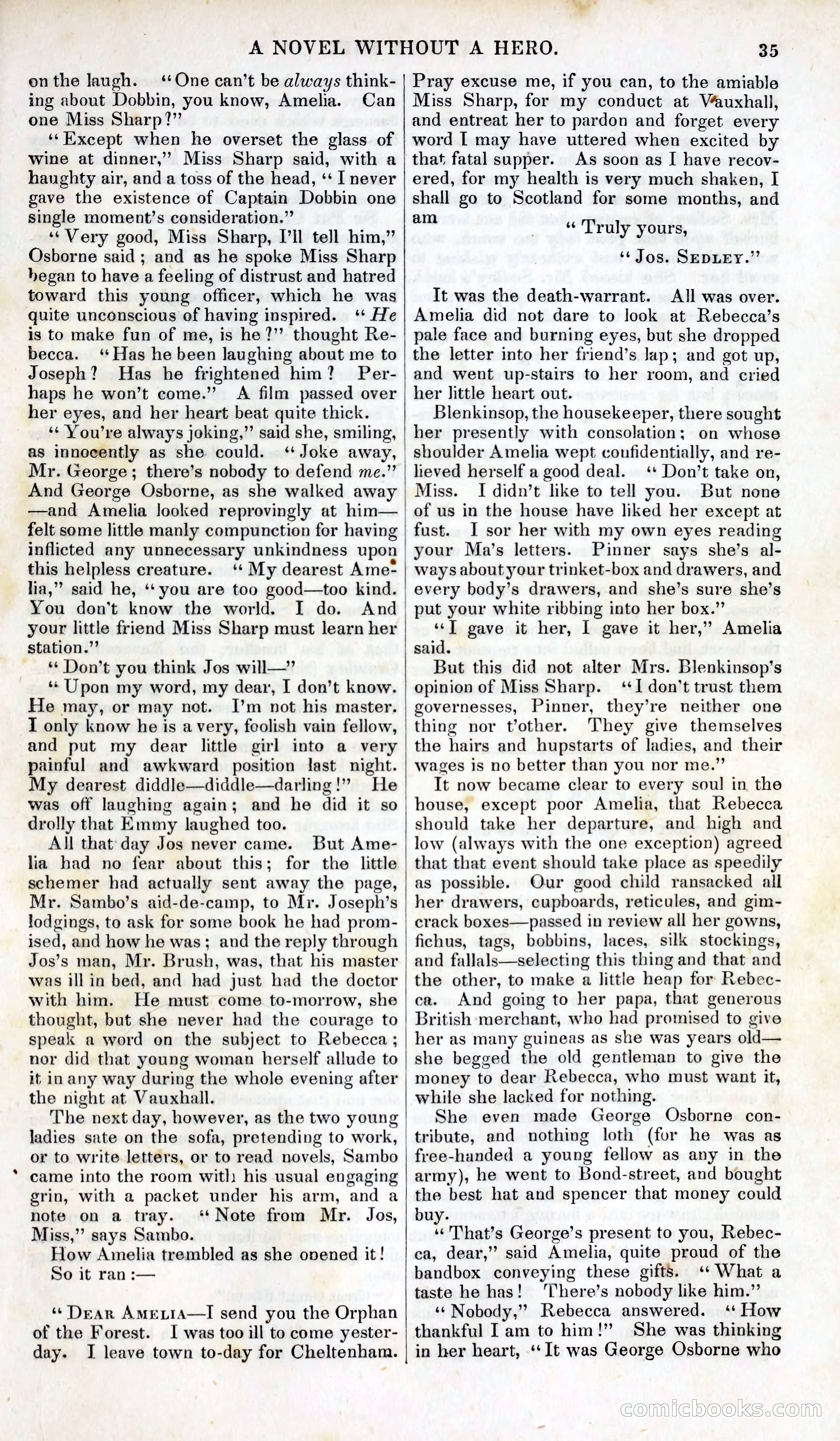
A restored page from Penny Dreadfuls, 1800. Page through the whole issue in the reader above.
📄 Transcribed text from this page (OCR, searchable)
Machine-transcribed from the original scan — historical spelling and the odd misread are preserved.
> A NOVEL WITHOUT A HERO. onthe laugh. ‘One can’t be always think- ing about Dobbin, you know, Amelia. Can one Miss Sharp?” ‘‘Kxcept when he overset the glass of Wine at dinner,” Miss Sharp said, with a haughty air, and a toss of the head, ‘“‘ I never gave the existence of Captain Dobbin one single moment’s consideration.” ‘‘ Very good, Miss Sharp, I’ll tell him,” Osborne said; and as he spoke Miss Sharp began to have a feeling of distrust and hatred toward this young officer, which he was quite unconscious of having inspired. ‘ He is to make fun of me, is he?” thought Re- becca. ‘Has he been laughing about me to Joseph? Has he frightened him? Per- haps he won’t come.” A film passed over her eyes, and her heart beat quite thick. ‘¢ You’re always joking,”’ said she, smiling, as innocently as she could. ‘Joke away, Mr. George; there’s nobody to defend me.” And George Osborne, as she walked away —and Amelia looked reprovingly at him— felt some little manly compunction for having inflicted any unnecessary unkindness upon this helpless creature. ‘+ My dearest Ame- lia,” said he, ‘‘ you are too good—too kind. You don’t know the world. I do. And your little friend Miss Sharp must learn her station.” ** Don’t you think Jos will—” ‘* Upon my word, my dear, I don’t know. He may, or may not. I’m not his master. I only know he is a very, feolish vain fellow, and put my dear little girl into a very painful and awkward position last night. My dearest diddle—diddle—darling!” He was off laughing again; and he did it so drolly that Emmy laughed too. All that day Jos never came. But Ame- lia had no fear about this; for the little schemer had actually sent away the page, Mr. Sambo’s aid-de-camp, to Mr. Joseph’s lodgings, to ask for some book he had prom- ised, and how he was; and the reply through Jos’s man, Mr. Brush, was, that his master was ill in bed, and had just had the doctor with him. He must come to-morrow, she thought, but she never had the courage to speak a word on the subject to Rebecca ; nor did that young woman herself allude to it in any way during the whole evening after the night at Vauxhall. The next day, however, as the two young ladies sate on the sofa, pretending to work, or to write letters, or to read novels, Sambo came into the room with his usual engaging grin, with a packet under his arm, and a note on a tray. ‘Note from Mr. Jos, Miss,” says Sambo. How Amelia trembled as she ovened it! So it ran :— ‘¢ Dear AmELIA—I send you the Orphan of the Forest. I was too ill to come yester- day. J leave town to-day for Cheltenham. ee eeeeeeeeeeeeeeeeeEOEOEOEEOeEEOEEeeeOEeEeeeEeeeeeeeeeee Pray excuse me, if you can, to the amiable Miss Sharp, for my conduct at V&éuxhall, and entreat her to pardon and forget every word [ may have uttered when excited by that fatal supper. As soon as I have recov- ered, for my health is very much shaken, I shall go to Scotland for some months, and om “Truly yours, ‘¢ Jos. SEDLEY.”’ It was the death-warrant. All was over. Amelia did not dare to look at Rebecca’s pale face and burning eyes, but she dropped the letter into her friend’s Jap; and got up, and went up-stairs to her room, and cried her little heart out. Blenkinsop, the housekeeper, there sought her presently with consolation; on whose shoulder Amelia wept confidentially, and re- lieved herself a good deal. ‘* Don’t take on, Miss. I didn’t like to tell you. But none of us in the house have liked her except at fust. I sor her with my own eyes reading your Ma’s letters. Pinner says she’s al- ways about your trinket-box and drawers, and every body’s drawers, and she’s sure she’s put your white ribbing into her box.” “] gave it her, I gave it her,” Amelia said. But this did not alter Mrs. Blenkinsop’s opinion of Miss Sharp. ‘I don’t trust them governesses, Pinner, they’re neither one thing nor tother. ‘They give themselves the hairs and hupstarts of ladies, and their wages is no better than you nor me.”’ It now became clear to every soul in the house, except poor Amelia, that Rebecca should take her departure, and high and low (always with the one exception) agreed that that event should take place as speedily as possible. Our good child ransacked all her drawers, cupboards, reticules, and gim- crack boxes—passed in review all her gowns, fichus, tags, bobbins, laces, silk stockings, and fallals—selecting this thing and that and the other, to make a little heap for Rebec- ca. And going to her papa, that generous British merchant, who had promised to give her as many guineas as she was years old— she begged the old gentleman to give the money to dear Rebecca, who must want it, while she lacked for nothing. She even made George Osborne con- tribute, and nothing loth (for he was as free-handed a young fellow as any in the army), he went to Bond-street, and bought the best hat and spencer that money could buy. + 'That’s George’s present to you, Rebec- ca, dear,” said Amelia, quite proud of the bandbox conveying these gift8s. ‘What a taste he has! ‘There’s nobody like him.” ‘‘ Nobody,” Rebecca answered. ‘‘ How thankful Iam to him!” She was thinking in her heart, ‘‘It was George Osborne who 35 CONIC OOO S (SO)