
Penny Dreadfuls, 1800 · page 131 of 400
Pickwick Abroad: A Companion to the Pickwick Papers — page 131: what you’re looking at
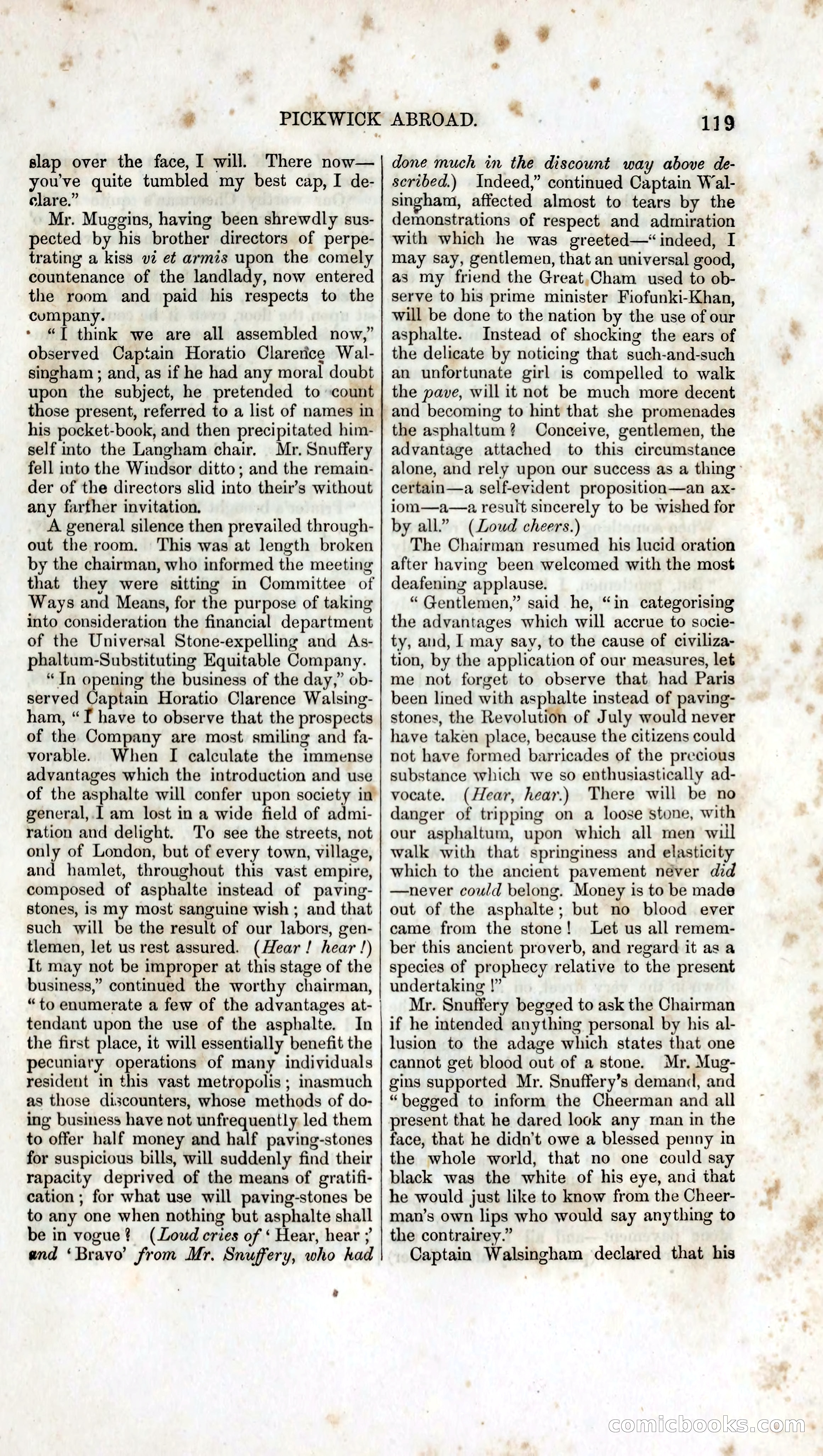
A restored page from Penny Dreadfuls, 1800. Page through the whole issue in the reader above.
📄 Transcribed text from this page (OCR, searchable)
Machine-transcribed from the original scan — historical spelling and the odd misread are preserved.
i slap over the face, I will. There now— you've quite tumbled my best cap, I de- clare.” Mr. Muggins, having been shrewdly sus- pected by his brother directors of perpe- trating a kiss vi et armis upon the comely countenance of the landlady, now entered the room and paid his respects to the cumpany. : * “JT think we are all assembled now,” observed Captain Horatio Clarerice Wal- singham ; and, as if he had any moral doubt upon the subject, he pretended to count those present, referred to a list of names in his pocket-book, and then precipitated him- self into the Langham chair. Mr. Snuffery fell into the Windsor ditto; and the remain- der of the directors slid into their’s without any farther invitation. A general silence then prevailed through- out the room. This was at length broken by the chairman, who informed the meeting that they were sitting in Committee of Ways and Means, for the purpose of taking into consideration the financial department of the Universal Stone-expelling and As- phaltum-Substituting Equitable Company. “ In opening the business of the day,” ob- served Captain Horatio Clarence Walsing- ham, “T have to observe that the prospects of the Company are most smiling and fa- vorable. When I calculate the immense advantages which the introduction and use of the asphalte will confer upon society in general, I am lost in a wide field of admi- ration and delight. To see the streets, not only of London, but of every town, village, and hamlet, throughout this vast empire, composed of asphalte instead of paving- stones, is my most sanguine wish ; and that such will be the result of our labors, gen- tlemen, let us rest assured. (Hear! hear !) It may not be improper at this stage of the business,” continued the worthy chairman, “to enumerate a few of the advantages at- tendant upon the use of the asphalte. In the first place, it will essentially benefit the pecuniary operations of many individuals resident in this vast metropolis ; inasmuch as those discounters, whose methods of do- ing business have not unfrequently. led them to offer half money and half paving-stones for suspicious bills, will suddenly find their rapacity deprived of the means of gratifi- cation ; for what use will paving-stones be to any one when nothing but asphalte shall be in vogue? (Loud cries of ‘ Hear, hear ; and ‘Bravo’ from Mr. Snuffery, who had A PICKWICK ABROAD. - 4 " 119 done much in the discount way above de- scribed.) Indeed,” continued Captain Wal- singham, affected almost to tears by the demonstrations of respect and admiration with which he was greeted—“indeed, I may say, gentlemen, that an universal good, as my friend the Great,Cham used to ob- serve to his prime minister Fiofunki-Khan, will be done to the nation by the use of our asphalte. Instead of shocking the ears of the delicate by noticing that such-and-such an unfortunate girl is compelled to walk the pave, will it not be much more decent and becoming to hint that she promenades the asphaltum? Conceive, gentlemen, the advantage attached to this circumstance alone, and rely upon our success as a thing’ certain—a self-evident proposition—an ax- iom—a—a result sincerely to be wished for by all.” (Loud cheers.) The Chairman resumed his lucid oration after having been welcomed with the most deafening applause. “ Gentlemen,” said he, “in categorising the advantages which will accrue to socie- ty, and, I may say, to the cause of civiliza- tion, by the application of our measures, let me not forget to observe that had Paris been lined with asphalte instead of paving- stones, the Revolution of July would never have taken place, because the citizens could not have formed barricades of the precious substance which we so enthusiastically ad- vocate. (Hear, hear.) There will be no danger of tripping on a loose stone, with our asphaltum, upon which all men will walk with that springiness and elasticity which to the ancient pavement néver did —never could belong. Money is to be made out of the asphalte; but no blood ever came from the stone! Let us all remem- ber this ancient proverb, and regard it as a species of prophecy relative to the present undertaking !” Mr. Snuffery begged to ask the Chairman if he intended anything personal by his al- lusion to the adage which states that one cannot get blood out of a stone. Mr. Mug- gins supported Mr. Snuffery’s demand, and “begeed to inform the Cheerman and all present that he dared look any man in the face, that he didn’t owe a blessed penny in the whole world, that no one could say black was the white of his eye, and that he would just like to know from the Cheer- man’s own lips who would say anything to the contrairey.” Captain Walsingham declared that his EOMiclooolkks (C@)