
Penny Dreadfuls, 1897 · page 10 of 36
New Nick Carter Weekly, No. 8 — page 10: what you’re looking at
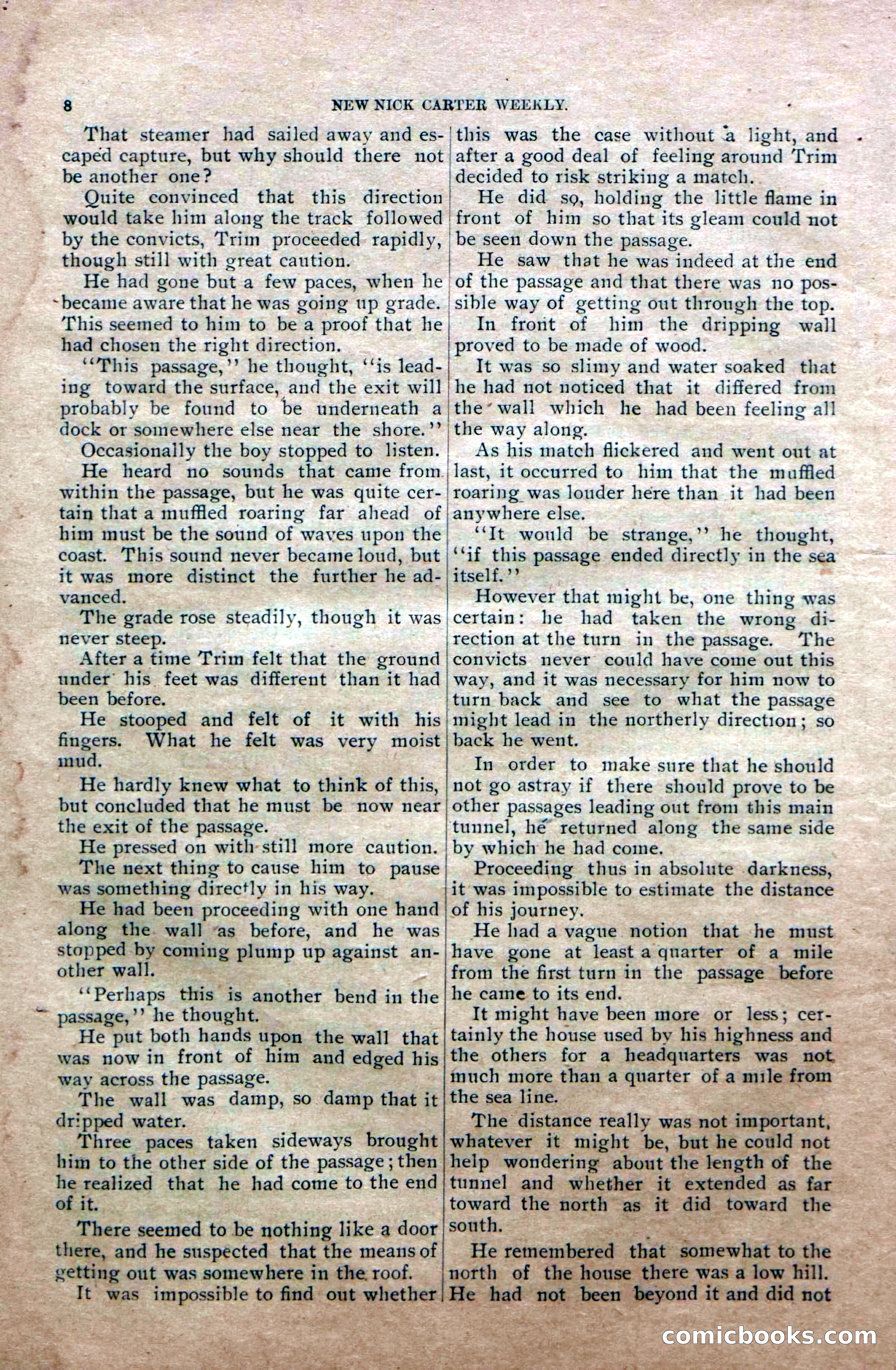
A restored page from Penny Dreadfuls, 1897. Page through the whole issue in the reader above.
📄 Transcribed text from this page (OCR, searchable)
Machine-transcribed from the original scan — historical spelling and the odd misread are preserved.
* re sors : _—" : > - . Ps a a < e df 2 “ — “ae 5 ag tee 8 NEW NICK CARTER WEEKLY. That steamer had sailed away and es-|this was the case without a light, and caped capture, but why should there not after a good deal of feeling around Trim be another one? Quite convinced that this direction would take him along the track followed by the convicts, Trim proceeded. rapidly, though still with great caution. He had gone but a few paces, when he This seemed to him to be a proof that he had chosen the right direction. ‘“This passage,’’ he thought, ‘‘is lead- decided to risk striking a match. He did sg, holding the little flame in front of him so that its gleam could not be seen down the passage. He saw that he was indeed at the end of the passage and that there was no pos- ~became aware that he was going up grade. | sible way of getting out through the top. In front of him the dripping wall proved to be made of wood. It was so slimy and water soaked that ing toward the surface, and the exit will| he had not noticed that it differed from probably be found to be underneath a) dock or somewhere else near the shore.’’ Occasionally the boy stopped to listen. He heard no sounds that came from. within the passage, but he was quite cer- tain that a muffled roaring far ahead of him must be the sound of waves upon the coast. This sound never became loud, but it was more distinct the further he ad- vanced. The grade rose steadily, though it was never steep. After a time Trim felt that the ground under his feet was different than it had been before. He stooped and felt of it with his fingers. What he felt was very moist inud, He hardly knew what to think of this, but concluded that he must be now near the exit of the passage. He pressed on with still more caution. The next thing to cause him to pause was something directly in his way. He had been proceeding with one hand along the. wall “as before, and he was stopped by coming plump up against an- other wall. ‘‘Perhaps this is another bend in the ~ passage,’’ he thought. He put both hands upon the wall that was now in front of him and edged his way across the passage. The wall was damp, so damp that it dripped water. Three paces taken sideways brought him to the other side of the passage ; then oP realized that he had come to the end it. There seemed to be nothing like a door there, and he suspected that the means of Saris: out was pomew betes im oee YOK the’ wall which he had been feeling al! the way along. As his match flickered and went out at last, it occurred to him that the muffled 'roaring was louder here than it had been anywhere else. ‘It would be strange,’’ he thought, ‘if this passage ended directly in the sea itself.’’ However that might be, one thing was certain: he had taken the wrong di- rection at the turn in the passage. The convicts never could have come out this way, and it was necessary for him now to turn back and see to what the passage might lead in the northerly direction; so back he went. In order to make sure that he should not go astray if there should prove to be other passages leading out from this main tunnel, hé returned along the same side by which he had come, Proceeding thus in absolute darkness, it was impossible to estimate the distance of his journey. He had a vague notion that he must have gone at least a quarter of a mile from the first turn in the passage before he came to its end. It might have been more or less; cer- tainly the house used by his highness and _ the others for a headquarters was not inuch more than a quarter of a mile from the sea line. The distance really was not important, whatever it might be, but he could not help wondering about ‘the length of the tunnel and whether it extended as far — | toward the north” as it ae: toward the south. He rine ‘that. Siiewhad to the ee jnosth of the} hou. 3 e — was a low hill. => ‘ze " os Sen at (ee) ak GE 000! Sj com