
Penny Dreadfuls, 1873 · page 5 of 20
The Duchess's Revenge or The Three Warnings — page 5: what you’re looking at
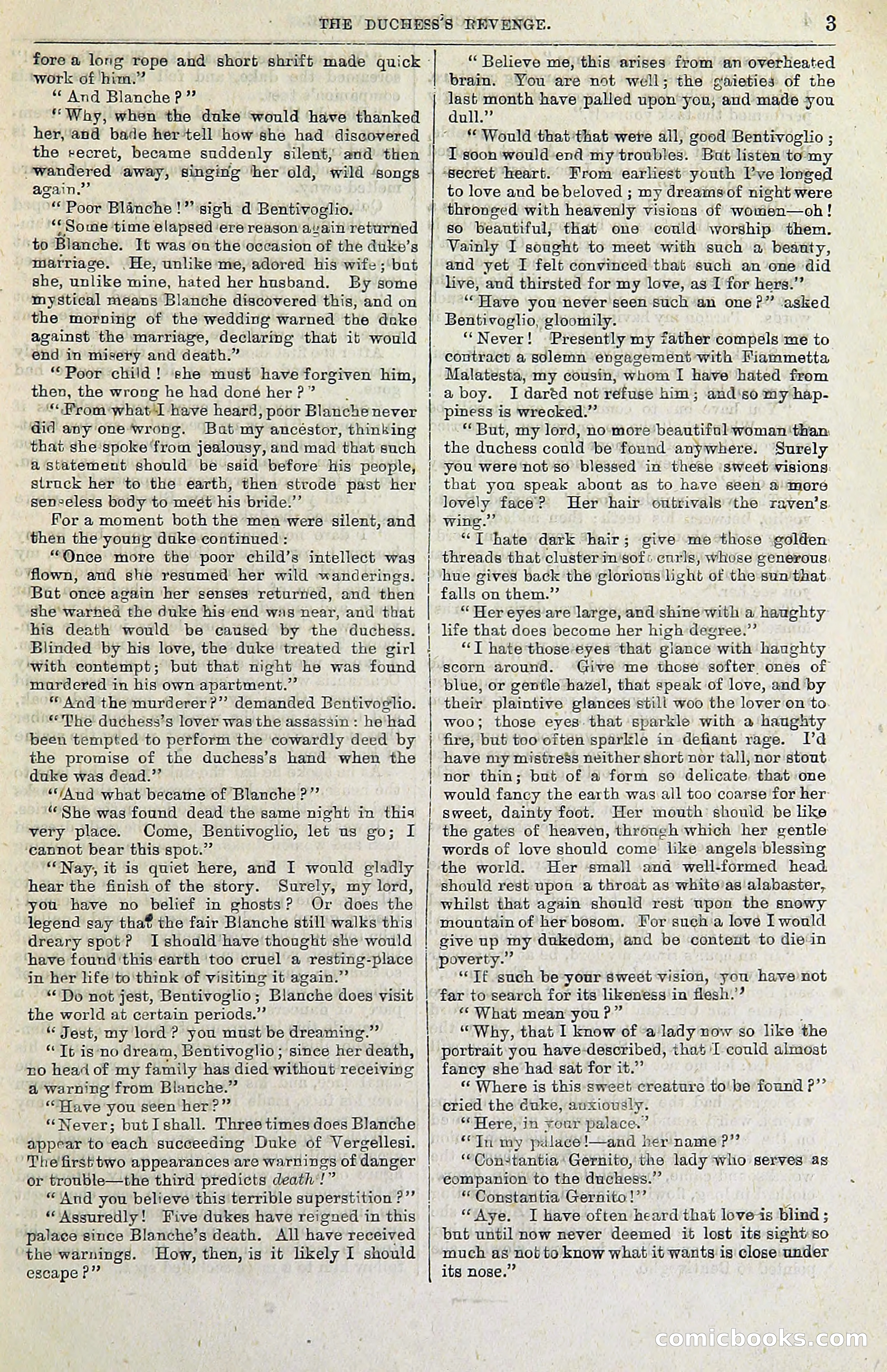
A restored page from Penny Dreadfuls, 1873. Page through the whole issue in the reader above.
📄 Transcribed text from this page (OCR, searchable)
Machine-transcribed from the original scan — historical spelling and the odd misread are preserved.
ns! DUCHESS’S BENENGE- fore a Tong rope and short shrift ane quick - work of him.” ‘And Blanche P ” ‘Why, when the duke would ne thanked her, and bade her'tell how she had discovered . the vecret, became suddenly silent, and’ then — singing ‘her old, wild ‘songs - 4 wandered away , again.’ 5 Poor Blanche !”’ sigh d Bentivogtio. ‘‘ Some time elapsed: ere reason avain returned to Blanche. It was on the occasion of the dtike’s marriage. .He, unlike me, adored his wife ;'but she, unlike mine, hated her husband. By some mystical means Blanche discovered this, and on the morning of the wedding warned the dake against the marriage, declaring that it would end in misery and death.” “Poor child! she must have forgiven him, then, the wrong he had doné her P” Prom what have heard, poor Blanche never did any one‘wrong. Bat my ancéstor, thinking that she'spoke’ from jealousy, and mad that such a statement should be said before his people, struck her to the earth, then strode past her sepeeless body to meet his bride.”’ For a moment both the men were silent, and then the young duke continued : “Once more the poor child’s intellect was flown, and she resumed her wild wanderings. Bat once again her senses returned, and then she warned the duke his end was near, and that his death would be caused by the duchess. Blinded by his love, the duke treated the girl ; ‘with contempt; but that night he was found murdered in his own apartment.” ‘And the murderer?’’ demanded Bentivoelio. “The duchess’s lover was the assassin: he’ had been tempted to perform the cowardly deed by the promise of the duchess’s hand when the duke was dead.”’ ‘““And what became of Blanche ?”’ “She was found dead the same night in this very place. Come, Bentivoglio, let us go; I ‘cannot bear this spot.” “Nay, it is quiet here, and I would gladly hear the finish of the story. Surely, my lord, ryyou have no belief in ghosts? Or does the legend say tha? the fair Blanche still walks this dreary spot? Ishoald have thought she would | have found ‘this earth ‘too cruel a resting-place in her hife'to think of visiting it again.”’ “Do not jest, Bentivoglio ; Blanche does visit the world at certain periods.” “ Jest, my lord ? you must be dreaming.” “Tt isno dream, Bentivoglio ; since her death, no head of my family has died without receiving a warning from Blanche.” 7 “Have you seen her?” “‘Never; but I shall. Three times does Blanche appear to each succeeding Duke of Vergellesi. ‘The firsttwo appearances are warnings of danger or trouble—the third predicts death!” “ And you believe this terrible superstition ?”’ ‘““Assuredly! Five dukes have reigned in this palace since Blanche’s death. All have received the warnings. How, then, is it likely I should escape P”’ - i ee © ES NS LEK —<——_— | SS //SseSssnss-sen-ssitstnsssStsdistitss - ‘ ‘4 -pecret heart. 3) “ Believe me, this arises from an overheated brain. You are not well; the gaieties of the | last month have palled upon you, aud made you dull.” “Would that that were all, good Bentivoglio ; TI soon would end my troubles. But listen tomy From earliest youth lve longed to love and be beloved ; my dreams of nicht were throneed with heavenly visions of wowen—oh! SO beautiful, that one could worship them. Vainly I sought to meet with such a beauty, and yet I felt convinced that such an one did live, and thirsted for my love, as I for hers.” ‘““Have you never seen such an one ?” asked Bentivoglio, gloomily. “Never! ‘Presently my father compels me to contract a solemn engagement with Fiammetta Malatesta, my cousin, whom I have hated from a boy. I daréd not refuse him; and'so my hap- pimess is wrecked.” “But, my lord, no: more beautiful woman ‘than: the duchess could be found anywhere. Surely you were not so blessed in these sweet visions. that you speak about as to have seen’ a more lovely face? Her hair outrivals ‘the raven’s wing.”’ “T hate dark ‘hair; give me-those olden threads that cluster im‘sof« enrls, whose generous. hue gives back the glorious ight of the sun'that falls onthem.” -| “Her eyes are large, and shine with a haughty life that does become her high degree.”’ “T hate those-eyes that glance with haughty scorn around. Give me those softer ones of blue, or gentle hazel, that speak of love, and by their plaintive elances still woo the lover‘on to. woo; those eyes that sparkle with a haughty fire, but too often sparkle in defiant rage. I’d have ny mistregs neither short nor tall, nor stout nor thin; but of a form so delicate. that one would fancy the earth was all too coarse for her sweet, dainty foot. Her mouth shonid he like the gates of heaven, throngh which her gentle words of love should come like angels blessing the world. Her small and well-formed head should rest upon a throat as white’as alabaster, whilst that again should rest upon the snowy mountain of her bosom. Wor sucha love I would give up Ty dukedom, and be content to die in poverty.” “Tf such be your sweet vision, you have not far to search for its likeness in flesh.” “ What mean you Pr” “Why, that I know of a lady now so like the portrait you have-described, that I could almost fancy she had sat for it.”’ “ Where is this sweet creature to'be found ?’’ cried the cuke, auxiously. “Here, in your palace.’ ‘Tr my pilace!—and her name ?”? “Oonstantia Gernito, the lady who serves as companion to the duchess.” * Constantia’ Gernito!”’ “Aye. I have often heard that love is blind ; but until now never deemed it lost its sightso much as not to know what it wants is close under its nose.” com ao )(o)),< (E(@)