
Penny Dreadfuls, 1873 · page 4 of 20
The Duchess's Revenge or The Three Warnings — page 4: what you’re looking at
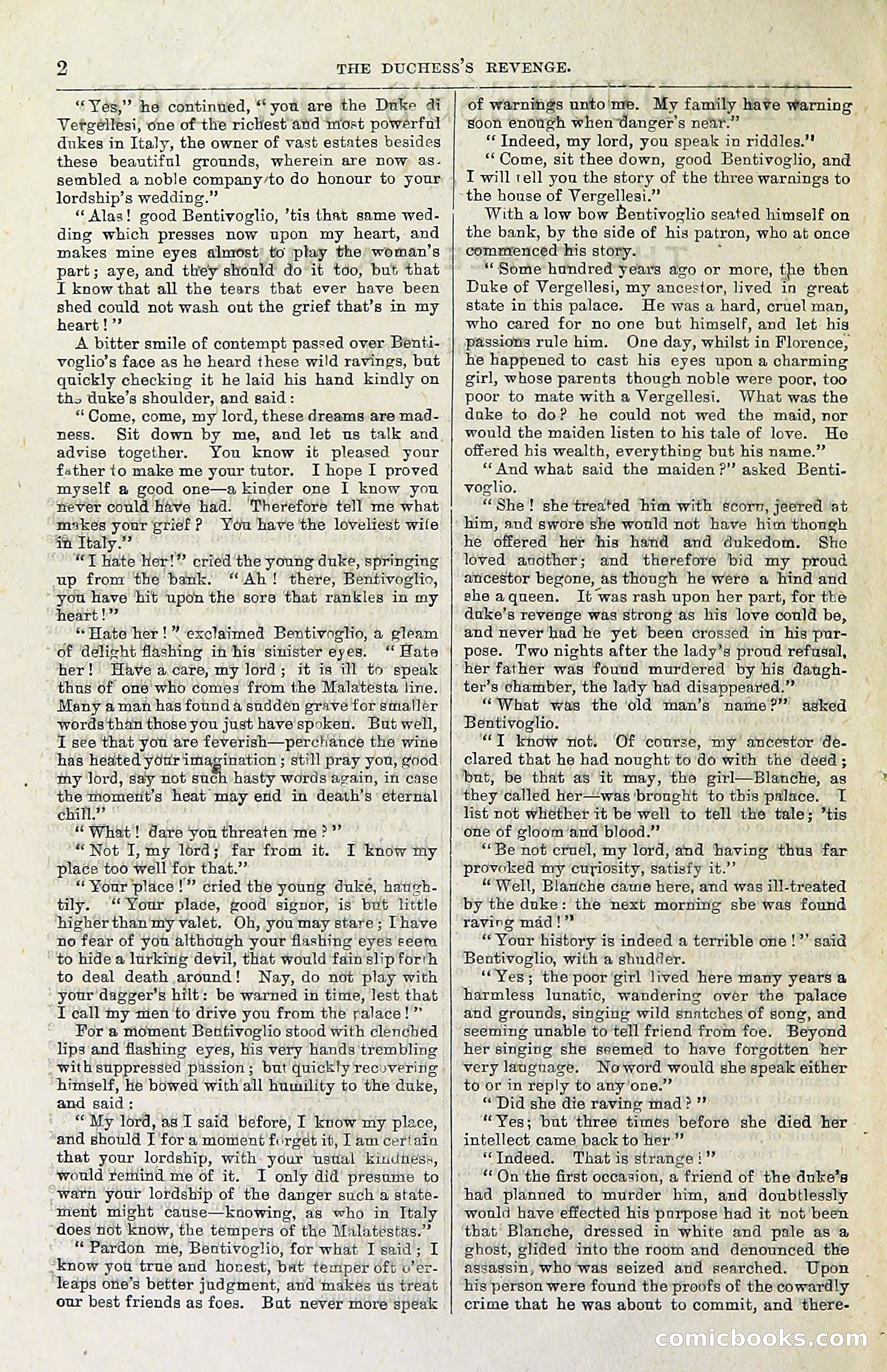
A restored page from Penny Dreadfuls, 1873. Page through the whole issue in the reader above.
📄 Transcribed text from this page (OCR, searchable)
Machine-transcribed from the original scan — historical spelling and the odd misread are preserved.
9 THE DUCHESS’ REVENGE. “Yés,” he continued, ‘you are the Duke di Vertgellesi, one of the richest and most powerful dukes in Italy, the owner of vast estates besides these beautiful grounds, wherein are now as- sembled a noble company’to do honour to your lordship’s wedding.” “ Alas! good Bentivoglio, ’tis that same wed- ding which presses now upon my heart, and makes mine eyes almost’ to play the woman's | part; aye, and they should do it too, but that © I know that all the tears that ever have been shed could not wash out the grief that’s in my heart! ”’ A bitter smile of contempt passed over Benti- voglio’s face as he heard these wild ravings, but quickly checking it he laid his hand kindly on ths duke’s shoulder, and said: “Come, come, my lord, these dreams are mad- — ness. advise together. You know it pleased your father to make me your tutor. I hope I proved myself a good one—a kinder one I know you never could have had. ‘Therefore tell me what makes your grief? You aN the loveliest wile in Italy.” '' "T hate her!” cried the young duke, springing up from the bank. “Ah! there, Bentivoglio, you have hit upon the sore that rankles in my heart!” “Hate her!” exclaimed Bentivoglio, a gleam of delicht flashing in ‘his sinister eyes. ‘ Hate her! Have a care, my lord; it is ill to speak thus of one who comes from the Malatesta line. Many aman has found a sudden grave for suiallér words than those you just have'spoken. But well, I see that you are feverish—perchance the wine has heated your ima pen still pray you, good my Jord, say not such hasty words again, in case the thomerit’s heat’ may end in death’s eternal chill.”’ “What! dare you threaten me ?”’ “Not I, my lord; far from it. place too well for that. he “Your place!” cried the young duke, hatith- tily. ‘Your place, good siguor, is but little higher than my valet. Oh, you may stare; Thave no fear of you althourch your flashing eyes réem to hide a Jurking devil, that would fain slip forth to deal death around! Nay, do not play with your dagger’s hilt: be warned in time, lest that I call my men ‘to drive you from the falace!” - Fora moment Bertivoglio stood with clenched I know my lips and flashing eyes, his very hands trembling withsuppressed passion; but quickly recovering himself, he bowed with all humility to the duke, and said : “My lord, as I said before, I know my place, ‘and should [ for a moment forget it, J am certain that your lordship, with your usual kindness, would remind me of it. I only did présume to warn your lordship of the danger such a state- ment might canse—knowing, as who in Italy does not know, the tempers of the Malatestas.” “Pardon me, Bentivoglio, for what I said ; I “know you true and horest, but temper oft o’er- leaps one’s better judgment, and makes us treat our best friends as foes. But never more speak Sit down by me, and let us talk and. soon enoweh whendanger’s near.” ‘Indeed, my lord, you speak in riddles.” “Come, sit thee down: cood Bentivoglio, and I will tell you the story of the three warnings to ~the house of Vergellesi.” WVaislny Ila Ors Bentivoelio seated himself on the bank, by the side of his patron, who at once commenced his story. ‘‘ Some hundred years avo or more, the then Duke of Vergellesi, my ancestor, lived in great state in this palace. He was a hard, cruel 1 man, who cared for no one but himself, and let his passions rule him. One day, whilst in Florence, he happened to cast his eyes upon a charming girl, whose parents though noble were poor, too poor to mate with a Vergellesi. What was the duke to do? he could not wed the maid, nor would the maiden listen to his tale of love. He offered his wealth, everything but his name.” ‘““And what said the maiden?” asked Benti- vog lio. “She! she treated him with scorn, jeered ‘at him, and swore she would not have him though hé offered ‘her this ‘hand’ and dukedom. She loved another; and therefore bid my proud ancestor begone, as though he were a hind and she aqueen. It was rash upon her part, for tke duke’s revenge was strong as his love could be, and never had he yet been crossed in his pur- pose. Two nights after the lady’s proud refusal, her father was found murdered by his daugh- ter’s chamber, the lady had disappeared. ¥ “What was the old man’s name?’ Bentivoglio. | “T kenow ‘ot. Of course, my’ ancestor ‘de- clared that he had nought to do with the deed ; but, be that as it may, the girl—Blanche, as they: called her—was ‘brought to this palace. T| list not whether it be well “to tell the tale; tis one of gloom’and blood.” ‘‘Be not cruel, my lord, and having thus far provoked nry curiosity, satisfy bees “Well, Blanche came here, and was ill-treated by the duke:'the ‘next morning sbe was found raving mad!” “Your history is indeed a terrible one!” said Bentivoglio, with a shudder. ‘““Yes; the poor girl lived here many years a harmless lunatic, wandering over the palace and grounds, singing wild snatches of song, and seeming unable to'tell friend from foe. Beyond her singing she seemed to have forgotten her very language. Noword would she speak either to or in reply to any’ one.’ “Did she die raving mad? ” “Yes; but ‘three timés before on died her intellect came back to her” “Indeed. That is strange :’ ** On the first occasion, a snot of the dnke’s had planned to murder him, and doubtlessly would have effected his purpose had it not been that’ Blanche, dressed in white and pale as a chost, glided into the room and denounced the assassin, who was seized and searched. Upon his person were found the proofs of the cowardly crime that he was about to commit, and there- EGOMIGE asked. JOO “S of warnings unto'me. My family have Warning | com a“