
Penny Dreadfuls, 1850 · page 390 of 394
The Mysteries of London; or, Lights and Shadows of London Life — page 390: what you’re looking at
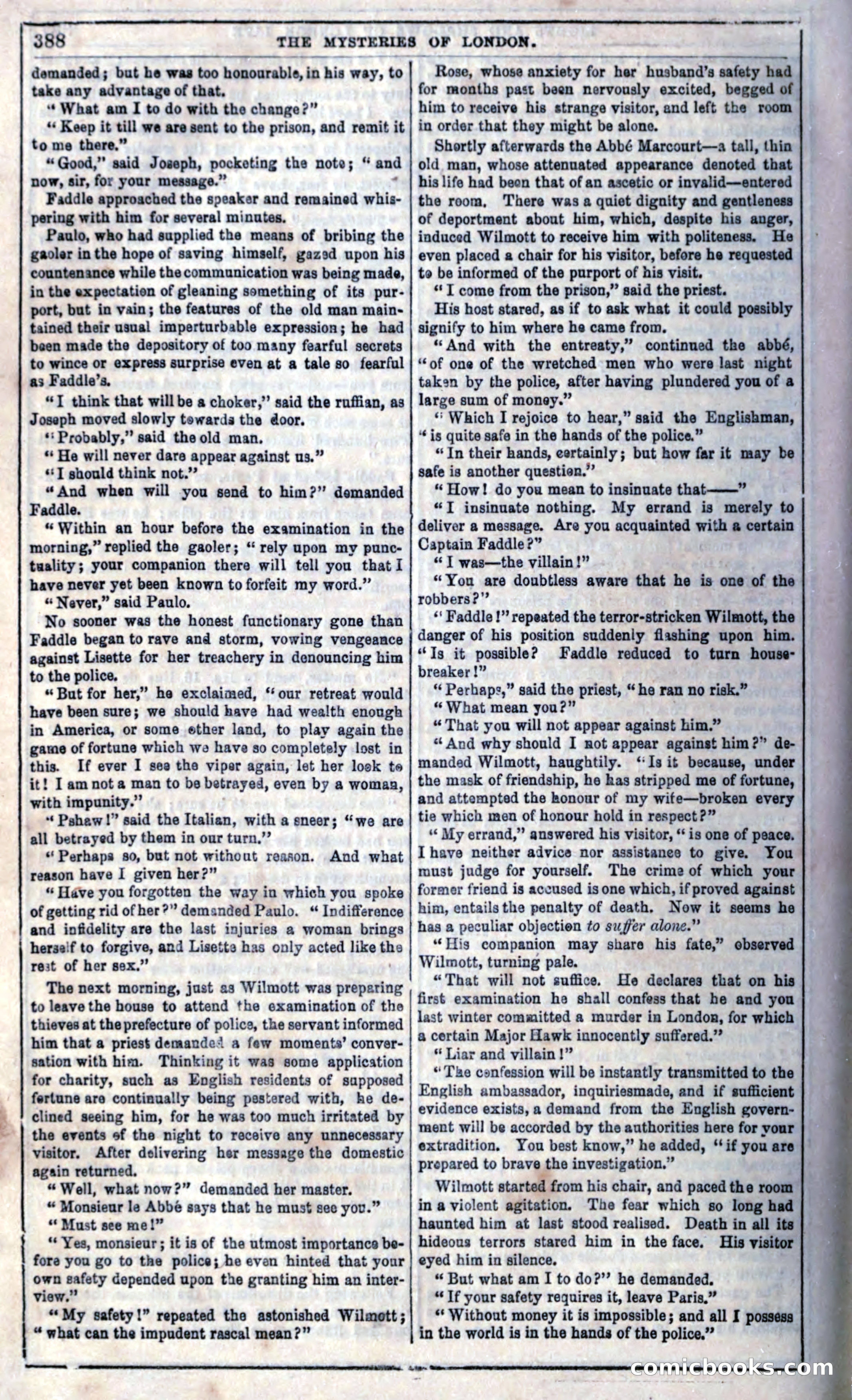
A restored page from Penny Dreadfuls, 1850. Page through the whole issue in the reader above.
📄 Transcribed text from this page (OCR, searchable)
Machine-transcribed from the original scan — historical spelling and the odd misread are preserved.
CS i . =e. wew ew 388 Rematdeks but he was too honoutable, in b his way, to take any advantage of that. “ What am I to do with the change?” ‘“« Keep it till we are sent to the prison, and remit it to me there,” “Good,” said Joseph, pocketing the note; “ and now, sir, for your message.” Faddle approached the speaker and remained whis- pering with him for several minutes. Paulo, who had supplied the means of bribing the gaoler in the hope of saving himself, gazed upon his countenance while the communication was being made, in the expectation of gleaning something of its pur- port, but in vain; the features of the old man main- tained their usual imperturbable expression; he had been made the depository of too many fearful secrets to wince or express surprise even at a tale so fearful as Faddle’s, “T think that willbe a choker,’ said the ruffian, as Joseph moved slowly towards the door. *‘ Probably,” said the old man. ‘‘ He will never dare appear against us.” ‘¢]T should think not.” “And when will you send to him?” demanded Faddle. “Within an hour before the examination in the morning,” replied the gaoler; “rely upon my punc- tuality; your companion there will tell you that Ii have never yet been known to forfeit my word.” «“ Never,” said Paulo. No sooner was the honest functionary gone than Faddle began to rave and storm, vowing vengeance against Lisette for her treachery in denouncing him to the police, “ But for her,” he exclaimed, ‘our retreat would have been sure; we should have had wealth enough in America, or some ether land, to play again the game of fortune which we have so completely lost in this. If ever I see the viper again, let her look te it! lam nota man to be betrayed, even by a womag, with impunity.” “ Pshaw!” said the Italian, with a sneer; “we are all betrayed by them in our turn,” “ Perhaps 380, but not without reason. And what reason have I given her?” “ Have you forgotten the way in which you spoke of getting rid of her?” demanded Paulo. “ Indifference and infidelity are the last injuries a woman brings herse!f to forgive, and Lisette has only acted like ae rest of her sex.” The next morning, just as Wilmott was preparing to leave the house to attend the examination of the thieves at theprefecture of police, the servant informed him that a priest demandes a few moments’ conver- sation with him. Thinking it was some application for charity, such as English residents of supposed fertune are continually being pestered with, he de- clined seeing him, for he was too much irritated by the events of the night to receive any unnecessary visitor. After delivering her message the domestic again returned. “ Well, what now?” demanded her master. “ Monsieur le Abbé says that he must see you.” “ Must see me!” “* Yes, monsieur ; it is of the utmost importance be- fore you go to the police; he even hinted that your own safety depended upon the granting him an inter- view.” “My safety!” repeated the astonished Wilmott; “ what can the impudent rascal mean?” ——- ——es—-- --- - "~~ —_—. THE | MYSTERIES _OF LONDON. Rose, whose anxiety for her husband’s safety had for months past been nervously excited, begged of him to receive his strange visitor, and left the room in order that they might be alone. Shortly afterwards the Abbé Marcourt—a tall, thin old man, whose attenuated appearance denoted that his life had been that of an ascetic or invalid—entered the room, There was a quiet dignity and gentleness of deportment about him, which, despite his anger, induced Wilmott to receive him with politeness. He even placed a chair for his visitor, before he requested to be informed of the purport of his visit. ‘‘T come from the prison,” said the priest. His host stared, as if to ask what it could possibly signify to him where he came from. “And with the entreaty,” continued the abbé, “of one of the wretched men who were last night taken by the police, after having plundered you of a large sum of money.” | ‘‘ Which I rejoice to hear,” said the Englishman, “ is quite safe in the hands of the police.” “In their hands, eertainly; but how far it may be safe is another question.” “ How! do you mean to insinuate that——” “T insinuate nothing. My errand is merely to deliver a message. Are you gg with a certain Captain Faddle?” “ T was—the villain!” “You are doubtless aware that he is one of the robbers?” ‘ Faddle !” repeated the terror-stricken Wilmott, the danger of his position suddenly flashing upon him. “Ts it possible? Faddle reduced to turn house- breaker !” “Perhaps,” said the priest, “he ran no risk.” “ What mean you?” “That you will not appear against him.” «And why should I not appear against him?” de- manded Wilmott, haughtily. ‘Is it because, under the mask of friendship, he has stripped me of fortune, and attempted the honour of my wife—broken every tie which men of honour hold in respect?” “ My errand,” answered his visitor, ‘is one of peace, Ihave neither advice nor assistanes to give. You must judge for yourself. The crime of which your former friend is accused is one which, if proved against him, entails the penalty of death. Now it seems he has a peculiar objection to suffer alone.” “His companion may share his fate,” observed Wilmott, turning pale. “That will not suffice. He declares that on his first examination he shall confess that he and you last winter committed a murder in London, for which a certain Major Hawk innocently suffered.” * Liar and villain !” “Te confession will be instantly transmitted to the English ambassador, inquiriesmade, and if sufficient evidence exists, a demand from the English govern- ment will be accorded by the authorities here for your extradition. You best know,” he added, “if you are prepared to brave the i investigation.” Wilmott started from his chair, and paced the rool in a violent agitation. The fear which so long had haunted him at last stood realised. Death in all its hideous terrors stared him in the face. His visitor eyed him in silence, “ But what am I to do?” he demanded, “If your safety requires it, leave Paris.” ‘“‘ Without money it is impossible; and all I possess | in the world is in the hands of the police.” q coe el ene Se. Es her » od = ~~ ‘ : - 7 _— hie *